
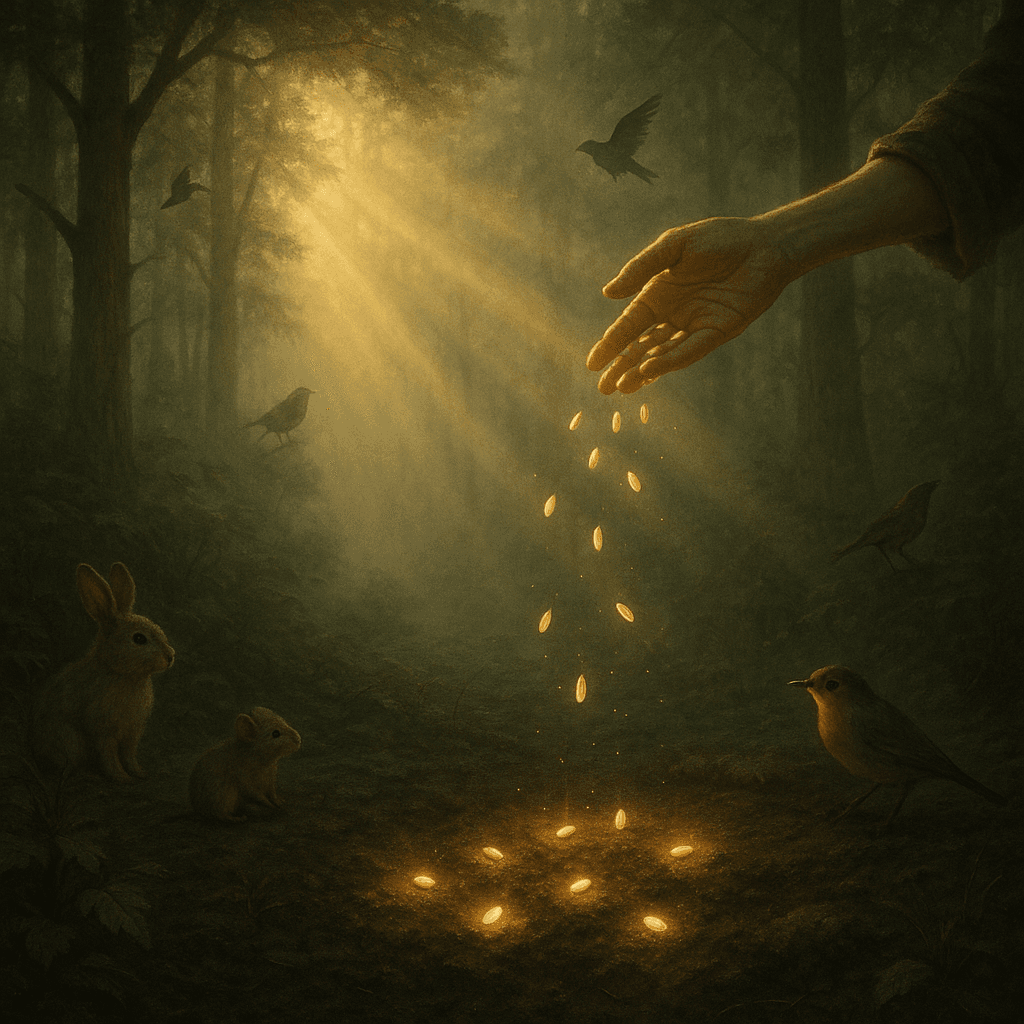
To act is to sow light in the shadows of doubt. — Paulo Freire
—What lingers after this line?
The Meaning Behind Freire’s Metaphor
Paulo Freire's statement, 'To act is to sow light in the shadows of doubt,' employs vivid imagery to suggest that purposeful action can dispel uncertainty. He likens action to the planting of light—an intentional act amidst the figurative darkness created by doubt. By choosing to act, individuals become agents of change, challenging ambiguity with the clarity of engagement.
Doubt as a Catalyst for Growth
Transitioning from metaphor to praxis, doubt often serves as the starting point for critical inquiry. Freire, renowned for his work in 'Pedagogy of the Oppressed' (1970), argued that questioning and uncertainty should not paralyze but instead provoke investigation and participation. In this sense, the 'shadows of doubt' are not obstacles to avoid but invitations to illuminate through deliberate steps.
Historical Examples of Action Overcoming Uncertainty
History provides numerous instances where decisive action cleared the fog of indecision. For example, Rosa Parks’ quiet refusal to relinquish her seat in 1955 was a single, courageous act that inspired a broader movement, transforming vague hopes for change into concrete progress. Like Freire’s concept, her action shed light where there was hesitation and fear.
The Role of Reflection and Dialogue
However, action alone is insufficient if divorced from reflection—another cornerstone of Freire’s pedagogy. Through dialogue, communities clarify intentions, consider consequences, and collectively identify what kind of 'light' they wish to bring forth. This reflective process reduces uncertainty by fostering shared understanding and empowering joint action.
Empowerment Through Small and Consistent Steps
Ultimately, Freire’s wisdom suggests that even minor actions can pierce the darkness of ambiguity. Taking small, deliberate steps, whether in personal growth or collective endeavors, validates our agency. As each gesture 'sows light,' we build momentum, inspiring others and gradually dispelling doubt—not through passive waiting, but through participation and courage.
Recommended Reading
As an Amazon Associate, we earn from qualifying purchases.
One-minute reflection
Where does this idea show up in your life right now?
Related Quotes
6 selectedThe world is before you, and you need not take it as it was. — James Baldwin
James Baldwin
James Baldwin’s line begins as a simple act of opening a door: the world is “before you,” available to your attention and judgment rather than locked behind tradition. Instead of treating reality as fixed scenery, he fra...
Read full interpretation →I can be changed by what happens to me, but I refuse to be reduced by it. — Maya Angelou
Maya Angelou
Maya Angelou begins with a disarming admission: experience alters us. To be “changed” by what happens is not weakness but evidence of being awake to reality—loss, joy, injustice, and love all leave traces.
Read full interpretation →Hands that persist sculpt destiny out of raw days. — Helen Keller
Helen Keller
Helen Keller’s line begins with a concrete image: hands. Rather than treating destiny as a distant, abstract force, she locates power in what we can do—touch, build, practice, and return to a task again.
Read full interpretation →Choose light over gloom; even small lamps banish a dark room. — Fyodor Dostoevsky
Fyodor Dostoevsky
Dostoevsky’s line frames hope as an active decision rather than a lucky mood: “Choose light over gloom.” The phrasing implies agency—an inner vote cast even when circumstances feel fixed. In that sense, light is not only...
Read full interpretation →Stride into the margins that fear drew and claim your space with dignity — Frederick Douglass
Frederick Douglass
Douglass’s image of “margins that fear drew” suggests that oppression often works by sketching invisible borders around a person’s life—where to speak, where to go, what to hope for. These boundaries are rarely neutral;...
Read full interpretation →Keep wonder close and let it push you to act. — Langston Hughes
Langston Hughes
Langston Hughes’ line begins with an intimate instruction: keep wonder close. Rather than treating awe as a rare lightning strike—something reserved for travel, art, or childhood—he frames it as a presence we can carry.
Read full interpretation →More From Author
More from Paulo Freire →Education that frees begins where curiosity is honored more than obedience — Paulo Freire
Paulo Freire argues that education becomes liberating only when curiosity outranks mere obedience. In Pedagogy of the Oppressed (1970), he critiques the “banking model,” where teachers deposit facts into passive students...
Read full interpretation →Vision and action are not mutually exclusive; they are complements. — Paulo Freire
The quote points out that having a vision (ideas or plans) and taking action (executing those plans) must go hand in hand.
Read full interpretation →The human soul is thirsty for change, like a dry riverbed waiting for rain. — Paulo Freire
Paulo Freire’s vivid comparison of the soul to a parched riverbed highlights an innate human yearning for transformation. Just as a riverbed longs for the life-giving touch of rain, so too do our spirits seek the revital...
Read full interpretation →Without action, the best intentions are nothing but lost dreams. — Paulo Freire
Paulo Freire’s statement draws attention to the gulf that often exists between our noblest intentions and tangible outcomes. Even the purest desires for change or improvement lose their potency if not acted upon.
Read full interpretation →