
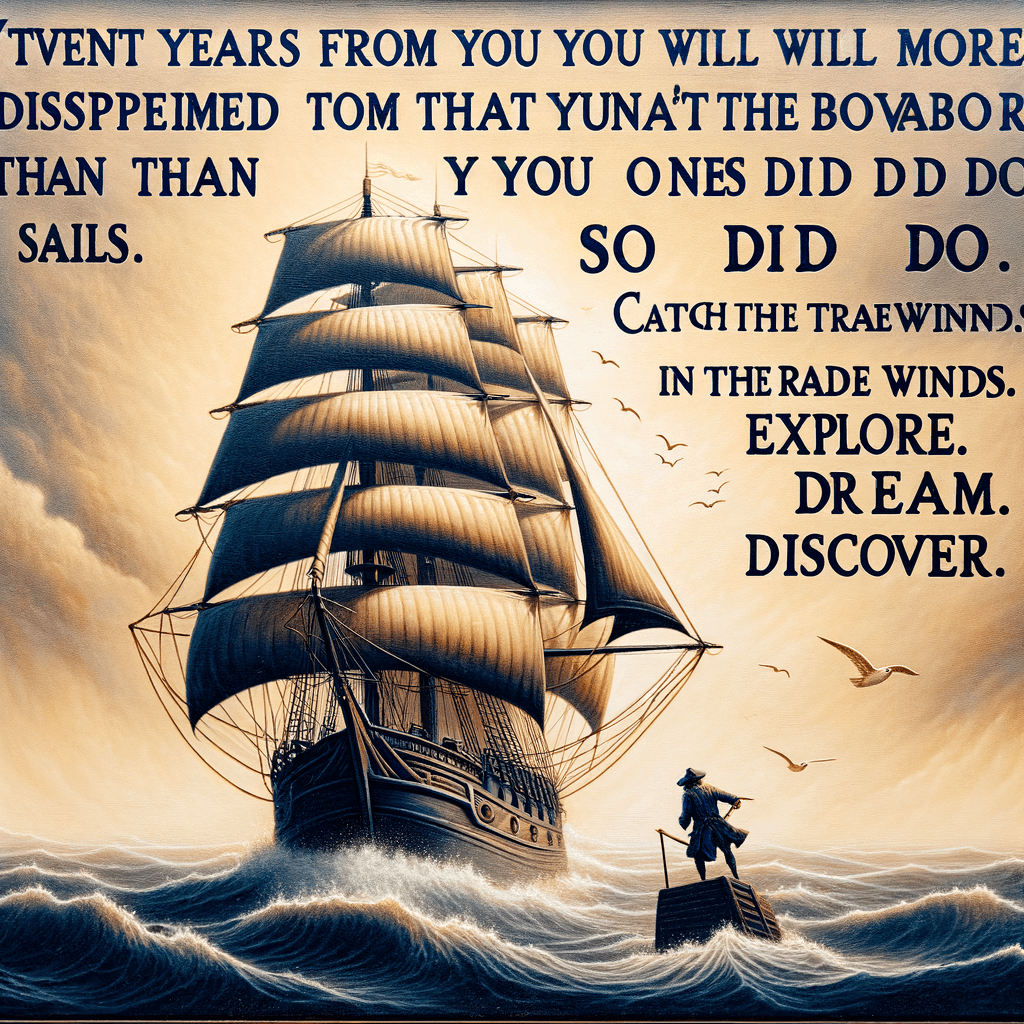
Twenty years from now you will be more disappointed by the things that you didn’t do than by the ones you did do. So throw off the bowlines. Sail away from the safe harbor. Catch the trade winds in your sails. Explore. Dream. Discover. — Mark Twain
—What lingers after this line?
Regret Minimization
The quote suggests that future regret often stems from missed opportunities rather than actions taken. It encourages seizing the moment and taking risks to avoid future disappointment.
Breaking Free from Comfort Zones
Twain urges readers to abandon their comfort zones, symbolized by 'throwing off the bowlines' and 'sailing away from the safe harbor.' This metaphor encourages boldness and venturing into the unknown.
Pursuit of Adventure
The call to 'catch the trade winds' speaks to embracing adventure and the journey of life. It's a reminder to actively seek out new experiences and opportunities.
Embracing Curiosity
'Explore. Dream. Discover.' encapsulates the essence of curiosity and learning. Twain advocates for a life driven by exploration, the pursuit of dreams, and the discovery of new horizons.
Philosophical Optimism
Mark Twain's message is fundamentally optimistic, encouraging a proactive approach to life. It's about taking initiative and finding fulfillment through action rather than passivity.
Legacy of Mark Twain
Twain, a celebrated American author and humorist, often reflected on human nature and life's journey in his works. This quote is consistent with his broader literary themes of adventure and personal growth.
One-minute reflection
What does this quote ask you to notice today?
Related Quotes
6 selectedEmbrace the uncertainty, for it is the canvas upon which your greatest adventures will be painted. – Unknown
Unknown
This quote encourages us to accept and embrace the unknown. It suggests that uncertainty is not something to fear, but rather an essential part of life's journey.
Read full interpretation →The creative process is not a straight line, but a labyrinth. To get lost in it is not a failure; it is the only way to find the hidden things worth saying. — M.C. Richards
M.C. Richards
At its core, M.C. Richards rejects the comforting myth that creative work unfolds through orderly steps.
Read full interpretation →In crafting, there are no mistakes, only new discoveries and unique creations. — Joseph Chilton Pierce
Joseph Chilton Pierce
At its heart, Joseph Chilton Pierce’s statement transforms the meaning of failure. Instead of treating a crooked stitch, a split piece of wood, or an unexpected color blend as proof of incompetence, he invites us to see...
Read full interpretation →I don't know where I'm going from here, but I promise it won't be boring. — David Bowie
David Bowie
David Bowie’s line begins with a disarming admission: he doesn’t know what comes next. Yet instead of treating uncertainty as a weakness, he turns it into a stage—an open space where possibility can thrive.
Read full interpretation →Face the stretch of life as an open road for discovery, not a wall to avoid. — Albert Camus
Albert Camus
Camus’ image hinges on a simple choice of metaphor: an “open road for discovery” versus a “wall to avoid.” The road suggests motion, curiosity, and an invitation to keep going even when the destination is unclear, while...
Read full interpretation →Plant a question and water it with curiosity; answers will grow — Albert Camus
Albert Camus
Albert Camus’s metaphor invites us to imagine thought as a garden where questions are seeds and curiosity is the water that sustains them. Rather than treating answers as objects to be seized, he suggests that they emerg...
Read full interpretation →More From Author
More from Mark Twain →We can secure other people's approval if we do right and try hard; but our own is worth a hundred of it. — Mark Twain
At its heart, Mark Twain argues that external approval is attainable through good conduct and honest effort, yet it remains secondary to a deeper judgment: our own. Praise from others can reassure us, but it is often cha...
Read full interpretation →Grief can take care of itself, but to get the full value of a joy you must have somebody to divide it with. — Mark Twain
Mark Twain’s remark begins with a striking contrast: grief, he says, can sustain its own weight, while joy needs companionship to reach its fullest meaning. In other words, sorrow often folds inward, making us solitary,...
Read full interpretation →Work consists of whatever a body is obliged to do, and that Play consists of whatever a body is not obliged to do. — Mark Twain
At first glance, Mark Twain’s line seems almost playful in its simplicity, yet it cuts directly to the heart of human motivation. Work, in his framing, is not defined by effort alone but by obligation: it is what a perso...
Read full interpretation →Eat a live frog first thing in the morning and nothing worse will happen to you the rest of the day. — Mark Twain
Mark Twain’s line is meant to jolt: the grotesque image of eating a live frog isn’t culinary advice but a metaphor for confronting the most unpleasant task first. By exaggerating the discomfort, Twain makes the underlyin...
Read full interpretation →