
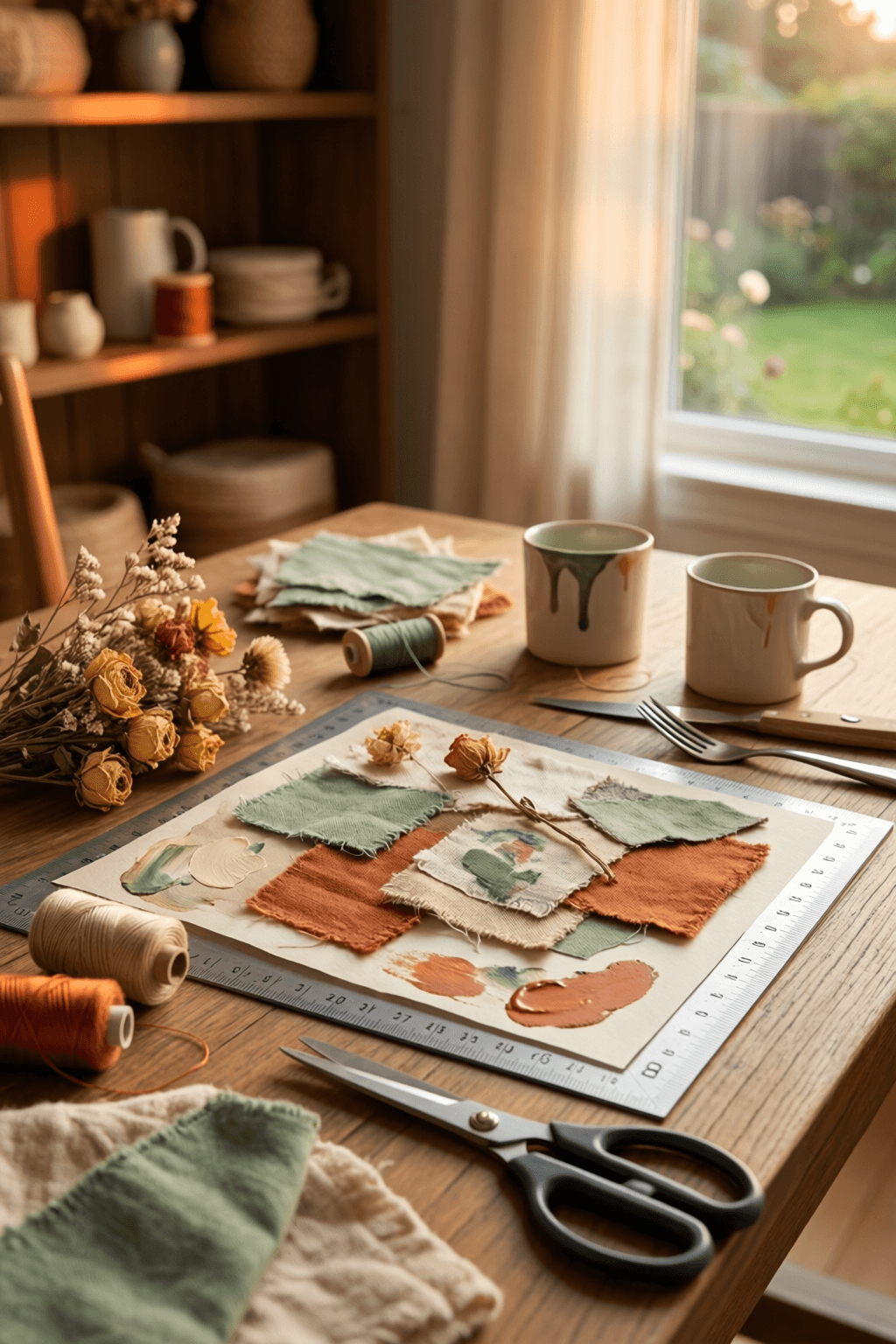
In crafting, there are no mistakes, only new discoveries and unique creations. — Joseph Chilton Pierce
—What lingers after this line?
Reframing Error as Possibility
At its heart, Joseph Chilton Pierce’s statement transforms the meaning of failure. Instead of treating a crooked stitch, a split piece of wood, or an unexpected color blend as proof of incompetence, he invites us to see them as openings. In crafting, where the hand constantly negotiates with imperfect materials, surprises are not exceptions but part of the process itself. This shift in perspective matters because it softens the fear that often stops people from beginning. Once a maker stops asking, “What if I ruin it?” and starts asking, “What might this become?”, the work gains freedom. What first appears to be a mistake can then become the very feature that gives a piece its originality.
The Dialogue Between Hand and Material
From there, the quote also highlights that crafting is never a one-sided act of control. Clay slumps, fabric stretches, paint bleeds, and wood reveals grain patterns that resist the maker’s original plan. Rather than dominating these materials, skilled crafters learn to respond to them, adjusting their intentions as the work evolves. In this way, creation becomes a conversation. A potter may notice that an uneven rim gives a bowl more character, just as a quilter might turn a mismatched patch into the visual center of a design. What emerges is not the defeat of intention, but a richer collaboration between imagination and matter.
Creativity Born From the Unexpected
Moreover, many artistic breakthroughs begin in accident. Art history is full of such moments: the Japanese aesthetic of wabi-sabi values irregularity and impermanence, while kintsugi—the practice of repairing broken pottery with lacquer and gold—turns damage into beauty rather than hiding it. These traditions show that imperfection can deepen meaning instead of diminishing it. Pierce’s idea fits naturally within that tradition. When crafters welcome the unforeseen, they often move beyond imitation and into invention. An unintended texture, a slipped brushstroke, or a warped form may reveal a direction the maker could not have planned in advance, and that is where originality often begins.
A Gentler Psychology of Making
Just as importantly, the quote offers an emotional lesson. Many beginners abandon creative work because they judge every deviation from the plan as failure. By replacing the language of mistake with the language of discovery, Pierce lowers the emotional stakes and makes experimentation feel safer. The workshop becomes less like a test and more like a place of exploration. Psychologically, this fosters resilience. Educational thinker Carol Dweck’s work on growth mindset, especially in Mindset (2006), argues that people learn better when they view setbacks as part of development rather than as fixed evidence of inadequacy. In crafting, that attitude encourages persistence, curiosity, and the confidence to keep working through uncertainty.
Uniqueness as the Mark of the Handmade
Finally, Pierce’s words celebrate what handmade objects uniquely offer in a world of standardization. Machine production aims for exact repetition, but craft often draws its value from variation—the slightly uneven glaze, the visible join, the embroidered line that bears the rhythm of a particular hand. These are not defects to erase but signatures of presence. For that reason, the quote speaks beyond craft itself. It suggests a broader philosophy of living: our detours, revisions, and imperfect outcomes may become the source of our most distinctive achievements. In the end, what we first call a mistake may simply be the beginning of something more personal, more truthful, and more alive.
Recommended Reading
As an Amazon Associate, we earn from qualifying purchases.
One-minute reflection
Why might this line matter today, not tomorrow?
Related Quotes
6 selectedTo live a creative life, we must lose our fear of being wrong. — Joseph Chilton Pearce
Joseph Chilton Pearce
This quote emphasizes the importance of embracing uncertainty and the unknown. Creativity often involves exploring uncharted territories, and fearing mistakes can stifle that exploration.
Read full interpretation →Mistakes are the portals of discovery. - James Joyce
James Joyce
This quote highlights that making mistakes is a vital part of learning. Each error provides an opportunity to gain new insights and understanding, leading to growth and improvement.
Read full interpretation →The creative process is not a straight line, but a labyrinth. To get lost in it is not a failure; it is the only way to find the hidden things worth saying. — M.C. Richards
M.C. Richards
At its core, M.C. Richards rejects the comforting myth that creative work unfolds through orderly steps.
Read full interpretation →Originality — A target best hit when not aimed at. — Charles Searle
Charles Searle
At first glance, Charles Searle’s remark seems contradictory: how can originality be achieved by not trying to achieve it? Yet that is precisely his point.
Read full interpretation →Getting sober is a radically creative act. — Meredith Bell
Meredith Bell
At first glance, Meredith Bell’s statement reframes sobriety in a striking way: it is not merely the removal of alcohol or drugs, but the invention of a new way to live. Calling it a “radically creative act” shifts the f...
Read full interpretation →The comfort zone is the great enemy to creativity; moving beyond it necessitates intuition, which in turn configures new perspectives and conquers fears. — Bruce Lee
Bruce Lee
Bruce Lee begins with a blunt diagnosis: comfort can quietly become the enemy of invention. Familiar routines feel safe because they reduce uncertainty, yet that same predictability often narrows perception and dulls exp...
Read full interpretation →More From Author
More from Joseph Chilton Pierce →