
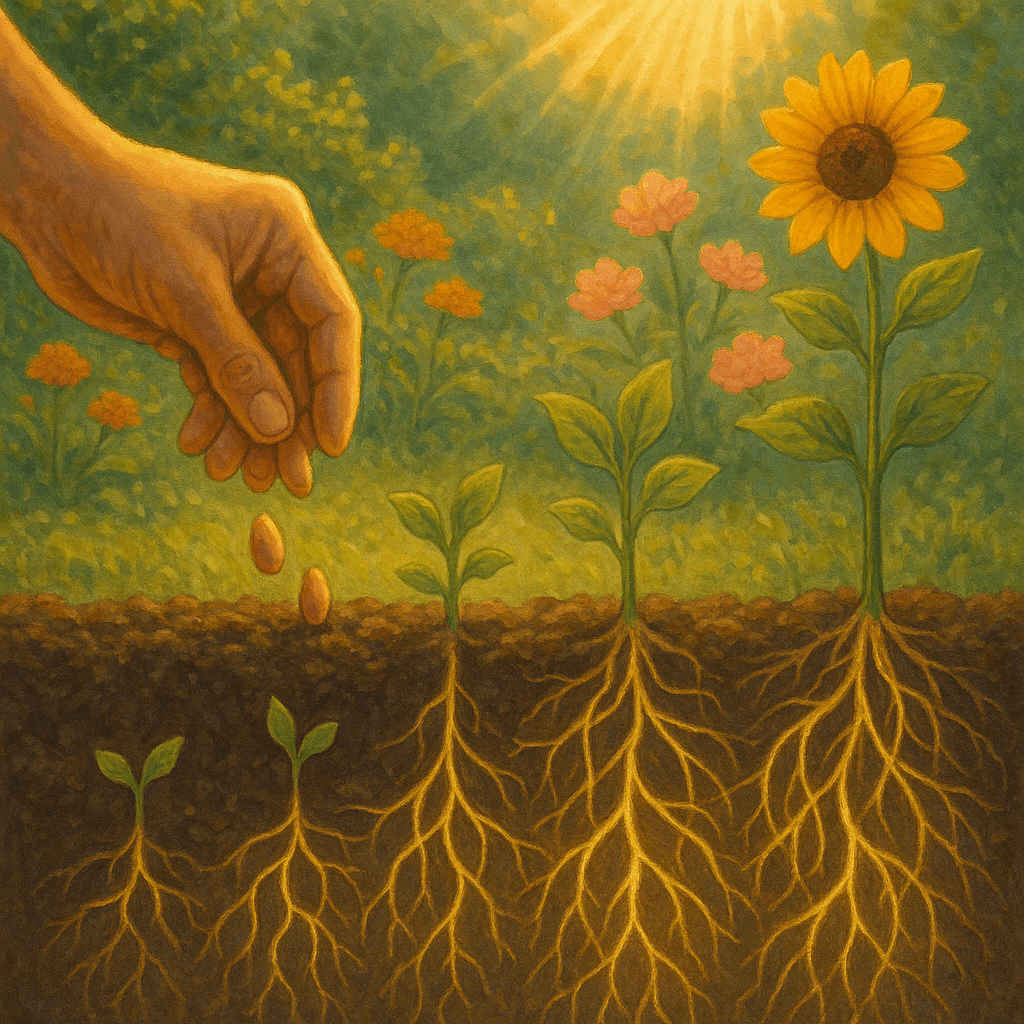
What we plant in the soil of contemplation, we shall reap in the harvest of action. — Meister Eckhart
—What lingers after this line?
The Soil of Contemplation
Meister Eckhart’s vivid metaphor begins with the act of planting in the ‘soil’ of contemplation. This image invites us to view our inner life as fertile ground, ready for intentional thought and deep reflection. Much like a gardener preparing earth for seeds, when we pause to ponder our values, ideas, and desires, we lay a foundation for future growth. Ancient philosophies, such as those expounded by Marcus Aurelius in his Meditations (c. 180 AD), echo the notion that the quality of our actions originates in this quiet, preparatory phase.
Cultivating Inner Seeds
Once the soil is prepared, the act of planting represents the mindful input we bring to our inner world. Whether through meditation, prayer, or critical thinking, what we ‘plant’ shapes what will eventually emerge. For example, Buddhist teachings emphasize that intentional thought sets the stage for ethical living—the seeds sown in meditation are mirrored in daily conduct. This step underscores the transformative potential of our private moments of stillness.
Growth Beneath the Surface
Transitioning from planting to growth, we recognize that change often occurs unnoticed. Contemplation is a dynamic process; ideas and insights germinate out of sight, gradually developing into convictions and intentions. Just as a seed’s early growth remains hidden underground, our reflective periods foster patience and faith in unseen progress. The writings of Thomas Merton, a 20th-century Trappist monk, stress that rich inner soil nurtures possibilities that only later reveal themselves in our choices.
Reaping the Harvest: Action
As contemplation matures, it naturally ripens into action—the ‘harvest’ Eckhart describes. This harvest is not accidental but the result of intentional cultivation. Throughout history, great leaders and thinkers have emerged from sustained reflection, their accomplishments serving as fruits of their contemplative labor. For instance, Mahatma Gandhi’s campaigns for social change originated in years of introspection and ethical discernment, demonstrating that action grounded in contemplation can bear transformative outcomes.
Renewing the Cycle
Lastly, the metaphor points toward a cyclical relationship: each harvest provides the seeds for future planting. After actions are taken, reflection allows us to learn, adjust, and begin anew. In modern psychology, practices such as mindful journaling and regular debriefs reinforce this ongoing interplay. By continually sowing contemplation and reaping action, we nurture a life characterized by purpose and thoughtful engagement with the world.
One-minute reflection
Why might this line matter today, not tomorrow?
Related Quotes
6 selectedNo matter how full a reservoir of maxims one may possess, if one has not taken advantage of every concrete opportunity to act, one's character may remain entirely unaffected. — William James
William James
At first glance, William James draws a sharp line between knowing and becoming. A person may store up countless moral sayings, noble principles, and wise resolutions, yet these remain largely ornamental if they never pas...
Read full interpretation →A garden is not made by singing 'Oh, how beautiful,' and sitting in the shade. — Rudyard Kipling
Rudyard Kipling
Kipling’s line immediately cuts through passive appreciation. Simply admiring a garden, however sincerely, does nothing to plant seeds, pull weeds, or carry water.
Read full interpretation →You cannot afford to live in potential for the rest of your life; at some point, you have to unleash it. — Eric Thomas
Eric Thomas
Eric Thomas’s quote begins with a stark warning: potential is not a place to live, only a promise of what might be. In other words, talent, intelligence, or ambition mean very little if they remain dormant.
Read full interpretation →The way to do is to be. — B.K.S. Iyengar
B.K.S. Iyengar
At first glance, B.K.S. Iyengar’s line seems to invert common advice.
Read full interpretation →It is by acts and not by ideas that people live. — Anatole France
Anatole France
At its core, Anatole France’s remark argues that life is sustained by what people actually do, not merely by what they think or proclaim. Ideas may inspire, guide, or justify, yet they remain inert until translated into...
Read full interpretation →Don't wait until you know who you are to get started. — Austin Kleon
Austin Kleon
Austin Kleon’s line challenges a common hesitation: the belief that we must first discover a fixed, authentic self before we can begin meaningful work. Instead, he implies that identity is not a prerequisite for action b...
Read full interpretation →More From Author
More from Meister Eckhart →Act, and God will act. — Meister Eckhart
“Act, and God will act” distills Meister Eckhart’s mystical theology into a compact challenge. Rather than picturing a passive believer waiting for a distant deity to intervene, Eckhart reverses the sequence: human initi...
Read full interpretation →Believe in the magic of beginnings. — Meister Eckhart
This quote encourages individuals to embrace new opportunities and beginnings with an open heart and mind. It highlights the potential and promise inherent in starting something new.
Read full interpretation →The price of inaction is far greater than the cost of making a mistake. — Meister Eckhart
This quote emphasizes the importance of action over hesitation. It suggests that doing something, even if it leads to mistakes, is more beneficial than doing nothing at all.
Read full interpretation →Affliction is the soil of compassion. — Meister Eckhart
Meister Eckhart’s evocative metaphor—'Affliction is the soil of compassion'—invites us to see hardship as the groundwork where empathy takes root. By likening affliction to fertile soil, Eckhart suggests that only throug...
Read full interpretation →