
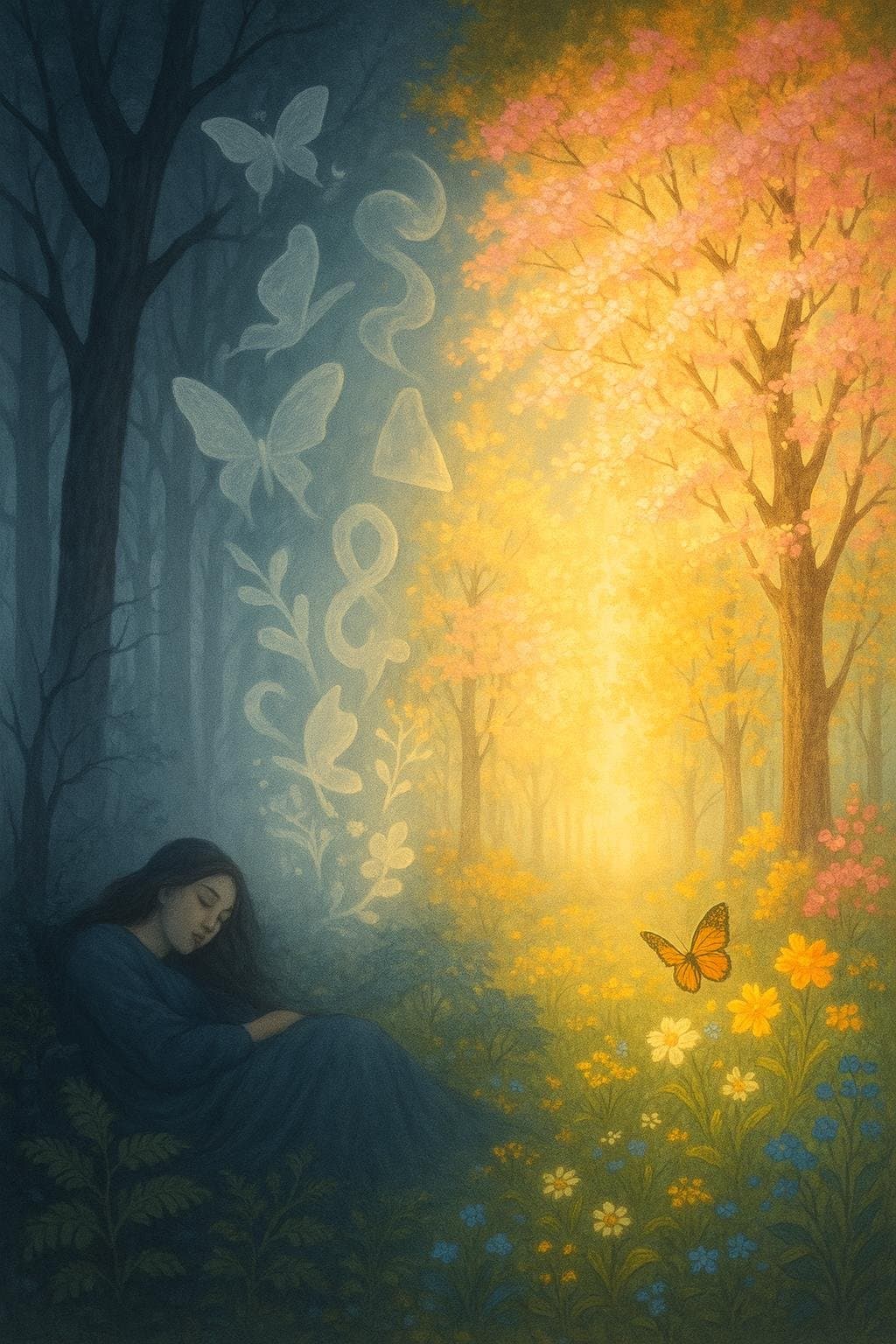
Dreams die when you wake, but action revives them. — Clarice Lispector
—What lingers after this line?
The Fragility of Dreams
Lispector suggests that dreams—our nocturnal hopes or daytime aspirations—are ephemeral, vanishing in the harsh light of reality. Like Coleridge’s 'Kubla Khan' (1816), inspired by an interrupted dream, the fleeting nature of inspiration is a recurrent literary motif.
The Role of Action
Action is portrayed as the life force that brings dreams from abstraction into existence. Thomas Edison is quoted as saying, 'Genius is 1% inspiration and 99% perspiration,' illustrating that mere vision is insufficient without effort and execution.
Bridging Imagination and Reality
Lispector’s line highlights the gulf between imagination and the world as it is. The anecdote of J.K. Rowling, who wrote 'Harry Potter' while struggling as a single mother, exemplifies how persistence and action transform private dreams into global phenomenon.
The Psychological Power of Hope
Psychologically, the cycle of dreaming, awakening, and acting underpins motivation. Viktor Frankl in 'Man's Search for Meaning' (1946) describes how hope can survive adversity only when supported by determined action.
Recurrent Themes in Lispector’s Work
Lispector’s characters often experience existential longing, but through decisive choices—however small—they reclaim agency. In 'The Hour of the Star' (1977), the protagonist’s acts, though modest, shape the meaning of her existence.
One-minute reflection
What feeling does this quote bring up for you?
Related Quotes
6 selectedThe distance between dreams and reality is called action. — Anonymous
Unknown
This quote highlights the distinction between dreams, which are often seen as aspirations or goals, and reality, which is the state of things as they actually exist. It suggests that dreams alone are not sufficient to ac...
Read full interpretation →The way to do a great deal is to keep on doing a little. The way to do nothing at all is to be continually resolving that you will do everything. — C.H. Spurgeon
C.H. Spurgeon
Spurgeon’s statement begins with a practical paradox: great accomplishments are rarely born from dramatic bursts of effort, but from the steady repetition of small acts. By saying that “a great deal” is done by “doing a...
Read full interpretation →No matter how full a reservoir of maxims one may possess, if one has not taken advantage of every concrete opportunity to act, one's character may remain entirely unaffected. — William James
William James
At first glance, William James draws a sharp line between knowing and becoming. A person may store up countless moral sayings, noble principles, and wise resolutions, yet these remain largely ornamental if they never pas...
Read full interpretation →Dreams are made of sturdy stuff. — William Carlos Williams
William Carlos Williams
At first glance, William Carlos Williams’s line reverses a familiar assumption: dreams are often treated as airy, fleeting, and insubstantial, yet he insists they are made of “sturdy stuff.” In that compact phrase, he gi...
Read full interpretation →Dreams are what lead us forward. — Kobe Bryant
Kobe Bryant
Kobe Bryant’s line turns dreams into more than private wishes; they become the engine of progress. At its core, the quote suggests that people do not move forward merely because time passes, but because they carry a visi...
Read full interpretation →A garden is not made by singing 'Oh, how beautiful,' and sitting in the shade. — Rudyard Kipling
Rudyard Kipling
Kipling’s line immediately cuts through passive appreciation. Simply admiring a garden, however sincerely, does nothing to plant seeds, pull weeds, or carry water.
Read full interpretation →More From Author
More from Clarice Lispector →Ask the world a question and let wonder answer with a path — Clarice Lispector
Clarice Lispector’s line begins with an outward gesture: “Ask the world a question.” Rather than treating reality as a fixed set of facts to be cataloged, she frames it as something we can address—almost like a conversat...
Read full interpretation →To act or not to act, that is my question. — Clarice Lispector
Clarice Lispector's adaptation of the iconic Hamlet phrase reframes the existential debate: should we step boldly into action, or remain in thoughtful hesitation? This question lies at the heart of human experience, echo...
Read full interpretation →When you stir your spirit’s waters, unexpected tides will follow. — Clarice Lispector
Clarice Lispector’s evocative imagery of stirring the 'spirit’s waters' serves as a potent metaphor for self-exploration. Much like the surface of a still pond disrupted by a single stone, our inner world reacts powerful...
Read full interpretation →Purpose is not given; it is carved from the raw stone of experience. — Clarice Lispector
Clarice Lispector’s metaphor likens purpose to a sculpture hidden within unshaped stone, waiting to be revealed through effort and interaction. Far from being a predetermined or bestowed quality, purpose emerges only thr...
Read full interpretation →