
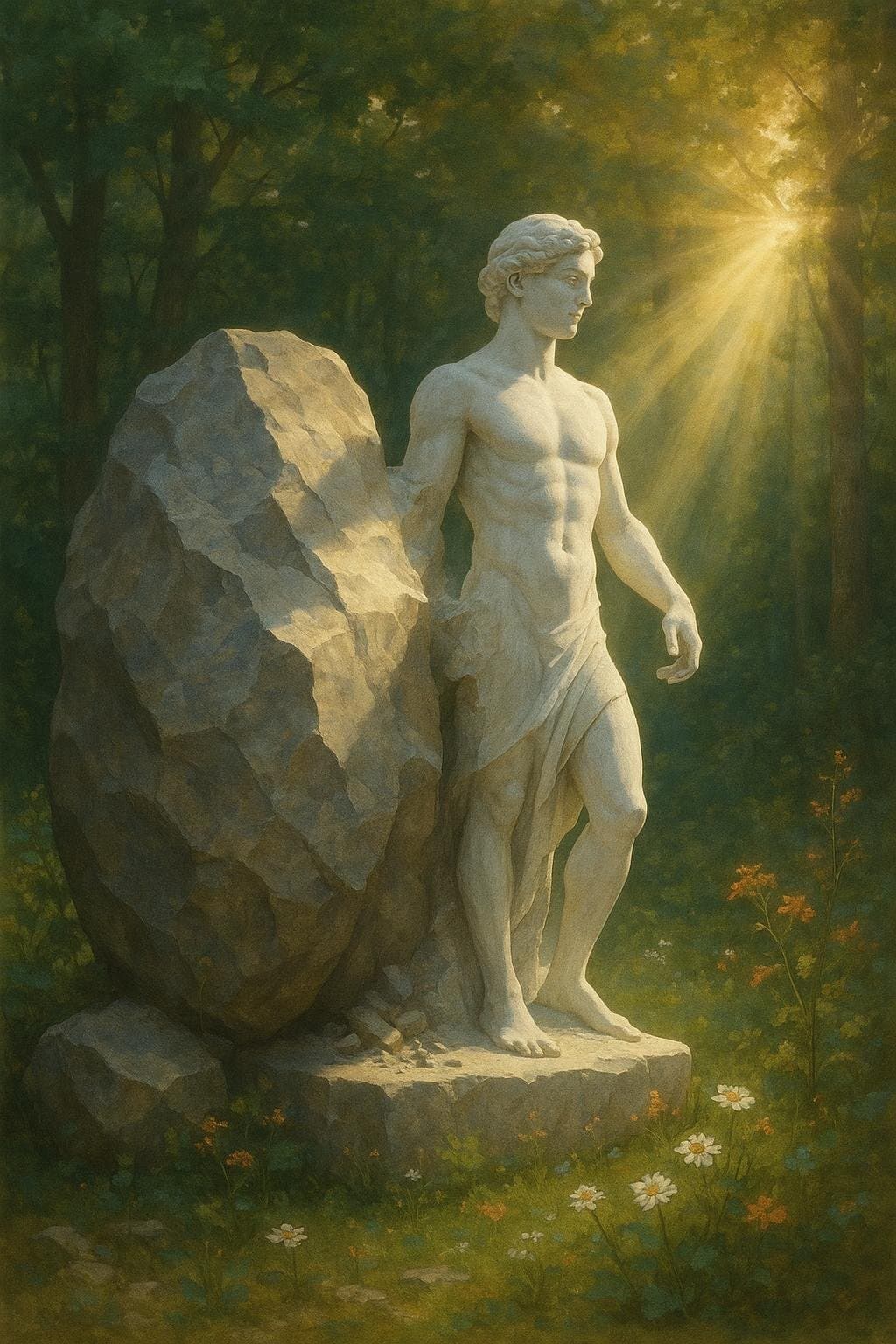
Purpose is not given; it is carved from the raw stone of experience. — Clarice Lispector
—What lingers after this line?
The Metaphor of Raw Stone
Clarice Lispector’s metaphor likens purpose to a sculpture hidden within unshaped stone, waiting to be revealed through effort and interaction. Far from being a predetermined or bestowed quality, purpose emerges only through the process of engagement with life’s events. This imagery invites us to reflect on the power of active creation over passive acceptance in defining meaning.
Experience as the Sculptor
Building on this idea, it becomes clear that our experiences—the pains and joys, setbacks and triumphs—serve as the tools that chisel away at our unformed potential. Throughout her works, Lispector often urges readers to confront discomfort and ambiguity, suggesting these are vital for personal revelation. Like Michelangelo seeing a figure within marble, we must persistently carve at our own blocks of experience to discover our unique forms.
Rejecting Preordained Meaning
Transitioning from creation to discovery, Lispector’s quote challenges philosophies that propose a fixed, universal purpose. Instead, she echoes existentialist thinkers like Jean-Paul Sartre, who argue that existence precedes essence. Just as Sartre proposed in 'Existentialism Is a Humanism' (1946), individuals must forge significance through the actions and choices they make, not through adherence to external scripts.
Purpose Mushrooms from Adversity
Moreover, the process of carving is not gentle; it often involves struggle. Lispector’s own life, as seen through her novels, was marked by exile, language barriers, and personal upheaval—each episode chipping away at the stone to reveal purpose. In much the same way, research shows that people frequently develop a sense of purpose after overcoming hardship, echoing Viktor Frankl’s chronicles in 'Man’s Search for Meaning' (1946).
A Lifelong, Evolving Process
Finally, Lispector’s metaphor suggests that purpose is not discovered in one decisive moment, but is a lifelong process of refinement. Just as a sculptor may continually adjust and redefine their vision, so too do we repeatedly shape our aims as we accumulate new experiences. Thus, purpose remains dynamic—an ever-evolving creation, unique to each sculptor of the self.
One-minute reflection
Where does this idea show up in your life right now?
Related Quotes
6 selectedWhatever you are doing, do it with a sense of purpose, not merely to pass the time. — Seneca
Seneca
Seneca’s counsel begins with a simple but demanding idea: life should not be treated as something to be spent carelessly. For the Stoics, time was not a disposable background to action but the very material of character.
Read full interpretation →Our plans miscarry because they have no aim. When a man doesn't know what harbor he's making for, no wind is the right wind. — Seneca
Seneca
Seneca’s remark begins with a simple but severe diagnosis: plans fail not merely from bad luck, but from the absence of a clear aim. In his view, activity alone is not progress.
Read full interpretation →Make your life simple, but significant. — Maria Defillo
Maria Defillo
Maria Defillo’s line begins with an apparent contrast and then quietly resolves it: a life can be simple without being small. In fact, the quote suggests that reducing clutter—whether in possessions, ambitions, or distra...
Read full interpretation →Doing the work is the only way to find out if the work is worth doing. — Flannery O'Connor
Flannery O'Connor
Flannery O’Connor’s line turns a common assumption upside down: we often think we must know a task’s value before we begin, yet she argues the opposite. The worth of serious work is rarely visible from a distance.
Read full interpretation →It is not the speed of the work, but the intention behind it that grants it value. — Rabindranath Tagore
Rabindranath Tagore
At first glance, Tagore’s statement challenges a modern habit of equating worth with speed. In many settings, quick results are praised as signs of competence, yet he redirects attention to the inner motive that shapes t...
Read full interpretation →You don't need a resolution. You need a foundation. You don't need pressure. You need purpose. — Minniis Learning
Minniis Learning
At first glance, the quote challenges two common instincts: the urge to solve everything immediately and the belief that stress will force growth. Instead, it redirects attention toward something more durable.
Read full interpretation →More From Author
More from Clarice Lispector →Ask the world a question and let wonder answer with a path — Clarice Lispector
Clarice Lispector’s line begins with an outward gesture: “Ask the world a question.” Rather than treating reality as a fixed set of facts to be cataloged, she frames it as something we can address—almost like a conversat...
Read full interpretation →Dreams die when you wake, but action revives them. — Clarice Lispector
Lispector suggests that dreams—our nocturnal hopes or daytime aspirations—are ephemeral, vanishing in the harsh light of reality. Like Coleridge’s 'Kubla Khan' (1816), inspired by an interrupted dream, the fleeting natur...
Read full interpretation →To act or not to act, that is my question. — Clarice Lispector
Clarice Lispector's adaptation of the iconic Hamlet phrase reframes the existential debate: should we step boldly into action, or remain in thoughtful hesitation? This question lies at the heart of human experience, echo...
Read full interpretation →When you stir your spirit’s waters, unexpected tides will follow. — Clarice Lispector
Clarice Lispector’s evocative imagery of stirring the 'spirit’s waters' serves as a potent metaphor for self-exploration. Much like the surface of a still pond disrupted by a single stone, our inner world reacts powerful...
Read full interpretation →