
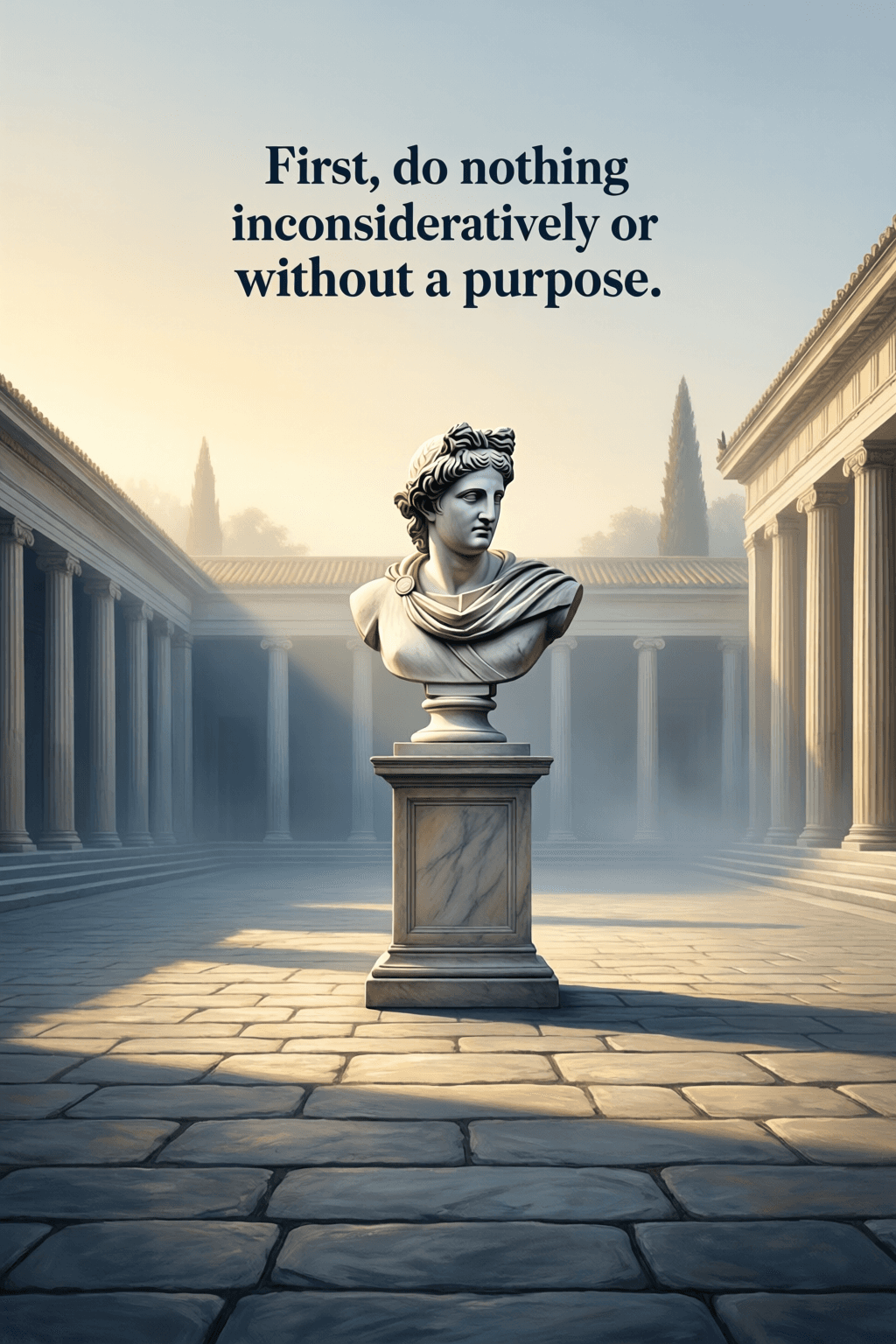
First, do nothing inconsiderately or without a purpose. — Marcus Aurelius
—What lingers after this line?
The Discipline of Deliberate Conduct
Marcus Aurelius begins with a demand for restraint: do nothing thoughtlessly and do nothing without aim. In the world of Stoic ethics, this is more than advice about efficiency; it is a rule for living with integrity. His Meditations (c. AD 170–180) repeatedly return to the idea that a rational person should act from clear judgment rather than impulse, vanity, or distraction. From this starting point, the quote frames human behavior as something that ought to be governed by intention. Even ordinary choices—speaking, spending, reacting, promising—acquire moral weight when they are made either carefully or carelessly. The point is not hesitation for its own sake, but action that knows why it exists.
Stoic Reason as a Moral Compass
Seen more broadly, the line reflects the Stoic conviction that reason is humanity’s proper guide. Thinkers like Epictetus in the Discourses (early 2nd century AD) argued that external events may lie beyond our control, yet our judgments and choices remain ours. Consequently, to act without purpose is to surrender the very faculty that makes ethical life possible. This idea leads naturally to a deeper moral claim: purposeless action is rarely neutral. When people drift into habits, arguments, or ambitions without examining them, they become governed by appetite or social pressure instead of principle. Marcus therefore asks us to pause and let reason determine not only what we do, but whether it deserves doing at all.
A Guard Against Impulse and Noise
In practical terms, the quote works as a safeguard against impulsiveness. A harsh reply sent in anger, a purchase made for status, or a commitment accepted merely to please others often begins in the absence of clear purpose. By contrast, Marcus Aurelius proposes a small but transformative interruption: ask what this action is for before taking it. This remains strikingly modern. In an age of endless notifications and constant reaction, many actions are immediate but not meaningful. The emperor’s warning reminds us that speed can imitate decisiveness while actually concealing emptiness. Thus, his counsel invites not passivity, but a more conscious form of engagement with the world.
Purpose and the Shape of Character
As the thought develops, it becomes clear that Marcus is concerned not only with isolated acts, but with character. Aristotle’s Nicomachean Ethics (4th century BC) similarly observes that repeated actions form habits, and habits form the person. If our deeds are careless and aimless, our character gradually takes on that same disorder. On the other hand, purposeful action creates internal coherence. A person who consistently asks, ‘Is this necessary? Is this honorable? What end does this serve?’ becomes harder to manipulate and less likely to regret their conduct. In this way, intention is not merely a planning tool; it is the architecture of a disciplined self.
A Lesson in Everyday Ethical Living
Finally, the power of the quotation lies in its everyday applicability. It does not require heroic sacrifice or philosophical expertise. It asks only that before acting, one bring together attention, reason, and moral purpose. A simple anecdote captures this well: a leader who delays an emotional decision until the next morning often prevents harm not through brilliance, but through disciplined intention. That is why the saying endures. Marcus Aurelius turns ethics into a daily practice of mindful action, where even small decisions become opportunities for self-command. By refusing to act inconsiderately or without purpose, we begin to live not randomly, but deliberately—and therefore more wisely.
One-minute reflection
What does this quote ask you to notice today?
Related Quotes
6 selectedMaster yourself and the world becomes a single field for your purpose. — Marcus Aurelius
Marcus Aurelius
Marcus Aurelius’ line distills a central Stoic promise: the surest form of influence begins inside. Rather than chasing control over people, events, or outcomes, he points to mastery of one’s own judgments, impulses, and...
Read full interpretation →When you begin with purpose, the distant horizon rearranges itself into reachable ground. — Marcus Aurelius
Marcus Aurelius
Marcus Aurelius frames purpose not as a final achievement but as a starting posture: when you begin with a clear “why,” the shape of everything that follows changes. In Stoic terms, intention organizes attention, and att...
Read full interpretation →Stand where your purpose meets patience, and the world will learn your footsteps. — Marcus Aurelius
Marcus Aurelius
The line frames a precise meeting point: purpose gives direction, while patience gives duration. By telling you to “stand where” they meet, it implies a disciplined stillness—not passivity, but a refusal to be blown off...
Read full interpretation →Temper your impulses with purpose; quiet resolve moves empires. — Marcus Aurelius
Marcus Aurelius
Marcus Aurelius, writing in his private journal later known as the *Meditations* (c. 170–180 CE), constantly urged himself to curb sudden reactions and act in accordance with reason.
Read full interpretation →A calm mind and a brave heart can turn a problem into a purpose. — Marcus Aurelius
Marcus Aurelius
This statement, attributed to Marcus Aurelius, distills a central Stoic insight: our greatest difficulties can become the raw material for a meaningful life. Rather than treating problems as dead ends, it suggests they c...
Read full interpretation →Act with clarity of purpose; even the smallest light dissolves darkness. — Marcus Aurelius
Marcus Aurelius
Marcus Aurelius’ words distill a central Stoic conviction: life should be lived on purpose, not by accident. To “act with clarity of purpose” means knowing why you do what you do, and aligning action with principle rathe...
Read full interpretation →More From Author
More from Marcus Aurelius →The art of life is more like the wrestler's art than the dancer's; stand ready and firm to meet sudden and unexpected onsets. — Marcus Aurelius
Marcus Aurelius contrasts two arts to clarify what living well demands. A dancer suggests elegance, rhythm, and practiced beauty; a wrestler, by contrast, suggests balance under pressure, resistance, and constant readine...
Read full interpretation →How much time he gains who does not look to see what his neighbour says or does or thinks, but only at what he does himself, to make it just and holy. — Marcus Aurelius
Marcus Aurelius argues that a great deal of life is wasted in watching other people—what they say, what they do, and even what they might be thinking. Instead, he recommends a disciplined inward turn: focus on your own c...
Read full interpretation →Sometimes, protecting your peace is the better choice. — Marcus Aurelius
At first glance, the saying frames peace not as passivity but as discipline. To protect one’s peace is to recognize that not every conflict deserves entry into the mind.
Read full interpretation →Don't go expecting perfection; be satisfied with even the smallest progress. — Marcus Aurelius
Marcus Aurelius advises against the exhausting demand for flawlessness and redirects attention toward modest improvement. In the spirit of Stoic thought, especially in his Meditations (c.
Read full interpretation →