
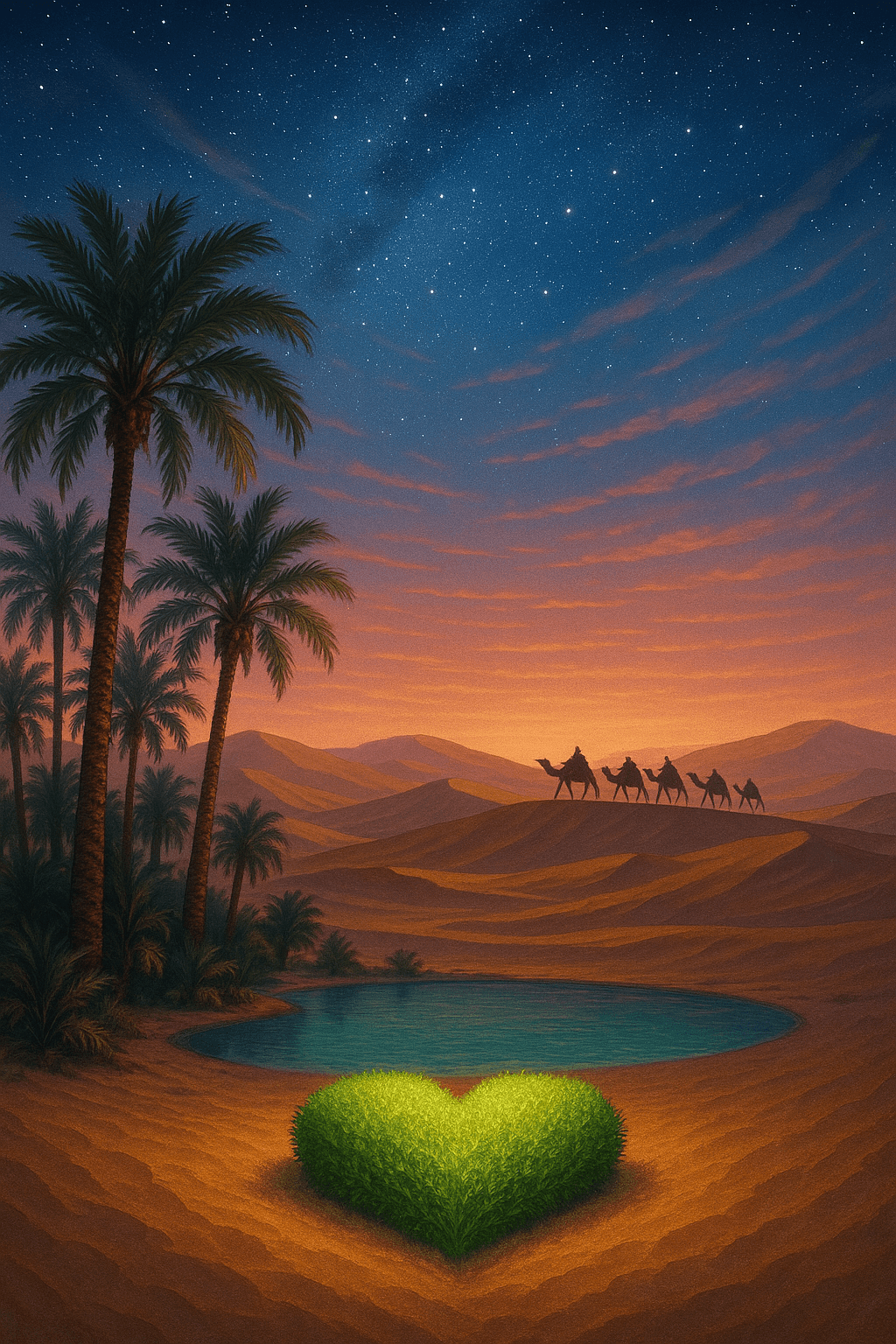
Faith is an oasis in the heart which will never be reached by the caravan of thinking. — Khalil Gibran
—What lingers after this line?
The Metaphor of the Oasis
Khalil Gibran’s quote evokes a vivid image: faith as a lush oasis, hidden deep within the heart, impervious to intellectual pursuit. This metaphor underscores the contrast between the soul’s inner sanctum and the external, arduous journey of reason. Just as a caravan traverses the desert in search of water but may never find the hidden oasis, so too does rational thought struggle to arrive at the serene certainty that faith provides.
Faith and Intellectual Inquiry
Building on this imagery, Gibran suggests that faith and rational inquiry occupy distinct domains. Throughout history, philosophers have grappled with this divide. For instance, Thomas Aquinas argued that reason serves to support faith but cannot replace or fully grasp its mysteries. Likewise, Blaise Pascal referred to 'the heart,' which has reasons 'that reason knows not,' illustrating how belief often transcends logical analysis.
The Limits of Thinking
As we consider the boundaries of human reasoning, Gibran’s analogy reminds us that certain truths may always elude rational explanation. In Albert Einstein’s reflections on science and religion, he wrote that 'the most beautiful experience we can have is the mysterious.' This recognition of mystery affirms that deliberate thought and analysis, much like a caravan’s methodical progress, have their limits when it comes to matters of faith.
Personal Experience and Inner Conviction
Moving from philosophy to the personal, Gibran places faith squarely in the realm of inner experience. It is not found along the busy caravan route of intellectual debate, but rather in the quiet solitude of the heart. Many spiritual traditions emphasize this inward focus: Rumi, for example, wrote that 'the soul lives in the silent spaces,' echoing Gibran’s view that faith grows where thought cannot tread.
Living with the Paradox
Ultimately, Gibran’s insight invites us to embrace the paradox of being both thinkers and believers. While our minds may tirelessly search for answers, true faith blooms beyond their reach—in the hidden gardens of the heart. Acknowledging this balance frees us to honor both our longing to understand and our need to trust in what transcends understanding, crafting a harmonious interplay between intellect and belief.
One-minute reflection
Why might this line matter today, not tomorrow?
Related Quotes
6 selectedDoubt is a pain too lonely to know that faith is his twin brother. — Kahlil Gibran
Kahlil Gibran
This quote suggests that doubt and faith are not opposites but rather two sides of the same experience. Doubt can feel isolating, but it exists alongside faith, shaping and strengthening belief.
Read full interpretation →The mind freed from passions is an impenetrable fortress — a person has no more secure place of refuge for all time. — Marcus Aurelius
Marcus Aurelius
At the heart of Marcus Aurelius’s statement lies a distinctly Stoic image: the mind, once freed from destructive passions, becomes a fortress no external force can breach. In his Meditations (c.
Read full interpretation →Acceptance is a small, quiet room. — Cheryl Strayed
Cheryl Strayed
Cheryl Strayed’s line frames acceptance not as an argument you win, but as a place you enter. Calling it “a small, quiet room” suggests something enclosed and intimate—an interior refuge rather than a public performance.
Read full interpretation →Faith sees the invisible, believes the unbelievable, and receives the impossible. — Corrie ten Boom
Corrie Ten Boom
Corrie ten Boom’s line unfolds in three ascending steps: seeing what cannot be seen, trusting what sounds implausible, and welcoming what appears unattainable. By structuring faith this way, she frames it not as vague op...
Read full interpretation →Feed belief with deeds; steady work dissolves the smallest doubts. — Frederick Douglass
Frederick Douglass
Douglass frames belief less as a private feeling and more as a living habit—something strengthened by what you repeatedly do. In this view, conviction is not primarily won through argument or reassurance, but through act...
Read full interpretation →Faith is a muscle: the more you use it, the steadier your reach becomes. — Helen Keller
Helen Keller
Helen Keller’s comparison of faith to a muscle immediately reframes belief as something dynamic rather than static. Instead of treating faith as a trait some people simply possess, she implies it is built through repetit...
Read full interpretation →More From Author
More from Kahlil Gibran →Your home is your larger body. It grows in the sun and sleeps in the stillness of the night. — Kahlil Gibran
At first glance, Gibran transforms the idea of home from a mere structure into something intimate and organic: “your larger body.” In this image, a dwelling is not separate from the person who inhabits it, but an outward...
Read full interpretation →March on. Do not tarry. To go forward is to move toward perfection. — Kahlil Gibran
Gibran’s opening imperative—“March on. Do not tarry.”—sets a tone of disciplined urgency.
Read full interpretation →There must be spaces in your togetherness, and let the winds of the heavens dance between you. — Kahlil Gibran
Gibran’s line opens with a gentle paradox: he speaks to people who are already “together,” yet insists that togetherness is healthiest when it includes room. Rather than portraying love as fusion, he frames it as a relat...
Read full interpretation →Our anxiety does not come from thinking about the future, but from wanting to control it. — Kahlil Gibran
Kahlil Gibran reframes anxiety as something more specific than mere anticipation. The future itself—uncertain, unfolding, and not yet real—doesn’t automatically distress us; rather, distress appears when we demand certai...
Read full interpretation →