
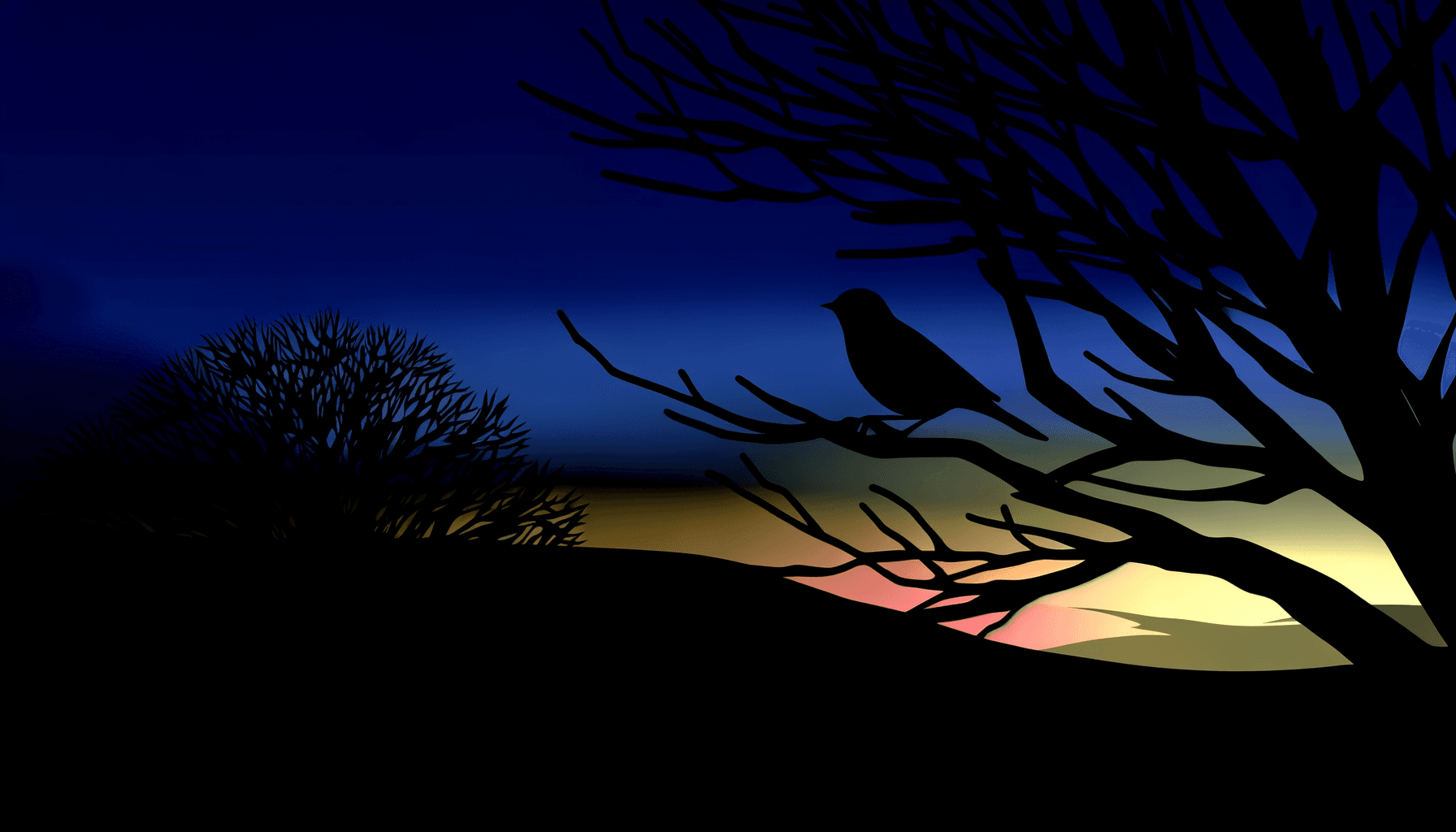
Faith is the bird that feels the light when the dawn is still dark. — Rabindranath Tagore
—What lingers after this line?
Definition of Faith
The quote likens faith to a bird that senses and trusts in the coming of light even before it appears, illustrating faith as belief without tangible evidence.
Hope Amid Uncertainty
It highlights the power of hope as it persists through uncertain or challenging times, just as a bird trusts that dawn will break.
Optimism in Adversity
This metaphor encourages an optimistic outlook, urging us to remain positive even when circumstances seem dark or uncertain.
Inner Strength
Faith is portrayed as an internal force that sustains and guides individuals through periods of darkness or doubt.
Poetic Imagery
Tagore uses elegant natural imagery, a hallmark of his poetic style, to express the abstract concept of faith in a relatable way.
One-minute reflection
What does this quote ask you to notice today?
Related Quotes
6 selectedWhen fear whispers 'pause,' let hope answer 'try'. — Rabindranath Tagore
Rabindranath Tagore
Tagore’s line stages a quiet yet powerful drama within the human mind: fear whispers “pause,” while hope responds “try.” Rather than depicting emotions as vague moods, he personifies them as conversational partners, each...
Read full interpretation →Build bridges with your hands and sow hope with your heart — Rabindranath Tagore
Rabindranath Tagore
Tagore’s image pairs tangible action with inner intention: hands build what people can cross; hearts cultivate what people can trust. By invoking bridges and seeds, he marries engineering to agriculture, suggesting that...
Read full interpretation →Just because your light flickers does not mean it is about to go out. — Yohancé Salimu
Yohancé Salimu
At first glance, Yohancé Salimu’s line separates appearance from reality. A flicker suggests instability, fatigue, or interruption, yet it does not automatically signal extinction.
Read full interpretation →Today's tears water tomorrow's gardens. — Matshona Dhliwayo
Matshona Dhliwayo
At first glance, Matshona Dhliwayo’s line transforms grief into something unexpectedly fertile. Tears, usually seen as signs of pain or loss, become water for a future garden, suggesting that suffering is not merely endu...
Read full interpretation →Hope is passion for the possible. — Søren Kierkegaard
Søren Kierkegaard
At first glance, Kierkegaard’s line transforms hope from a passive feeling into an active force. To call hope “passion for the possible” means that hope is not mere daydreaming; rather, it is an inward energy that leans...
Read full interpretation →A ship should not ride on a single anchor, nor life on a single hope. — Epictetus
Epictetus
At first glance, Epictetus turns a practical image into a moral lesson: a ship secured by only one anchor is vulnerable to shifting winds, rough tides, and hidden strain. In the same way, a life fastened to a single hope...
Read full interpretation →More From Author
More from Rabindranath Tagore →Adaptability is not imitation. It means power of resistance and assimilation. — Rabindranath Tagore
At the heart of Tagore’s statement lies a careful distinction between changing and merely copying. Adaptability, he argues, is not the passive act of becoming like one’s surroundings; rather, it is an active power that a...
Read full interpretation →It is not the speed of the work, but the intention behind it that grants it value. — Rabindranath Tagore
At first glance, Tagore’s statement challenges a modern habit of equating worth with speed. In many settings, quick results are praised as signs of competence, yet he redirects attention to the inner motive that shapes t...
Read full interpretation →When I stand before thee at the day's end, thou shalt see my scars and know that I had my wounds and also my healing. — Rabindranath Tagore
At its heart, Tagore imagines an ultimate moment of reckoning in which nothing essential can be hidden. To stand before another “at the day’s end” suggests the close of life, a spiritual homecoming, or simply the end of...
Read full interpretation →A home is not a mere transient shelter of brick and stone, but a place where hearts dwell and souls are nurtured. — Rabindranath Tagore
At its core, Tagore’s statement rejects the idea that a home can be defined by architecture alone. Walls, roofs, and doors may provide protection, yet they do not automatically create belonging.
Read full interpretation →