
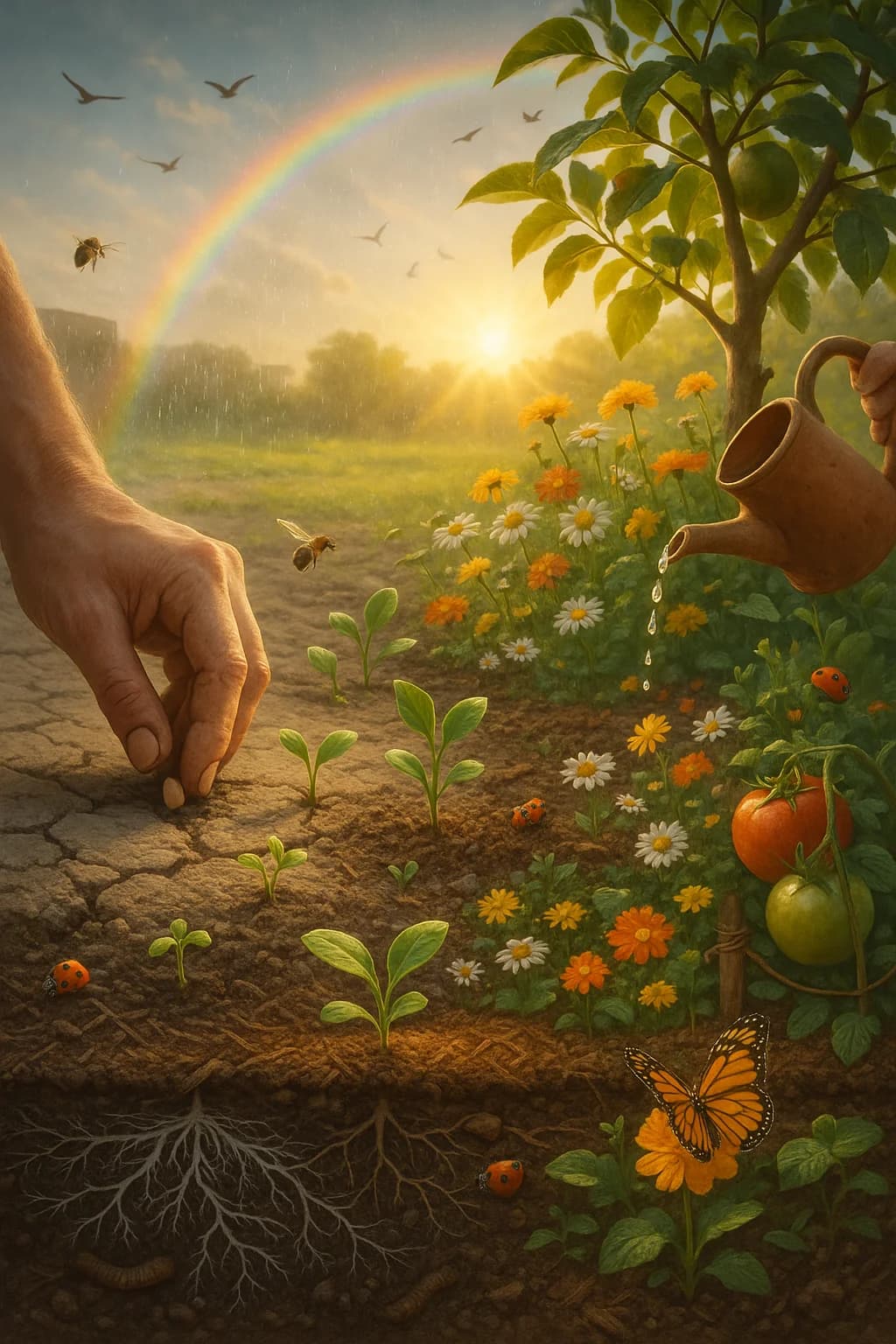
Plant hope like seeds and tend it with stubborn care. — Naomi Shihab Nye
—What lingers after this line?
Seeds as a Promise, Not a Guarantee
Naomi Shihab Nye frames hope as a planted thing: small, ordinary, yet filled with latent life. Seeds make a quiet promise, but they do not sprout because we wish them to; they sprout because conditions are patiently created. In this sense, hope is not a mood but a craft. Nye’s work often braids such tenderness with pragmatism; her airport vignette "Gate A-4" turns strangers into companions through simple acts of care, illustrating how a tiny gesture can germinate communal hope.
From Metaphor to Method: How to Tend
From metaphor to method, gardening teaches that tending is rhythmic and specific: preparing soil, watering on schedule, thinning crowded sprouts, shielding against late frost. Translated to a life of hope, this becomes building routines that protect fragile beginnings—setting small goals, limiting bleak news diets, and inviting accountability from a trusted friend. Stubborn care is not clenched; it is consistent. By returning, even on dull days, we tell the seed it is expected to grow.
The Psychology Behind Stubborn Care
Psychology reinforces this craft perspective. C. R. Snyder’s hope theory describes hope as the blend of agency (I can) and pathways (I know how) (Snyder, 1994). Stubborn care feeds both: repeated effort grows agency, and creative problem-solving multiplies pathways. Relatedly, Carol Dweck’s growth mindset reframes setbacks as information, not verdicts (Dweck, 2006), while Angela Duckworth’s work on grit highlights sustained effort toward long aims (Duckworth, 2016). Thus, tending hope is measurable behavior, not vague optimism.
Community Gardens as Hope in Common
Beyond individuals, hope thrives in common ground. Community gardens show how literal seeds can cultivate social trust. Studies link urban greening with reduced stress and violence, from Kuo and Sullivan’s Chicago housing research (Environment and Behavior, 2001) to a randomized trial in Philadelphia that found greening vacant lots improved mental health and lowered crime nearby (South et al., PNAS, 2018). When neighbors share tools and harvests, they also share futures; the plot becomes a small prophecy that tomorrow is worth arranging.
Hope Under Displacement: Carrying Seeds Across Borders
In the harshest contexts, stubborn care becomes lifeline. Nye, a Palestinian American, often writes of displacement and steadfastness—sumud—as everyday courage; her collection "19 Varieties of Gazelle" (2002) gathers such voices. Likewise, seed keepers safeguard continuity: when war disrupted Syria’s gene bank, withdrawals from the Svalbard Global Seed Vault (est. 2008) enabled replanting in safer fields. These stories suggest that hope travels like a pocketed seed—light enough to carry, durable enough to wait, and ready when soil returns.
Weathering Setbacks: Seasons, Dormancy, and Return
Inevitably, some sowings fail. Gardeners accept dormancy, late frosts, and gnawed leaves without surrendering the season. So too with hope: pauses are not proof of futility but part of growth’s tempo. We can prune goals, compost lessons, and reseed with better timing. By naming seasons—germination, flowering, fruit, rest—we resist the panic of stalled progress and honor cycles that renew.
Daily Rituals to Keep Hope Alive
To embody this idea, adopt small, repeatable rituals: a morning intention written on paper, a weekly hour devoted to one hopeful project, and a monthly gratitude note to someone who watered your courage (Emmons and McCullough, 2003). Pair each intention with a pathway and a date. Then, as in any garden, keep a log. Over time the pages thicken, and with them, the quiet knowledge that care, stubbornly applied, makes hope take root.
One-minute reflection
Why might this line matter today, not tomorrow?
Related Quotes
6 selectedPlant hope like trees of fruit: their shade and harvest arrive long after the first seed. — Kahlil Gibran
Kahlil Gibran
Gibran frames hope as something planted rather than simply felt, shifting it from a mood into a practice. A seed is small, even unimpressive, yet it carries a future that can’t be rushed into view.
Read full interpretation →Hope becomes habit when fed by persistent effort. — Desmond Tutu
Desmond Tutu
Desmond Tutu’s line reframes hope from a fleeting feeling into something deliberately cultivated. Rather than treating hope as a gift that arrives when circumstances improve, he implies it can be trained—much like a skil...
Read full interpretation →If we are facing in the right direction, all we have to do is keep walking. — Thích Nhất Hạnh
Thich Nhat Hanh
Thích Nhất Hạnh’s words begin with a simple but profound premise: progress depends first on direction, not speed. If a person is turned toward compassion, clarity, healing, or truth, then each modest step becomes meaning...
Read full interpretation →Do the best one can. Do it over again. Then still improve, even if ever so slightly, those retouches. — Marguerite Yourcenar
Marguerite Yourcenar
Yourcenar’s words begin with a simple demand: do the best one can. Yet she immediately refuses to let effort become an excuse for stopping.
Read full interpretation →A good-enough novel violently written now is better than a perfect novel meticulously written never. — Elizabeth Gilbert
Elizabeth Gilbert
Elizabeth Gilbert’s line immediately shifts the argument from artistic purity to artistic existence. A “good-enough” novel, even one “violently written,” has entered the world and can move, provoke, or comfort someone; b...
Read full interpretation →Just because your light flickers does not mean it is about to go out. — Yohancé Salimu
Yohancé Salimu
At first glance, Yohancé Salimu’s line separates appearance from reality. A flicker suggests instability, fatigue, or interruption, yet it does not automatically signal extinction.
Read full interpretation →More From Author
More from Naomi Shihab Nye →Stillness isn't the absence of movement, but the presence of awareness. — Naomi Shihab Nye
At first glance, stillness seems to imply silence, immobility, or retreat from the world. Naomi Shihab Nye overturns that assumption by suggesting that true stillness is not about stopping movement but about deepening at...
Read full interpretation →Keep a small flame of courage; it will light a thousand steps. — Naomi Shihab Nye
Nye’s image of a “small flame” reframes courage as something modest yet persistent—less a bonfire than a pilot light. In darkness, a single flame reveals enough for the next step, which is precisely its wisdom: courage r...
Read full interpretation →Before you know kindness as the deepest thing inside, you must know sorrow as the other deepest thing. — Naomi Shihab Nye
Naomi Shihab Nye’s line turns a key in the lock of experience: the deepest kindness does not arise from comfort, but from an encounter with sorrow that opens the floor beneath us. The poem Kindness insists on sequence—lo...
Read full interpretation →