
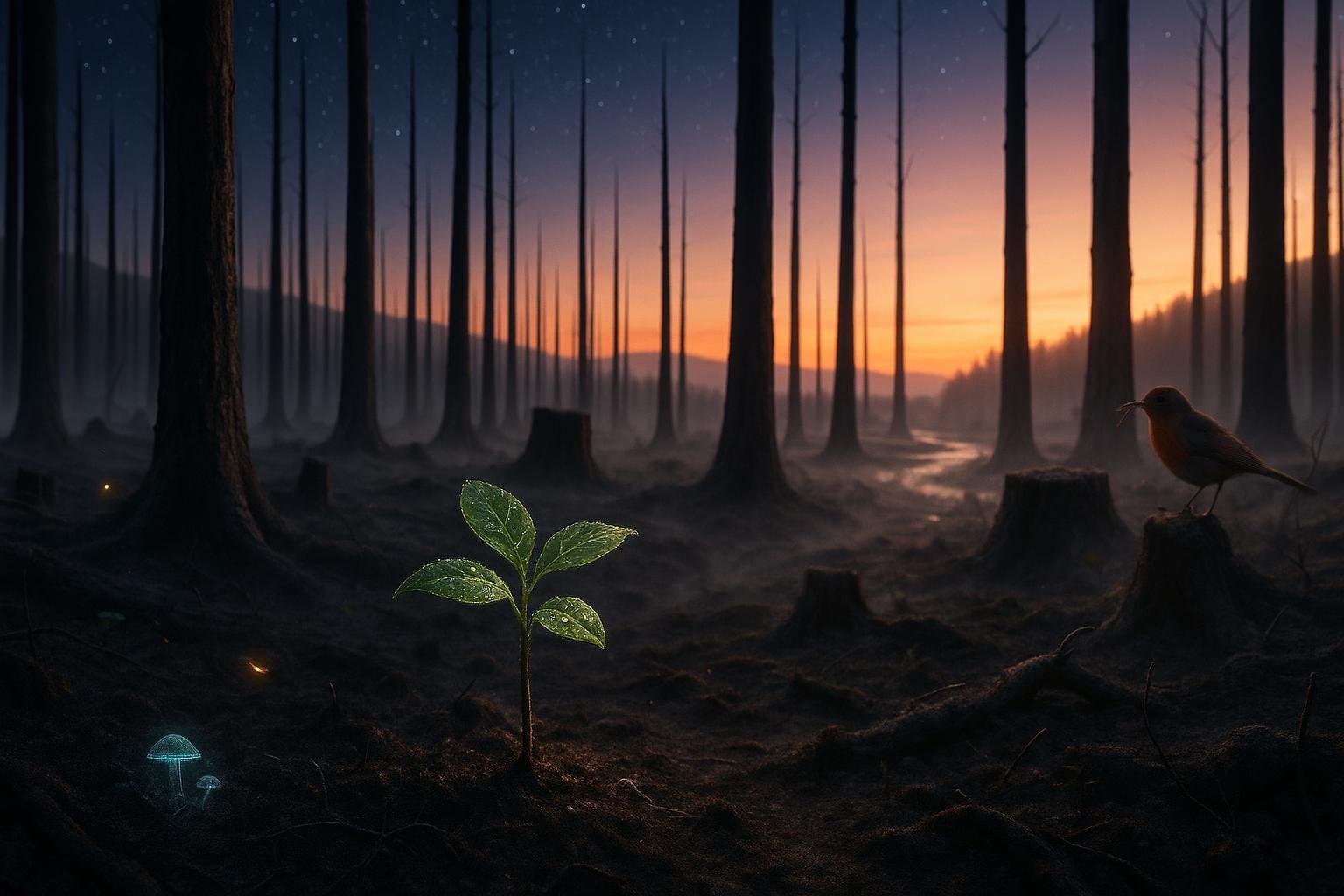
The future is dark, which is the best thing the future can be. — Toni Morrison
—What lingers after this line?
Uncertainty as Freedom
To begin, calling the future “dark” reframes uncertainty as freedom rather than doom. Darkness here is not a moral verdict but a description of what is not yet illuminated—what has not hardened into inevitability. Because nothing is decided, much remains possible. This stance resonates with John Keats’s notion of “negative capability” (1817), the capacity to dwell in mysteries without anxious grasping, and with Rainer Maria Rilke’s advice to “live the questions” in Letters to a Young Poet (1903). In both cases, not-knowing becomes a space for transformation. Thus, the future’s best quality is its openness: it resists prediction, and in doing so, resists foreclosure. By accepting the night, we recover the agency to move, adjust, and invent, rather than merely submitting to forecasts pretending to be fate.
Morrison’s Generative Use of Darkness
Building on this, Toni Morrison repeatedly turned “darkness” into a generative lens. In Playing in the Dark: Whiteness and the Literary Imagination (1992), she shows how Blackness—figured as darkness—has been a crucible for American literary creativity, not a void. Similarly, Beloved (1987) insists that history’s shadowed rooms contain voices that, once heard, remake what counts as truth. The novel’s hauntedness refuses the false comfort of bright, flattening certainty; instead, it invites readers to linger until new vision forms. Even in Sula (1973), moral ambiguity is not a failure of light but a deeper honesty about human motives and costs. Through such works, Morrison treats darkness as fertile ground: a place where the unsayable can be spoken and the unimagined can take shape—exactly the sort of ground from which a better future might grow.
Hope as Discipline, Not Prediction
From literature to civic life, the dark future invites hope practiced as a discipline rather than optimism as a forecast. Rebecca Solnit’s Hope in the Dark (2004) argues that uncertainty protects possibility; you continue to work because outcomes are undecided. Organizer Mariame Kaba’s phrase “hope is a discipline” (often cited in 2020) sharpens this into a daily ethic: prepare, collaborate, and persist without guarantees. Under this view, hope is not a sunny mood but a set of repeatable actions—listening, building, revising—that keep new paths available. The “best” future, then, is one we refuse to pre-close with either despair or naive assurance. By treating unlit horizons as a practice field, communities grow capacity, so that when openings appear, they are ready to move through them.
Acting Bravely Without Guarantees
Consequently, many of history’s breakthroughs arose precisely because people acted before outcomes were knowable. The Montgomery bus boycott (1955–56) began with uncertainty yet reconfigured a city’s moral map. Freedom Summer (1964) risked lives to register voters, betting on seeds whose harvest would be delayed. Decades later, ACT UP’s direct action pressured institutions during the AIDS crisis, accelerating research and access when timelines were murky. In each case, darkness did not paralyze; it clarified the stakes and multiplied tactics. Theodore Parker’s line—popularized by Martin Luther King Jr.—that “the arc of the moral universe is long, but it bends toward justice” (1853/1965) points less to inevitability than to labor: hands must do the bending. Acting without guarantees transforms uncertainty from threat into leverage.
Creative Work in Unlit Rooms
Likewise, the creative process thrives on not-knowing. Morrison often wrote in the early hours, when the world was quiet and undefined—time she described as essential for hearing the work before it calcified into answers. Her counsel, “If there’s a book that you want to read, but it hasn’t been written yet, then you must write it,” comes from this posture of invention (see interviews collected in Conversations with Toni Morrison, ed. Denard, 2008). Artists, scientists, and entrepreneurs begin with questions, sketches, and prototypes that accept the dark as a working condition. Rather than demand perfect foresight, they iterate, allowing forms to emerge. Thus the darkness of the future mirrors the studio or lab: a space where missteps inform the next draft, and ambiguity shelters fragile beginnings.
Humility, Design, and the Unknown
Ultimately, embracing darkness counsels humility in planning. High-modernist overconfidence often failed precisely because it pretended to know too much too soon; James C. Scott’s Seeing Like a State (1998) catalogs such disasters. By contrast, adaptive approaches—pilot projects, community co-design, and incremental policy—treat uncertainty as a design parameter. This does not mean drifting; it means setting a compass and updating the map as terrain reveals itself. In ethical terms, admitting you cannot see everything makes space for those who can—local knowledge, marginalized voices, and emergent data. The future is best when dark because it keeps us honest and alert, asking, testing, listening. As our eyes adjust, we discern new constellations—and with them, new routes through the night.
One-minute reflection
What does this quote ask you to notice today?
Related Quotes
6 selectedDreams are the seeds of possibility planted in the soil of the future. - Unknown
Unknown
This quote highlights the importance of dreams as the foundation for what can be achieved in the future. Dreams ignite the potential within us to create and accomplish great things.
Read full interpretation →The ultimate mysteries are opened only to those who have immense patience. — Osho
Osho
Osho’s statement begins with a simple but demanding premise: the deepest truths do not yield to force. In this view, mystery is not a puzzle to be solved quickly but a reality that unfolds on its own terms.
Read full interpretation →Hope is passion for the possible. — Søren Kierkegaard
Søren Kierkegaard
At first glance, Kierkegaard’s line transforms hope from a passive feeling into an active force. To call hope “passion for the possible” means that hope is not mere daydreaming; rather, it is an inward energy that leans...
Read full interpretation →And now let us believe in a long year that is given to us, new, untouched, full of things that have never been. — Rainer Maria Rilke
Rainer Maria Rilke
Rilke opens by shifting the tone from planning to believing: the year is “given to us,” implying something received rather than conquered. This framing matters because it replaces the pressure of achievement with the hum...
Read full interpretation →Underneath the grid is a field—it was always there—where to be lost is never to be wrong, but simply more. — Ocean Vuong
Ocean Vuong
Vuong opens with a quiet contrast: a “grid” suggests order, measurement, and right angles—an imposed way of seeing life as legible and correct. Underneath it, however, is a “field,” something organic and unruled, where g...
Read full interpretation →The world is before you, and you need not take it as it was. — James Baldwin
James Baldwin
James Baldwin’s line begins as a simple act of opening a door: the world is “before you,” available to your attention and judgment rather than locked behind tradition. Instead of treating reality as fixed scenery, he fra...
Read full interpretation →More From Author
More from Toni Morrison →The building of the architecture of a novel - the craft of it - is something I never tire of. — Toni Morrison
At its core, Toni Morrison’s remark celebrates not merely storytelling, but the deliberate construction behind it. By speaking of the “architecture of a novel,” she shifts attention from inspiration alone to design, sugg...
Read full interpretation →The role of art has never been to escape reality, but to help us understand it. — Toni Morrison
At first glance, art is often treated as a refuge from hardship, a private world where pain can be softened or forgotten. Toni Morrison overturns that expectation by arguing that art’s deeper purpose is not avoidance but...
Read full interpretation →The ability to endure is the discipline of the soul. — Toni Morrison
Toni Morrison’s line shifts endurance from a mere survival trait into a deliberate inner practice: a discipline cultivated in the soul. Rather than glorifying pain for its own sake, she suggests that the capacity to cont...
Read full interpretation →You are your best thing. — Toni Morrison
Toni Morrison’s line, “You are your best thing,” quietly overturns a common habit: looking outward for proof of worth. Instead of treating love, status, or achievement as the final measure, the quote plants value inside...
Read full interpretation →