
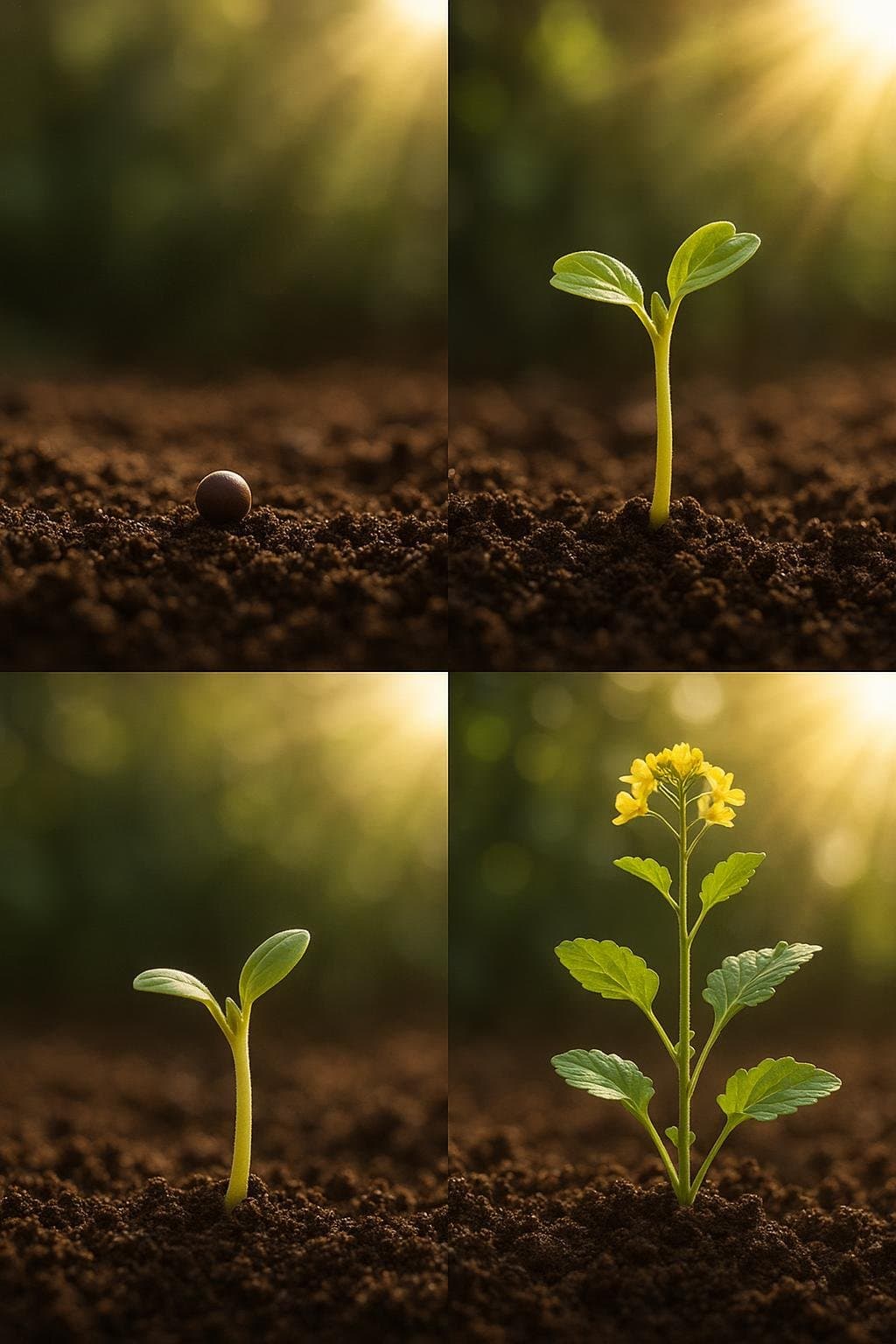
The mustard seed is the smallest of all seeds, but when it has grown it is the greatest among shrubs. — The Bible (Luke 13:19)
—What lingers after this line?
The Power of Small Beginnings
To begin, the mustard seed is renowned in biblical times for its minuscule size, and yet, as noted in Luke 13:19, it grows into a sturdy, expansive shrub. This comparison underscores the profound truth that even beginnings that seem insignificant or humble can result in remarkable transformations over time. The seed's physical smallness thus becomes a metaphor for potential that lies hidden in modest starts.
Spiritual Growth and the Kingdom of God
Building on this imagery, Jesus uses the mustard seed in the Gospel of Luke as a symbol for the Kingdom of God. The parable assures listeners that spiritual growth often starts quietly, even invisibly, but has the capacity to fill and transform entire lives and communities. Much like how a tiny seed becomes a place of refuge for birds, so does the Kingdom shelter those who seek it—expanding far beyond its unassuming origins.
Historical Resonance in Religious Tradition
Consequently, this vivid metaphor reverberates through centuries of theological reflection. Early Church Fathers such as Augustine and Irenaeus would reference the mustard seed to illustrate how early Christianity, starting with a handful of followers, blossomed into a global faith. The story fueled perseverance among believers, reminding them that faith’s impact grows regardless of humble circumstances.
Lessons for Personal Development
Translating the parable into everyday life, the mustard seed motif invites us to value patient, persistent growth. Whether learning a new skill or nurturing a relationship, the process may initially seem slow or invisible. Yet, as with the seed, steady effort and care ultimately yield results that exceed initial expectations, proving that greatness is born from consistency and hope.
Modern Echoes in Society and Culture
Ultimately, the parable’s message finds echoes in many facets of modern culture. Social entrepreneurs, educators, and innovators often invoke the mustard seed to inspire confidence that small actions or ideas, though easily dismissed at first, can spark large-scale change. The enduring power of this biblical symbol invites us to trust in the unseen growth occurring beneath the surface—encouraging faith in both spiritual and worldly pursuits.
Recommended Reading
As an Amazon Associate, we earn from qualifying purchases.
One-minute reflection
Why might this line matter today, not tomorrow?
Related Quotes
6 selectedThe mustard seed is the smallest of all seeds, but when it has grown it is the greatest among shrubs. — The Bible (Luke 13:19)
The Bible (Luke 13:19
The biblical reference to the mustard seed as the smallest of all seeds serves as a powerful metaphor for potential. While physically unremarkable and easy to overlook, the seed becomes a symbol for things that start hum...
Read full interpretation →The mustard seed is the smallest of all seeds, but when it has grown it is the greatest among shrubs. — The Bible (Luke 13:19)
The Bible (Luke 13:19
The parable of the mustard seed, as recounted in Luke 13:19, draws attention to how significant growth often emerges from inconspicuous beginnings. The mustard seed, described as the smallest of all seeds, serves as a me...
Read full interpretation →Do not despise the small beginning, for it is the only foundation upon which a great structure can stand. — Marcus Aurelius
Marcus Aurelius
At its core, this saying argues that modest beginnings are not a weakness but a necessity. A great structure, whether a life, a skill, or an institution, cannot appear fully formed; it must emerge from first attempts tha...
Read full interpretation →Faith sees the invisible, believes the unbelievable, and receives the impossible. — Corrie ten Boom
Corrie Ten Boom
Corrie ten Boom’s line unfolds in three ascending steps: seeing what cannot be seen, trusting what sounds implausible, and welcoming what appears unattainable. By structuring faith this way, she frames it not as vague op...
Read full interpretation →Feed belief with deeds; steady work dissolves the smallest doubts. — Frederick Douglass
Frederick Douglass
Douglass frames belief less as a private feeling and more as a living habit—something strengthened by what you repeatedly do. In this view, conviction is not primarily won through argument or reassurance, but through act...
Read full interpretation →Faith is a muscle: the more you use it, the steadier your reach becomes. — Helen Keller
Helen Keller
Helen Keller’s comparison of faith to a muscle immediately reframes belief as something dynamic rather than static. Instead of treating faith as a trait some people simply possess, she implies it is built through repetit...
Read full interpretation →More From Author
More from The Bible (Luke 13:19 →The mustard seed is the smallest of all seeds, but when it has grown it is the greatest among shrubs. — The Bible (Luke 13:19)
The biblical reference to the mustard seed as the smallest of all seeds serves as a powerful metaphor for potential. While physically unremarkable and easy to overlook, the seed becomes a symbol for things that start hum...
Read full interpretation →The mustard seed is the smallest of all seeds, but when it has grown it is the greatest among shrubs. — The Bible (Luke 13:19)
The parable of the mustard seed, as recounted in Luke 13:19, draws attention to how significant growth often emerges from inconspicuous beginnings. The mustard seed, described as the smallest of all seeds, serves as a me...
Read full interpretation →