
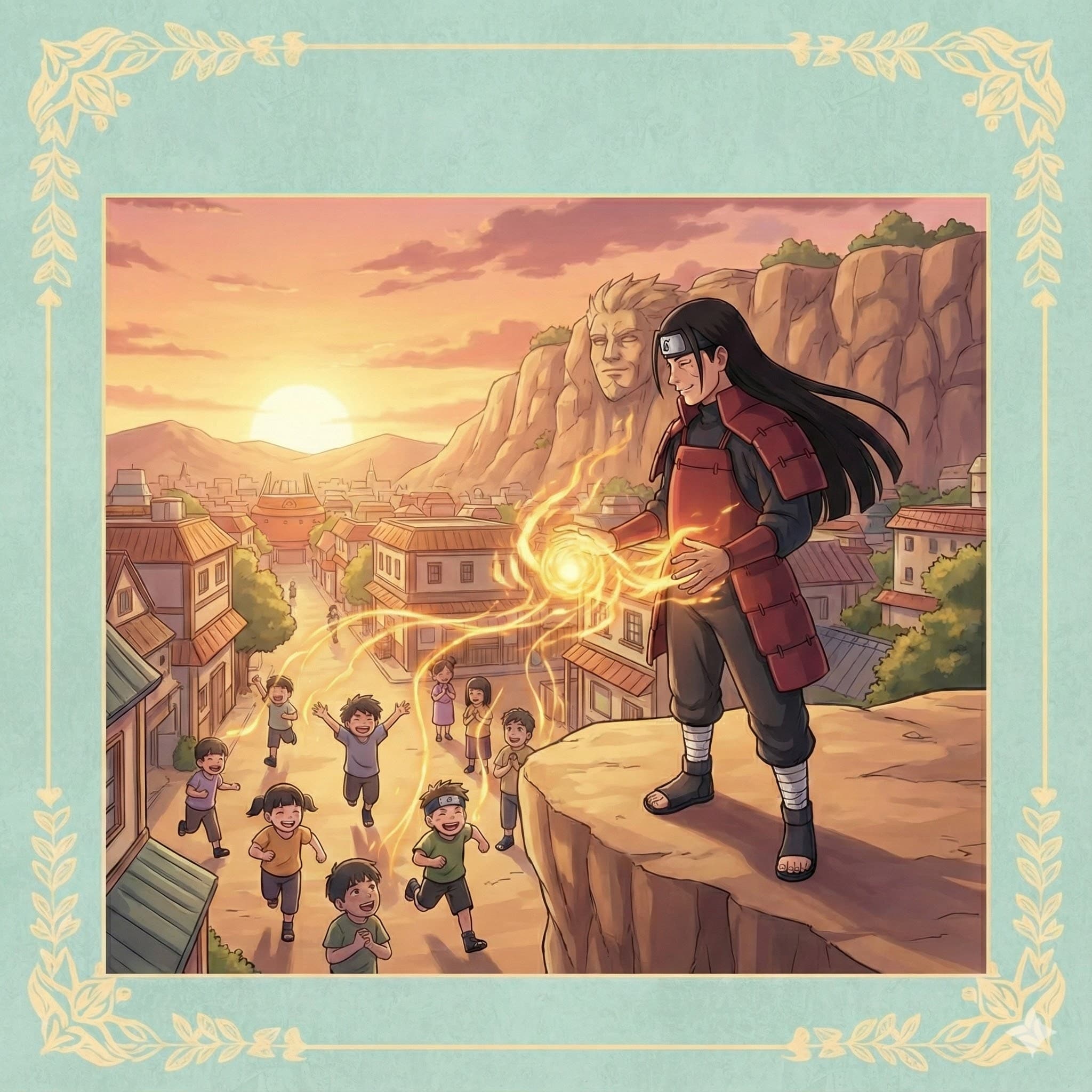
The will of fire burns brightest when shared. — Hashirama Senju, Naruto Series
—What lingers after this line?
A Fire That Grows When Given Away
Hashirama Senju’s line, “The will of fire burns brightest when shared,” captures a paradox at the heart of human motivation: some inner flames strengthen not by being guarded, but by being given. In the world of Naruto, the Will of Fire is the spiritual inheritance of the Hidden Leaf Village—a conviction that each generation must protect and nurture the next. Rather than depicting will as a solitary, stoic force, Hashirama frames it as something communal. This immediately shifts the image of fire from a single candle in the dark to a bonfire that draws people together. In doing so, the quote reminds us that conviction, courage, and hope are most powerful when they move beyond the individual and become a shared purpose.
From Personal Resolve to Village Philosophy
Moving from image to ideology, the quote signals how a private determination becomes a public ethos. Hashirama’s dream of a village where children need not die in war transforms personal trauma into a unifying principle. The Will of Fire thus evolves from one man’s resolve into the moral backbone of Konoha: elders teach it to students, comrades live and die by it, and leaders are chosen for embodying it. This transition echoes how real-world movements arise when one person’s moral stance becomes a collective narrative. Just as civil rights leaders turned individual outrage into shared language and rituals, Konoha’s shinobi convert Hashirama’s inner flame into a culture that outlives its founder.
The Psychology of Shared Motivation
Beneath the story, Hashirama’s insight aligns with how psychologists understand group motivation. Research on “collective efficacy” by Albert Bandura (1997) shows that people persevere more when they believe not only in themselves, but in their group’s ability to succeed. By sharing a guiding will, individuals draw strength from one another’s resolve, making the group more resilient than any lone hero. This dynamic is visible whenever Naruto rallies allies who had nearly given up; their power multiplies as their beliefs converge. Thus, the Will of Fire burning “brightest” when shared is not only poetic but also psychologically grounded: common purpose amplifies endurance, courage, and hope.
Mentorship and the Passing of the Flame
Furthermore, the quote underlines the importance of mentorship as the means by which will is transmitted. In Naruto, teachers like Hiruzen, Jiraiya, and Kakashi serve as living conduits of Hashirama’s vision, embodying the Will of Fire while reshaping it for new eras. This mirrors how wisdom and values are handed down in families, schools, and communities: elders articulate principles, but their true transmission occurs through example and sacrifice. By insisting that the fire burns brightest when shared, Hashirama implies that hoarded strength fades, while invested strength multiplies. Each time a mentor entrusts their ideals to a student, the original spark grows into a lineage of conviction that can withstand even tragedy.
From Sacrifice to Inherited Hope
Yet the quote also gestures toward the cost of keeping such a fire alive. Hashirama’s dream requires sacrifices—of time, safety, and sometimes life itself—but those sacrifices are framed as seeds for a more peaceful future. In the series, many characters die believing their will will live on, much like soldiers who fight so their children might not have to. This belief transforms individual loss into inherited hope, ensuring that despair does not have the final word. Consequently, the brightness of the shared fire lies not only in present unity, but in the conviction that one generation’s suffering can kindle another generation’s possibility.
Beyond Konoha: A Universal Lesson
Finally, stepping outside the Naruto universe, Hashirama’s words offer a broader lesson about communities anywhere. Whether in a workplace, activist group, or family, shared purpose turns scattered efforts into focused change. A lone person with a strong will can resist hardship, but a group linked by a common flame can reshape their world. Movements for independence, social justice, or scientific discovery frequently begin with a single spark that catches on in others’ hearts. Thus, the Will of Fire becomes a metaphor for any value—kindness, justice, curiosity—that intensifies when practiced together. When we choose to share our inner fire, we do not diminish ourselves; we help light a horizon no one could illuminate alone.
One-minute reflection
Where does this idea show up in your life right now?
Related Quotes
6 selectedTo be alone is to suffer. But to suffer with others is to find meaning. — Gaara, Naruto Series
Gaara, Naruto Series
Gaara’s words begin with a stark observation: “To be alone is to suffer.” This captures the idea that isolation is not just the absence of company but a distinct kind of pain. Even when life is objectively difficult, bei...
Read full interpretation →A true leader builds a world where children can laugh freely. — Hashirama Senju, Naruto Series
Hashirama Senju, Naruto Series
Hashirama Senju’s words shift leadership away from power and glory toward a gentler benchmark: the sound of children laughing without fear. Rather than celebrating conquest or authority, this view treats safety, joy, and...
Read full interpretation →Your presence is a form of resistance against a culture that profits from your isolation. Show up for those you love, even when it is inconvenient. — bell hooks
bell hooks
At first glance, bell hooks reframes something ordinary—being present for others—as a political and moral act. Her words suggest that care is not merely private sentiment; rather, it pushes back against a social order th...
Read full interpretation →Live like a tree, alone and free, and like a forest in brotherhood. — Nâzım Hikmet
Nâzım Hikmet
Nâzım Hikmet’s line opens with a vivid pairing: the solitary tree and the interwoven forest. A tree suggests a life rooted in self-reliance—standing on its own, taking up space without apology, and growing according to i...
Read full interpretation →Joy is found where we lend our hands to another's burden. — Desmond Tutu
Desmond Tutu
Desmond Tutu’s line reframes joy as something discovered rather than stored up—an experience that arises when our lives intersect with someone else’s needs. Instead of treating happiness like a private achievement, he su...
Read full interpretation →You can't hold a man down without staying down with him. — Booker T. Washington
Booker T. Washington
Booker T. Washington’s line turns a physical act—holding someone down—into a moral diagram.
Read full interpretation →More From Author
More from Hashirama Senju, Naruto Series →