
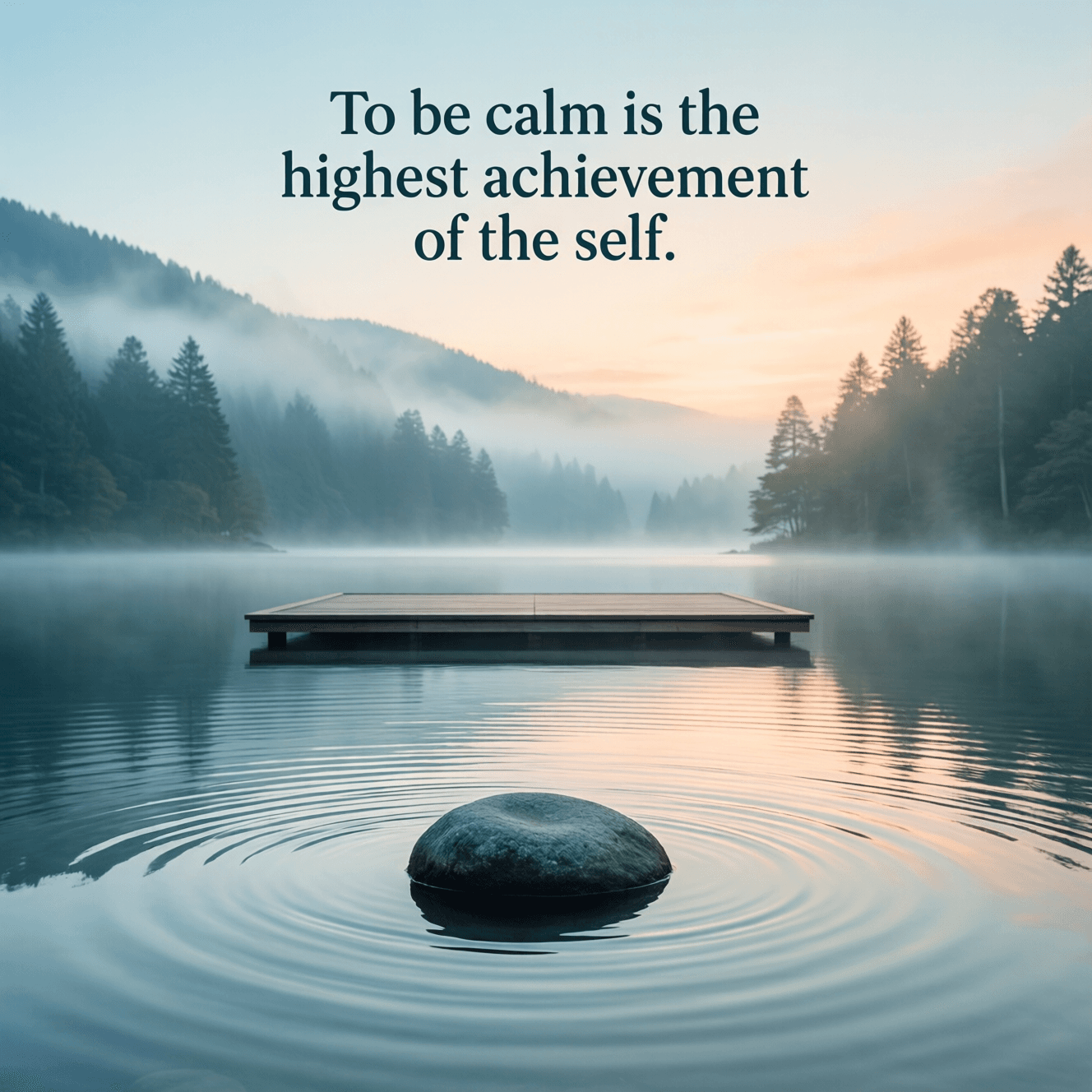
To be calm is the highest achievement of the self. — Zen Proverb
—What lingers after this line?
Calm as an Earned State
The proverb treats calm not as a personality trait but as an accomplishment—something forged rather than found. In that framing, serenity is closer to mastery than to mood: it suggests the self has been trained to meet life without being tossed around by every provocation. From the outset, this redefines “calm” as active inner work. Instead of meaning passivity or indifference, it points to a steadiness that has been tested by restlessness, fear, and desire and refined through repeated return to balance.
Zen’s Discipline of Returning
Building on that idea, Zen practice emphasizes returning—again and again—to direct experience, often through zazen (seated meditation). Calm, in this sense, is not the absence of thoughts but the ability to notice them without being captured by them, a theme echoed in Dōgen’s writings in *Shōbōgenzō* (13th century), where practice is portrayed as continuous realization. Because the mind naturally wanders, the achievement lies in repetition: each return to breath, posture, or simple awareness becomes a small act of freedom, gradually making calm less fragile and more dependable.
The Self That Doesn’t Need to Win
As the proverb centers “the self,” it implies that agitation often comes from self-protection: the urge to be right, to be seen, to control outcomes, or to secure certainty. Calm becomes the signal that the ego’s reflexes have loosened, allowing a person to respond instead of react. In everyday terms, it’s the difference between snapping back in a tense meeting and pausing long enough to choose a wiser sentence. That pause can look small, yet it marks a profound shift: the self no longer needs immediate victory to feel safe.
Clarity Without Withdrawal
Moving from inner discipline to outward life, Zen calm is not an escape from difficulty but a clearer way of meeting it. The mind that is calm can perceive more accurately—what matters, what is temporary, what is truly being asked—so action becomes cleaner rather than merely quieter. This is why calm can coexist with urgency: a doctor in an emergency room, a parent guiding a frightened child, or a mediator in conflict may act quickly while staying internally steady. The achievement is composure that keeps compassion and intelligence online under pressure.
Calm as Ethical Strength
Finally, the proverb hints that calm has moral weight. When the self is calm, it is less likely to harm others through impulsive speech, panic-driven decisions, or displaced anger. In Buddhist ethical thought, this aligns with the practical aim of reducing suffering, where mental training supports wise conduct rather than serving as a private comfort. Seen this way, calm is not self-centered tranquility but a form of reliability. It is the achievement of becoming someone whose presence steadies a room—because the self has learned to rest, even while life continues to move.
One-minute reflection
What does this quote ask you to notice today?
Related Quotes
6 selectedTo be calm is the highest achievement of the self. — Zen Proverb
Zen Proverb
The quote emphasizes that attaining calmness within oneself is the most significant personal accomplishment.
Read full interpretation →To be calm is the highest achievement of the self. — Zen Proverb
Zen Proverb
This proverb emphasizes that attaining inner calm is the ultimate accomplishment a person can achieve.
Read full interpretation →Just for today, I will not worry. — Zen Proverb
Zen Proverb
This proverb encourages mindfulness by focusing on the present moment rather than worrying about the past or future. By letting go of worries, one can experience greater peace and clarity.
Read full interpretation →Before complaining that you are a slave to another, be sure that you are not a slave to self. — James Allen
James Allen
James Allen’s warning begins with a reversal: the most immediate master may not be another person, institution, or circumstance, but one’s own impulses. Before condemning external control, he asks us to examine whether a...
Read full interpretation →Breathe in calm, breathe out chaos, and anchor yourself in peace. — Lori Deschene
Lori Deschene
Lori Deschene’s words begin with a simple invitation: return to the breath. In moments of stress, the mind often rushes ahead, but breathing offers an immediate way back to the present.
Read full interpretation →Stop shrinking yourself to make others comfortable. Your peace is worth more than their approval. — Nedra Glover Tawwab
Nedra Glover Tawwab
Nedra Glover Tawwab’s words begin with a quiet but powerful warning: when we constantly make ourselves smaller to keep others comfortable, we often pay with our confidence, honesty, and emotional well-being. This kind of...
Read full interpretation →More From Author
More from Zen Proverb →To know and not to do is not yet to know. Your collection of insights is worthless without execution. — Zen Proverb
The proverb challenges the comforting idea that understanding is primarily mental. In this view, “to know” is not merely to recognize a principle, repeat it, or even agree with it; knowledge becomes real only when it sha...
Read full interpretation →When you reach the top, keep climbing. — Zen Proverb
This proverb suggests that success is not a final destination. Even when you reach your goals, there is always room for further growth and improvement.
Read full interpretation →It is not the distance that matters, but the direction. — Zen Proverb
This proverb emphasizes the importance of focusing on the path or goal rather than how far one has to go. It's the alignment with the right direction or purpose that truly counts, not how much ground has been covered so...
Read full interpretation →Just for today, I will not worry. — Zen Proverb
This proverb encourages mindfulness by focusing on the present moment rather than worrying about the past or future. By letting go of worries, one can experience greater peace and clarity.
Read full interpretation →