
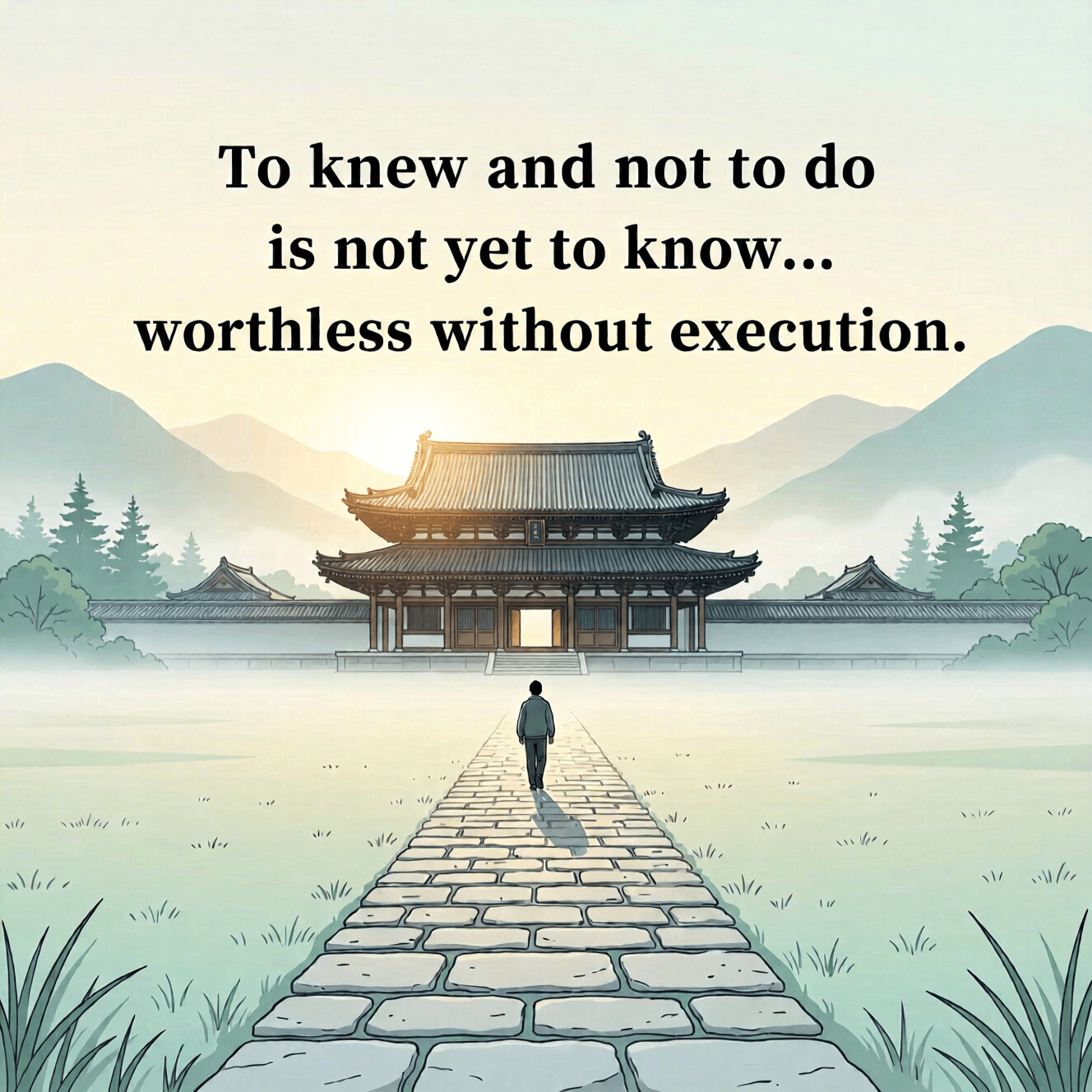
To know and not to do is not yet to know. Your collection of insights is worthless without execution. — Zen Proverb
—What lingers after this line?
Knowing as a Lived Reality
The proverb challenges the comforting idea that understanding is primarily mental. In this view, “to know” is not merely to recognize a principle, repeat it, or even agree with it; knowledge becomes real only when it shapes behavior. The line “to know and not to do is not yet to know” reframes knowledge as something verified by lived outcomes rather than stored concepts. From there, the second sentence sharpens the point: insights collected like trophies may feel valuable, but without execution they remain inert. The proverb therefore treats action as the final test that separates genuine comprehension from intellectual rehearsal.
Zen’s Suspicion of Mere Concepts
This attitude aligns with Zen’s recurring suspicion that conceptual thinking can become a substitute for direct experience. Zen literature often critiques attachment to words and theories because they can create the illusion of mastery while leaving one’s habits untouched; Dōgen’s *Shōbōgenzō* (13th century) repeatedly emphasizes practice-realization as inseparable, not sequential. Seen in that light, the proverb is not anti-knowledge but anti-pretend-knowledge. It suggests that insight is meant to be digested through practice—like meditation, ethical conduct, or mindful work—so that it becomes embodied rather than merely discussed.
Execution as the Proof of Understanding
Once action becomes the criterion, execution stops being a secondary step and becomes the evidence that learning has taken root. Anyone can say they understand patience, for instance, but the test arrives when plans collapse, tempers rise, and one still responds with steadiness. In that moment, behavior reveals whether the idea has been integrated. This is why the proverb calls a “collection of insights” worthless without execution: it exposes a gap between aspiration and habit. Bridging that gap is not about dramatic gestures but about repeated, concrete choices that make the insight observable in daily life.
Why We Hoard Insights Instead of Acting
The saying also hints at a common trap: collecting insight can feel productive while keeping us safe from the vulnerability of trying. Reading, planning, and optimizing provide the emotional reward of progress without the risks of failure, criticism, or discomfort. As a result, “knowing” becomes a shield—an identity—rather than a catalyst. Moving from insight to execution often requires tolerating imperfect starts. The proverb’s bluntness cuts through the preference for certainty, implying that partial action teaches more than complete theorizing, because action generates feedback that thought alone cannot supply.
From Insight to Practice: A Simple Path
To honor the proverb, the question becomes practical: what is the smallest action that expresses the insight today? If the insight is about health, it might be a ten-minute walk; if it’s about honesty, it might be one difficult conversation; if it’s about focus, it might be a single uninterrupted work block. By translating ideas into modest, repeatable behaviors, knowledge becomes measurable. Over time, this turns execution into a form of study. Each attempt refines understanding, and each repetition deepens it, until the insight no longer lives in the mind as a statement but in the body as a default response.
Wisdom as Habit, Not Possession
Ultimately, the proverb redefines wisdom as something enacted rather than owned. The goal is not to amass better conclusions but to become the kind of person whose actions reliably express what they claim to value. In that sense, execution is not merely productivity; it is integrity—the alignment of insight with conduct. By ending with a harsh valuation—“worthless without execution”—the saying offers a clarifying standard: ideas are only as precious as the life they shape. What remains after that standard is not a collection, but a practice, and practice is where knowledge finally becomes real.
One-minute reflection
What feeling does this quote bring up for you?
Related Quotes
6 selectedKnowing is not enough; we must apply. Willing is not enough; we must do. — Johann Wolfgang von Goethe
Johann Wolfgang von Goethe
This quote highlights the importance of putting knowledge into action. Merely understanding or knowing something is insufficient if it is not applied in practical ways to make a difference.
Read full interpretation →Vision without action is a daydream. Action without vision is a nightmare. — Japanese Proverb
Japanese Proverb
The proverb highlights the necessity of balancing vision and action. Neither should exist without the other if one wishes to achieve meaningful results.
Read full interpretation →Knowledge is of no value unless you put it into practice. — Anton Chekhov
Anton Chekhov
This quote highlights that knowledge alone is useless unless it is applied in real-life situations. Practical implementation is what gives knowledge its true value.
Read full interpretation →Success is not in the possession of knowledge; it is in the application of that knowledge. — Unknown (widely attributed to various authors)
Unknown (widely attributed to various authors
This quote highlights the distinction between merely possessing knowledge and effectively applying it. While acquiring knowledge is critical, success comes from putting that knowledge into action.
Read full interpretation →A little knowledge that acts is worth infinitely more than much knowledge that is idle. — Khalil Gibran
Kahlil Gibran
Khalil Gibran’s quote draws our attention to a striking truth: it is not the sheer quantity of knowledge one possesses that matters, but rather the application of even small insights. This perspective shifts the focus fr...
Read full interpretation →Knowledge without application is simply knowledge. Applying the knowledge to one’s life is wisdom. — Karen A. Baquiran
Karen A. Baquiran
At its core, Karen A. Baquiran’s statement separates the accumulation of knowledge from its practical use.
Read full interpretation →More From Author
More from Zen Proverb →To be calm is the highest achievement of the self. — Zen Proverb
The proverb treats calm not as a personality trait but as an accomplishment—something forged rather than found. In that framing, serenity is closer to mastery than to mood: it suggests the self has been trained to meet l...
Read full interpretation →When you reach the top, keep climbing. — Zen Proverb
This proverb suggests that success is not a final destination. Even when you reach your goals, there is always room for further growth and improvement.
Read full interpretation →It is not the distance that matters, but the direction. — Zen Proverb
This proverb emphasizes the importance of focusing on the path or goal rather than how far one has to go. It's the alignment with the right direction or purpose that truly counts, not how much ground has been covered so...
Read full interpretation →Just for today, I will not worry. — Zen Proverb
This proverb encourages mindfulness by focusing on the present moment rather than worrying about the past or future. By letting go of worries, one can experience greater peace and clarity.
Read full interpretation →