
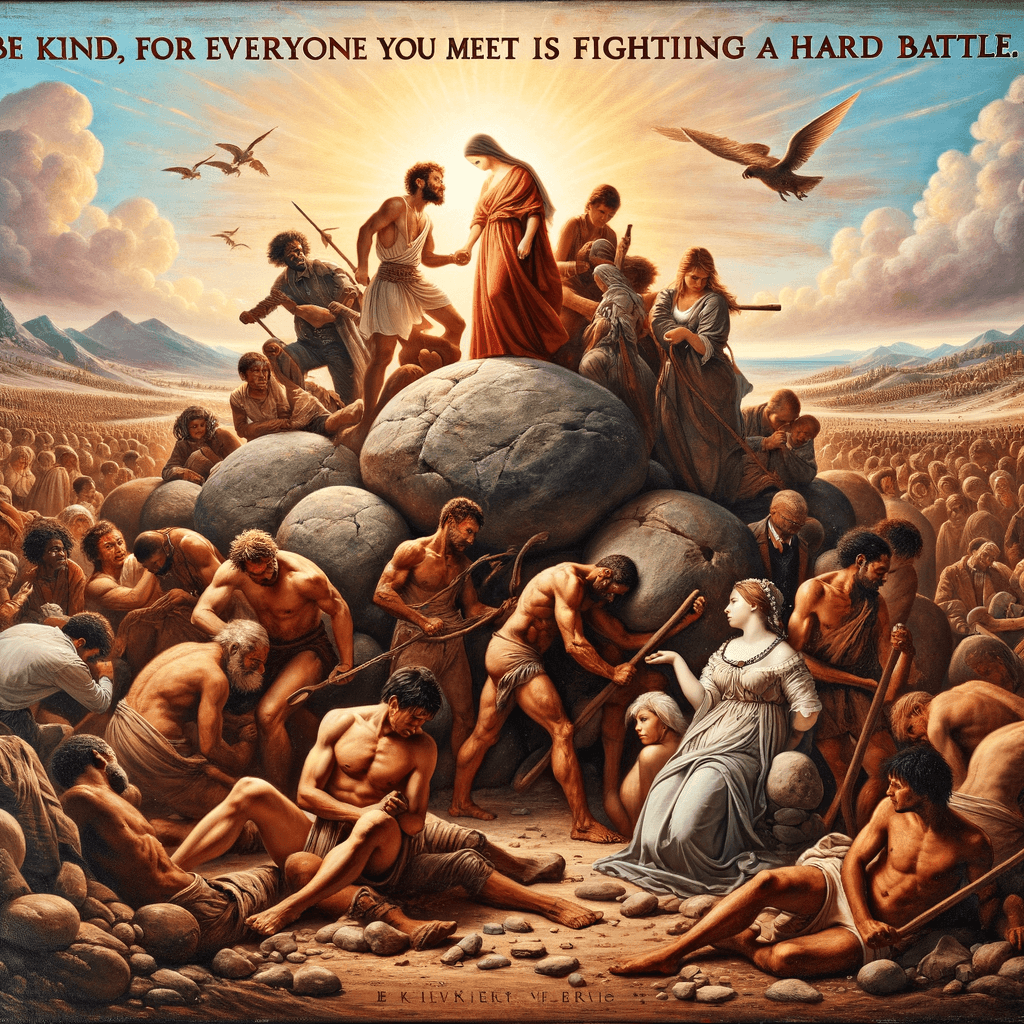
Be kind, for everyone you meet is fighting a hard battle. — Ian Maclaren
—What lingers after this line?
Empathy and Understanding
This quote highlights the importance of empathy, encouraging individuals to understand that everyone has their struggles, which may not be visible at first glance.
The Human Condition
It reflects a universal truth about the human experience; everyone faces challenges, making kindness an essential response to our shared struggles.
Spreading Positivity
By advocating for kindness, the quote suggests that small acts of compassion can significantly impact others who may be enduring tough times.
Breaking Down Barriers
This perspective encourages breaking down social barriers and preconceived notions, fostering a more connected and understanding community.
Legacy of Ian Maclaren
Ian Maclaren was a Scottish author known for his contributions to literature and theology. His writings often reflect insights into human character and the moral virtues of kindness and compassion.
One-minute reflection
Where does this idea show up in your life right now?
Related Quotes
6 selectedBe kinder than necessary, for everyone you meet is fighting some kind of battle. — J. M. Barrie
J.M. Barrie
J. M.
Read full interpretation →In a world where you can be anything, be kind.
Unknown
The message highlights the vast array of possibilities available in today's world. With numerous paths and opportunities, kindness is suggested as a fundamental and powerful choice.
Read full interpretation →You must love in such a way that the person you love feels free. — Thich Nhat Hanh
Thich Nhat Hanh
At its core, Thich Nhat Hanh’s statement redefines love as an act of care that does not confine. To love someone so that they feel free means offering affection without turning it into control, guilt, or dependence.
Read full interpretation →The sort of fearless openness required to turn toward our suffering is only possible within the spacious receptivity of love. — Frank Ostaseski
Frank Ostaseski
Frank Ostaseski’s statement begins with a striking claim: real courage is not simply toughness or willpower. Instead, the bravery required to face suffering honestly arises from love’s presence.
Read full interpretation →Healing is an art. It takes time, it takes practice, it takes love. — Maza Dohta
Maza Dohta
Maza Dohta’s quote begins by reframing healing as an art rather than a mechanical repair. That distinction matters, because art is rarely instant: it involves sensitivity, patience, revision, and care.
Read full interpretation →The only way to exist in a world that feels increasingly cold is to be the warmth you wish to receive from others. — Maya Angelou
Maya Angelou
At its core, Maya Angelou’s line reframes loneliness as a call to action rather than a verdict on the world. If life feels impersonal, distant, or harsh, she suggests that waiting passively for kindness may only deepen t...
Read full interpretation →More From Author
More from Ian Maclaren →