
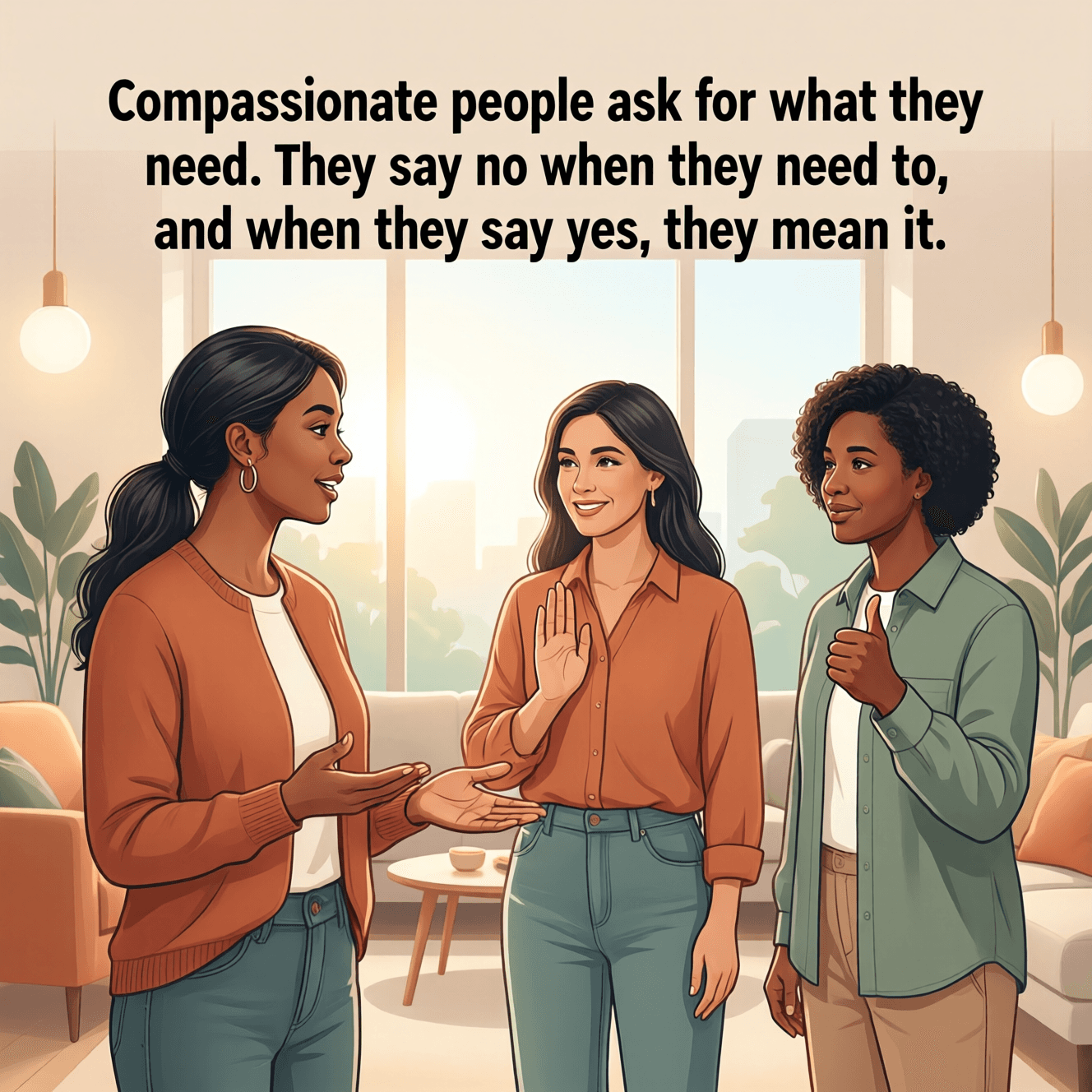
Compassionate people ask for what they need. They say no when they need to, and when they say yes, they mean it. — Brené Brown
—What lingers after this line?
Redefining Compassion Beyond Niceness
Brené Brown’s line challenges the common belief that compassion is synonymous with being endlessly agreeable. Instead, she frames compassion as a practice rooted in honesty—toward ourselves and others—where care is expressed through clarity rather than compliance. In this view, saying “yes” to everyone isn’t kindness; it can be a quiet form of self-abandonment. From there, compassion becomes more demanding: it asks for self-awareness about our limits and the courage to be truthful even when it risks disappointing someone. The warmth of compassion remains, but it’s paired with an insistence on reality, which is often what relationships need most.
Asking for What You Need as Self-Respect
The first marker Brown names—asking for what you need—treats needs as legitimate rather than shameful. Many people learn to hint, overfunction, or hope others will guess, but that often breeds resentment. By contrast, direct requests give others a fair chance to show up, and they reduce the emotional confusion that comes from unspoken expectations. This also reframes vulnerability as an act of integrity. Brown’s broader work, such as *Daring Greatly* (2012), argues that naming needs is part of wholehearted living: you risk being seen, yet you also create conditions for support that is real rather than imagined.
The Compassionate Power of “No”
Next, Brown links compassion to the ability to say no. A well-placed “no” isn’t rejection of the other person’s worth; it is a protection of time, energy, and values. Without that protection, “helping” can become performative or obligatory, and the relationship quietly accumulates strain. Moreover, a clear refusal can be kinder than a reluctant yes. It prevents halfhearted commitments and reduces the likelihood of future withdrawal or bitterness. In this sense, “no” becomes a boundary that keeps generosity sustainable, rather than a wall that shuts people out.
When “Yes” Becomes a Commitment
Brown’s final clause—when they say yes, they mean it—ties compassion to reliability. A meaningful yes implies consent, capacity, and intention; it’s not a reflexive attempt to avoid conflict or to be perceived as good. Because the yes is chosen rather than coerced, it carries trustworthiness. That trustworthiness matters socially: people feel safer with someone whose words match their actions. Over time, consistent yeses and honest nos create a dependable emotional environment, where others don’t have to decode mixed signals or manage hidden resentment.
Boundaries as a Form of Care
Taken together, the quote suggests that boundaries are not the opposite of compassion but one of its vehicles. Boundaries communicate what is possible and what is not, which helps relationships operate in the realm of reality rather than fantasy. In practice, they also reduce the quiet manipulation that can appear when someone agrees outwardly but punishes inwardly. This aligns with a broader ethical tradition that ties care to truthfulness. For instance, Aristotle’s *Nicomachean Ethics* (4th century BC) treats virtue as a mean guided by practical wisdom—implying that good intention must be matched with appropriate action, not excess that collapses into harm.
A Practical Way to Live the Quote
The quote ultimately reads like a behavioral checklist for compassionate integrity: state needs plainly, decline what you cannot do, and accept only what you can follow through on. A small anecdote captures it: a friend asked to help someone move might say, “I can’t do Saturday, but I can bring dinner that night,” turning an honest no into a realistic yes. With that shift, compassion stops being a vague sentiment and becomes a set of choices that preserve dignity on both sides. The relationship benefits because expectations are explicit, promises are kept, and care is expressed without self-erasure.
One-minute reflection
What's one small action this suggests?
Related Quotes
6 selectedI set boundaries not to offend, but to honor my needs. — Brené Brown
Brené Brown
At first glance, boundaries are often mistaken for rejection, yet Brené Brown’s quote gently overturns that assumption. By saying she sets boundaries not to offend but to honor her needs, she reframes limits as an act of...
Read full interpretation →Our boundaries define our personal space — and we need to be sovereign there in order to be able to step into our full power and potential. — Brené Brown
Brené Brown
Brené Brown’s insight begins with a simple but profound claim: boundaries are not walls meant to isolate us, but lines that clarify where our responsibility begins and ends. To be sovereign in our personal space means to...
Read full interpretation →Lasting change requires compassion alongside courage, not punishment disguised as self-improvement. — Brené Brown
Brené Brown
Brené Brown’s line challenges the common belief that harshness is the fastest route to transformation. Instead, she argues that durable change is built from two forces working together: the courage to face what must shif...
Read full interpretation →You can't pour from an empty cup. Take care of yourself first. — Arianna Huffington
Arianna Huffington
At its heart, Arianna Huffington’s line turns self-care into an image anyone can understand: a cup cannot nourish others if it has nothing left to give. The metaphor is gentle, but its message is firm.
Read full interpretation →Saying no is an act of integrity. It aligns what you do with what you believe. — Annie Wright
Annie Wright
Annie Wright’s statement reframes the word “no” not as rejection, but as moral clarity. At its core, saying no is a way of protecting the space between one’s values and one’s actions.
Read full interpretation →The most loving thing I ever did was say no to things that were killing me slowly. — Prentis Hemphill
Prentis Hemphill
At first glance, Hemphill’s line sounds simple, yet it redefines love as an act of protection rather than mere tenderness. Saying no becomes the deepest form of care when a person recognizes that certain habits, relation...
Read full interpretation →More From Author
More from Brené Brown →Our boundaries define our personal space — and we need to be sovereign there in order to be able to step into our full power and potential. — Brené Brown
Brené Brown’s insight begins with a simple but profound claim: boundaries are not walls meant to isolate us, but lines that clarify where our responsibility begins and ends. To be sovereign in our personal space means to...
Read full interpretation →Perfectionism is a twenty-ton shield we lug around thinking it will protect us, when in fact, it's the thing that's really preventing us from taking flight. — Brené Brown
Brené Brown’s metaphor turns perfectionism into something heavy, defensive, and exhausting: a twenty-ton shield. At first, that shield seems useful because it promises protection from criticism, failure, and shame.
Read full interpretation →We cannot be more connected to others than we are to ourselves. — Brené Brown
Brené Brown’s statement begins with a simple but demanding truth: our relationships with others are limited by the relationship we have with ourselves. If we are estranged from our own feelings, needs, and fears, then ou...
Read full interpretation →It is not about what can I accomplish? but what do I want to accomplish? — Brené Brown
Brené Brown’s line redirects attention from external capacity to internal intention. At first glance, asking “What can I accomplish?” seems practical and ambitious; however, it often keeps a person trapped within expecta...
Read full interpretation →