
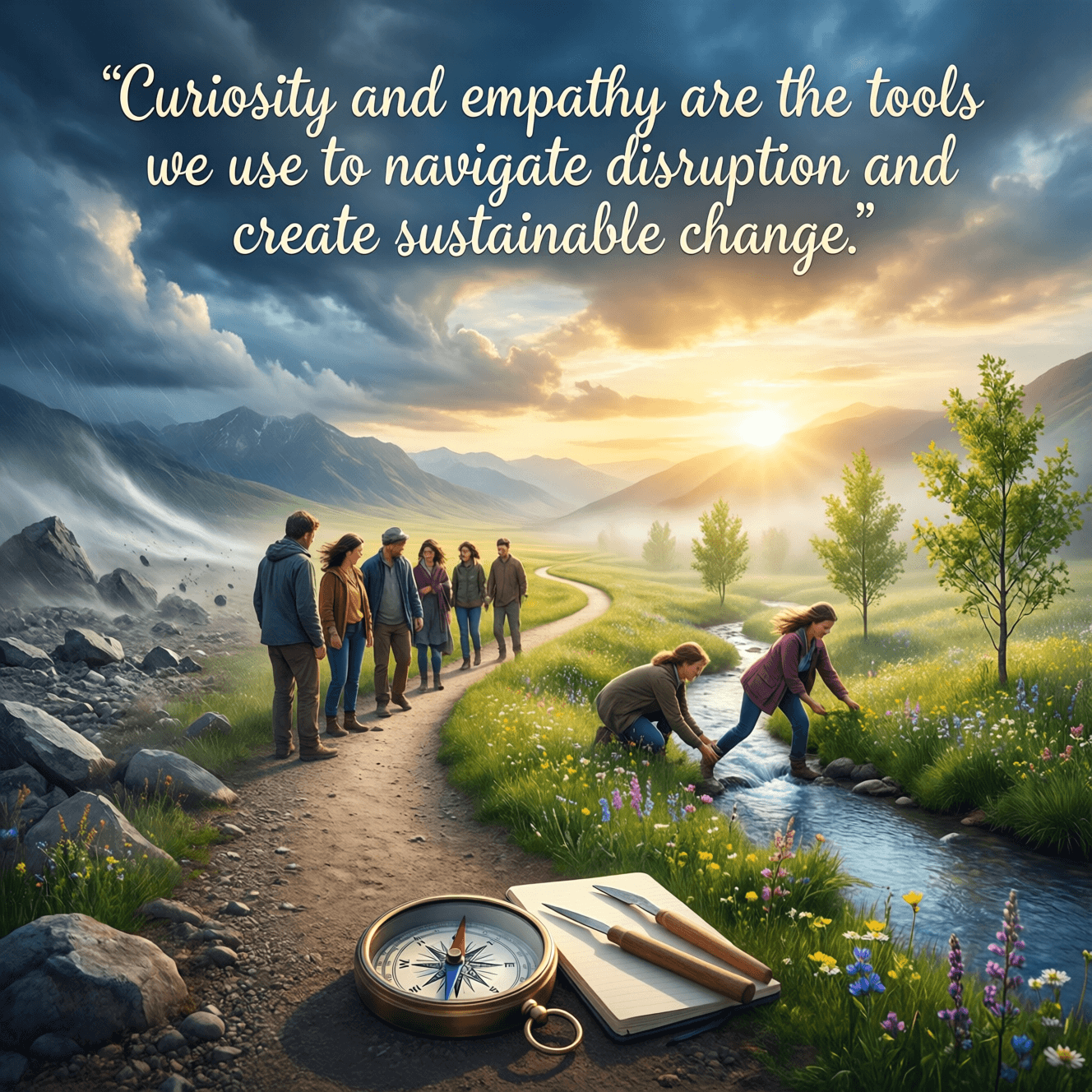
Curiosity and empathy are the tools we use to navigate disruption and create sustainable change. — Wendi S. Williams
—What lingers after this line?
Disruption as a Human Experience
Wendi S. Williams frames disruption not merely as a market event or a technological shift, but as something people must actively move through. When routines break—whether through reorgs, crises, or cultural change—uncertainty spreads quickly, and the first challenge becomes sense-making rather than strategy. From there, her quote implies that the most reliable way to regain footing is not rigid certainty but adaptable perception. Disruption demands tools that help us interpret what’s changing, how it affects different people, and what choices remain possible without defaulting to panic or denial.
Curiosity as a Wayfinding Practice
Curiosity functions as the navigational instrument in the quote: it turns confusion into inquiry. Instead of asking, “How do we restore what we had?” curiosity asks, “What is happening, what’s driving it, and what might be true that we haven’t seen yet?” That posture widens options and reduces the blind spots that often lead to brittle decisions. Moreover, curiosity is practical, not abstract. In organizations, it shows up as leaders who ask frontline teams what customers are actually saying, or who run small experiments before committing to a sweeping transformation—an approach aligned with iterative learning in modern change methods such as Eric Ries’ *The Lean Startup* (2011).
Empathy as the Stabilizing Counterweight
Yet curiosity alone can become detached—treating disruption like an intellectual puzzle while people carry the emotional cost. Empathy supplies the second tool: it keeps change grounded in lived experience. By trying to understand fear, fatigue, or loss of status, we reduce the likelihood that change is designed for efficiency while producing quiet harm. This shift is especially important because disruption often redistributes burdens unevenly. Empathy helps decision-makers notice who is absorbing risk, whose workload is expanding, and whose identity is threatened by new expectations—making it more likely that change will be accepted as legitimate rather than imposed.
Why Sustainable Change Requires Both
The quote’s pairing suggests a system: curiosity discovers what needs to change, while empathy shapes how change should happen. Without curiosity, organizations repeat old playbooks that no longer match reality; without empathy, they create resistance, burnout, or turnover that undermines long-term results. Consider a common transformation scenario: a company introduces automation to improve service speed. Curiosity prompts leaders to study where delays truly occur and what technology can realistically do; empathy prompts them to involve affected staff, redesign roles thoughtfully, and plan reskilling so the solution doesn’t succeed operationally while failing socially.
Turning Tools into Everyday Behaviors
To make these tools usable, they must become habits. Curiosity can be practiced through consistent questions—“What evidence supports this?” “What are we assuming?”—and through structured listening, such as retrospectives that surface weak signals early. Empathy, in turn, becomes tangible through stakeholder mapping, user interviews, and feedback loops that continue after the rollout, not just before it. As a result, disruption becomes less of a derailment and more of a learning cycle. When people feel seen and leaders keep asking better questions, change gains durability: it adapts over time, maintains trust, and stays connected to the realities it aims to improve.
One-minute reflection
What does this quote ask you to notice today?
Related Quotes
6 selectedThe only way to exist in a world that feels increasingly cold is to be the warmth you wish to receive from others. — Maya Angelou
Maya Angelou
At its core, Maya Angelou’s line reframes loneliness as a call to action rather than a verdict on the world. If life feels impersonal, distant, or harsh, she suggests that waiting passively for kindness may only deepen t...
Read full interpretation →Art and love are the same thing: it's the process of seeing yourself in things that are not you. — Chuck Klosterman
Chuck Klosterman
At first glance, Chuck Klosterman’s line collapses two vast experiences into one elegant idea: both art and love involve recognizing ourselves in something outside us. In this sense, a painting, a song, or another person...
Read full interpretation →Don't be intimidated by what you don't know. That can be your greatest strength. — Sara Blakely
Sara Blakely
At first glance, Sara Blakely’s quote sounds like a simple encouragement, yet it points to a deeper truth: ignorance is not always a weakness. When people are not trapped by assumptions about how things are “supposed” to...
Read full interpretation →Be a loner. That gives you time to wonder, to search for the truth. Have holy curiosity. Make your life worth living. — Albert Einstein
Albert Einstein
At first glance, Einstein’s advice to “be a loner” may sound like a rejection of society, yet his deeper point is about protecting the inner space where thought can mature. Solitude gives a person room to hear their own...
Read full interpretation →With each person you meet, remind yourself that you share a common humanity. — Epictetus
Epictetus
At its core, Epictetus’s advice asks for a disciplined shift in perception. Rather than meeting others as rivals, strangers, or obstacles, we are urged to begin with a deeper truth: each person participates in the same f...
Read full interpretation →Sometimes, you have to find new angles on life to keep you interested. — John Travolta
John Travolta
John Travolta’s remark begins with a simple but revealing truth: interest in life is not always automatic; sometimes it must be actively rekindled. By suggesting that we ‘find new angles,’ he implies that boredom often c...
Read full interpretation →More From Author
More from Wendi S. Williams →