
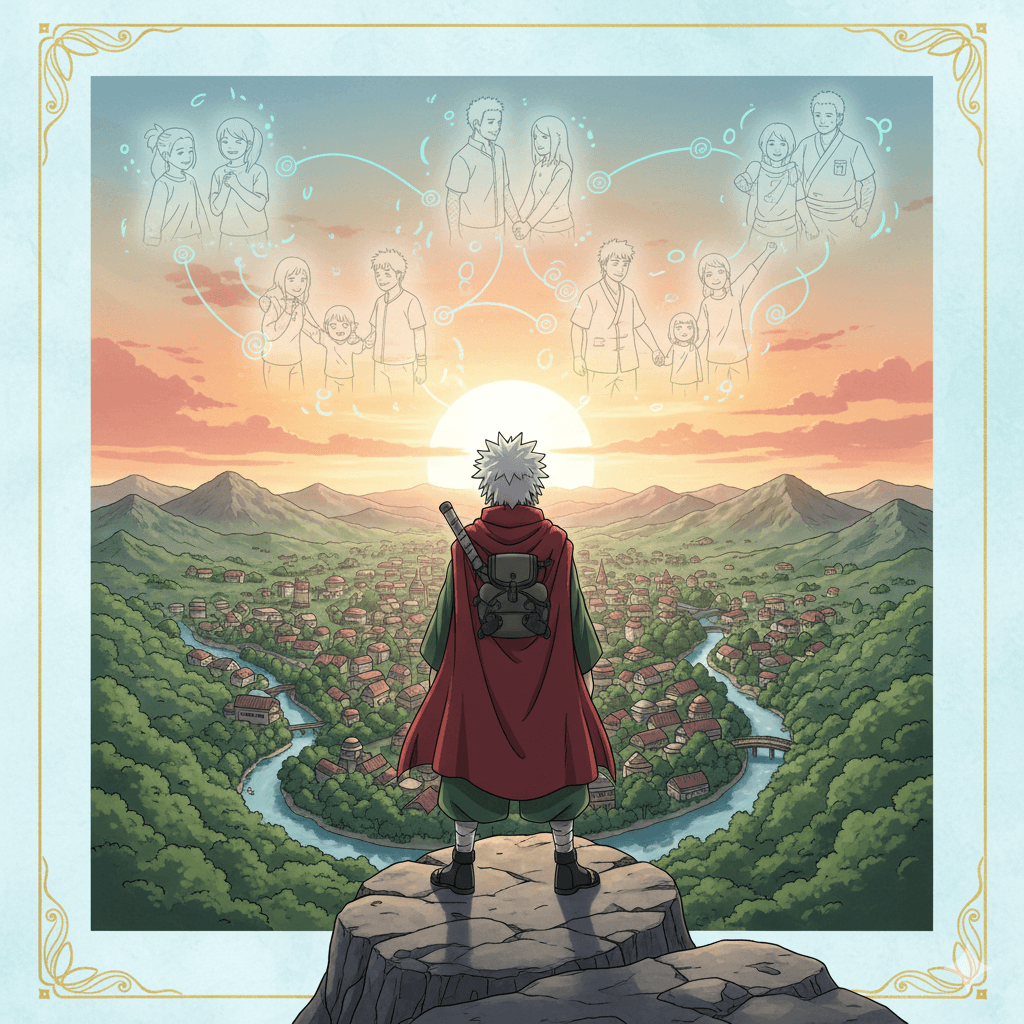
I believe the day will come when people can truly understand each other. — Jiraiya, The Teacher of Naruto
—What lingers after this line?
Jiraiya’s Hope in a Harsh World
Jiraiya voices his belief amid a cycle of vengeance that defines the shinobi world. Rather than resigning himself to fatalism, he frames understanding as a destination worth striving for, even if he may never arrive. Naruto Shippuden’s “The Tale of Jiraiya the Gallant” (ep. 133) portrays this conviction not as naïveté but as defiant courage: a teacher who insists that empathy can interrupt inherited hatred. His dream becomes a moral north star, inviting students and enemies alike to imagine a different ending to the same old story.
Passing the Torch to Naruto
From this starting point, Jiraiya’s belief takes root in Naruto, who translates hope into action. Confrontations that might have ended in annihilation become conversations that alter destinies: Naruto reaches Gaara not with superiority but with shared pain, and later faces Nagato with restraint rather than revenge. In the Naruto manga by Masashi Kishimoto (1999–2014), the post-battle dialogue with Nagato—after the devastation of Konoha—shows how recognizing another’s grief can reopen the future. Thus the pupil operationalizes the teacher’s thesis: understanding is a technique, not only a sentiment.
Dialogue as Jutsu: From Words to Worlds
Proceeding from story to theory, Jiraiya’s ideal aligns with Jürgen Habermas’s communicative action (1981), which holds that mutual understanding emerges when participants seek truthfulness over domination. Likewise, Hans-Georg Gadamer’s “fusion of horizons” in Truth and Method (1960) suggests that dialogue can enlarge what each side is able to see. Fandom’s nickname—“Talk-no-Jutsu”—captures this insight humorously: persuasion is not spellcraft but disciplined listening that reframes conflict. In this light, Naruto’s conversations are not detours from action; they are the action.
Empathy’s Evidence: What Research Suggests
Moreover, social science lends weight to Jiraiya’s hope. Gordon Allport’s contact hypothesis (1954) found that structured contact across groups, under equal status and shared goals, reduces prejudice. C. Daniel Batson’s empathy–altruism research (1991) shows that perspective-taking can motivate real helping behavior. Training studies—such as Tania Singer’s compassion programs (2012)—suggest empathy is plastic, not fixed. Even practical frameworks like Marshall Rosenberg’s Nonviolent Communication (2003) demonstrate how naming feelings and needs de-escalates conflict. Taken together, these findings indicate that understanding is not mystical; it is teachable.
History’s Glimpses of Mutual Recognition
History, too, offers brief windows when adversaries chose recognition over rage. The Christmas Truce of 1914—soldiers sharing carols across trenches—proved that even in war, common humanity can surface. More enduringly, South Africa’s Truth and Reconciliation Commission (1996), led by Desmond Tutu, used testimony and conditional amnesty to prioritize truth-telling and acknowledgment over pure retribution. Though imperfect, such experiments echo Jiraiya’s wager: understanding may not erase harm, but it can redirect the future.
The Cost and Courage of Belief
Finally, the narrative reminds us that belief incurs risk. Jiraiya dies fighting Pain, yet he spends his last strength to pass on a coded message—an act of faith that someone else can finish the conversation he began (Naruto Shippuden ep. 133). In doing so, he reframes hope as a duty across generations. Thus his line becomes less a prediction than a project: if people can learn to hear one another, then the day he imagined approaches with every hard, honest dialogue we choose.
One-minute reflection
Why might this line matter today, not tomorrow?
Related Quotes
6 selectedA place where someone still thinks about you is a place you can call home. — Jiraiya, The Teacher of Naruto
Jiraiya, The Teacher of Naruto
Jiraiya’s line reframes home from a physical shelter to a relational climate: the place where someone still carries you in their thoughts. Rather than bricks and boundaries, it is attention—steadfast, returning, and warm...
Read full interpretation →Failure is not the end. It’s just a stepping stone to success. — Jiraiya, The Teacher of Naruto
Jiraiya, The Teacher of Naruto
Jiraiya’s maxim invites a shift from finality to process: failure is not a verdict but information. Instead of signaling an ending, each misstep uncovers where skill, strategy, or understanding must evolve.
Read full interpretation →The only way to exist in a world that feels increasingly cold is to be the warmth you wish to receive from others. — Maya Angelou
Maya Angelou
At its core, Maya Angelou’s line reframes loneliness as a call to action rather than a verdict on the world. If life feels impersonal, distant, or harsh, she suggests that waiting passively for kindness may only deepen t...
Read full interpretation →Art and love are the same thing: it's the process of seeing yourself in things that are not you. — Chuck Klosterman
Chuck Klosterman
At first glance, Chuck Klosterman’s line collapses two vast experiences into one elegant idea: both art and love involve recognizing ourselves in something outside us. In this sense, a painting, a song, or another person...
Read full interpretation →With each person you meet, remind yourself that you share a common humanity. — Epictetus
Epictetus
At its core, Epictetus’s advice asks for a disciplined shift in perception. Rather than meeting others as rivals, strangers, or obstacles, we are urged to begin with a deeper truth: each person participates in the same f...
Read full interpretation →The older I get, the more convinced I am that the space between people who are trying their best to understand each other is hallowed ground. — Fred Rogers
Fred Rogers
Fred Rogers frames understanding not as a finished achievement but as a shared attempt, and that distinction matters. By calling the space between people “hallowed ground,” he suggests that dignity arises whenever two in...
Read full interpretation →More From Author
More from Jiraiya, The Teacher of Naruto →A place where someone still thinks about you is a place you can call home. — Jiraiya, The Teacher of Naruto
Jiraiya’s line reframes home from a physical shelter to a relational climate: the place where someone still carries you in their thoughts. Rather than bricks and boundaries, it is attention—steadfast, returning, and warm...
Read full interpretation →Failure is not the end. It’s just a stepping stone to success. — Jiraiya, The Teacher of Naruto
Jiraiya’s maxim invites a shift from finality to process: failure is not a verdict but information. Instead of signaling an ending, each misstep uncovers where skill, strategy, or understanding must evolve.
Read full interpretation →