
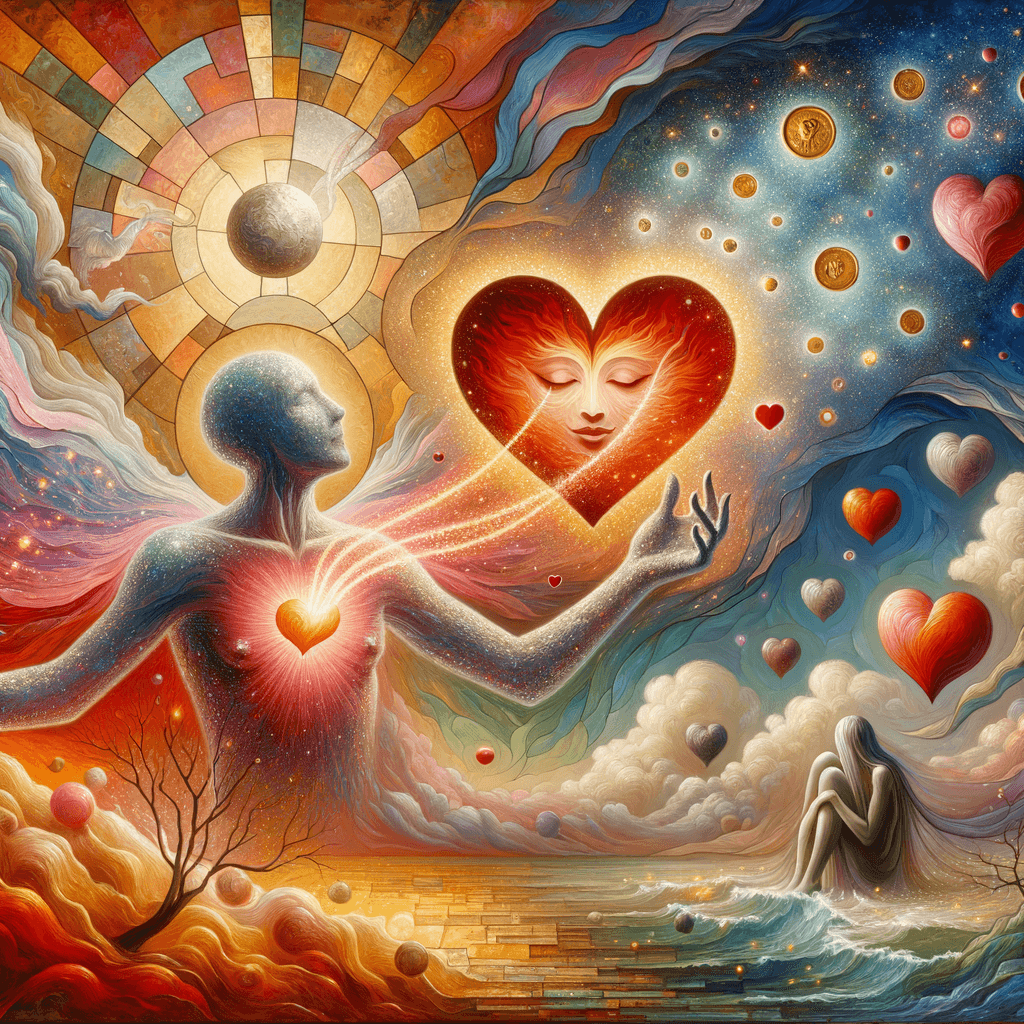
Let my soul smile through my heart and my heart smile through my eyes, that I may scatter rich smiles in sad hearts. - Paramahansa Yogananda
—What lingers after this line?
Inner Radiance
This quote highlights the concept of inner radiance. Paramahansa Yogananda suggests that the soul has a natural ability to generate joy and positivity, which radiates through the heart and is visible in one's eyes.
Emotional Expression
It emphasizes the importance of expressing positive emotions. By letting the soul’s happiness flow through the heart and eyes, one can impact others positively.
Empathy and Compassion
The quote encourages empathy and compassion. Sharing our own happiness can uplift others, especially those who are feeling down or sad.
Healing Power of Smiles
Smiling can be a powerful tool to spread joy and heal emotional wounds. Seeing someone smile can bring comfort and support to those who are experiencing sadness.
Spiritual Perspective
Coming from Paramahansa Yogananda, a spiritual teacher, the quote also implies a deeper spiritual connection. It suggests that allowing one's soul to influence others through simple acts like smiling is a form of spiritual practice.
Legacy of Paramahansa Yogananda
Paramahansa Yogananda, an Indian yogi and guru, is known for his teachings on meditation and self-realization. His teachings focused on inner peace and spreading positive energy, which is reflected in this quote.
One-minute reflection
What does this quote ask you to notice today?
Related Quotes
6 selectedYou must love in such a way that the person you love feels free. — Thich Nhat Hanh
Thich Nhat Hanh
At its core, Thich Nhat Hanh’s statement redefines love as an act of care that does not confine. To love someone so that they feel free means offering affection without turning it into control, guilt, or dependence.
Read full interpretation →The sort of fearless openness required to turn toward our suffering is only possible within the spacious receptivity of love. — Frank Ostaseski
Frank Ostaseski
Frank Ostaseski’s statement begins with a striking claim: real courage is not simply toughness or willpower. Instead, the bravery required to face suffering honestly arises from love’s presence.
Read full interpretation →Healing is an art. It takes time, it takes practice, it takes love. — Maza Dohta
Maza Dohta
Maza Dohta’s quote begins by reframing healing as an art rather than a mechanical repair. That distinction matters, because art is rarely instant: it involves sensitivity, patience, revision, and care.
Read full interpretation →The only way to exist in a world that feels increasingly cold is to be the warmth you wish to receive from others. — Maya Angelou
Maya Angelou
At its core, Maya Angelou’s line reframes loneliness as a call to action rather than a verdict on the world. If life feels impersonal, distant, or harsh, she suggests that waiting passively for kindness may only deepen t...
Read full interpretation →We are called to be strong companions and clear mirrors to one another, to seek those who reflect with compassion how we are doing. — Wayne Muller
Wayne Muller
Wayne Muller’s quote begins with a call to companionship that is more than simple friendship. To be a strong companion is to stand beside another person with steadiness, honesty, and care, especially when life becomes co...
Read full interpretation →You can't save people from themselves. You can only love them while they save themselves. — Al-Anon Philosophy
Anon Philosophy
At its core, this Al-Anon saying confronts a painful truth: no amount of devotion can force another person to change. It rejects the fantasy of rescue, reminding us that healing, sobriety, and emotional growth must ultim...
Read full interpretation →More From Author
More from Paramahansa Yogananda →The journey of spirituality is not about perfection, but about progress and evolution. — Anonymous (Replaced with: The greatest adventure is the journey of the soul, exploring the depths of our own being. — Paramahansa Yogananda)
Paramahansa Yogananda’s statement reframes adventure in a striking way: the most profound voyage does not cross oceans or continents, but moves inward through the landscape of the self. Rather than presenting spiritualit...
Read full interpretation →The season of failure is the best time for sowing the seeds of success. — Paramahansa Yogananda
Yogananda’s image of a “season of failure” invites us to treat setbacks not as isolated disasters but as part of a natural cycle. Just as winter looks barren yet prepares the soil for spring, periods of defeat strip away...
Read full interpretation →Be as simple as you can be; you will be amazed to see how uncomplicated and happy your life will become. — Paramahansa Yogananda
Paramahansa Yogananda’s words invite us to experiment with a different way of living: instead of adding more, we deliberately choose less. He suggests that simplicity is not a loss but a doorway, and that by stepping thr...
Read full interpretation →Persistence guarantees that results are inevitable. — Paramahansa Yogananda
The quote highlights the importance of maintaining consistent effort over time to achieve desired outcomes.
Read full interpretation →