
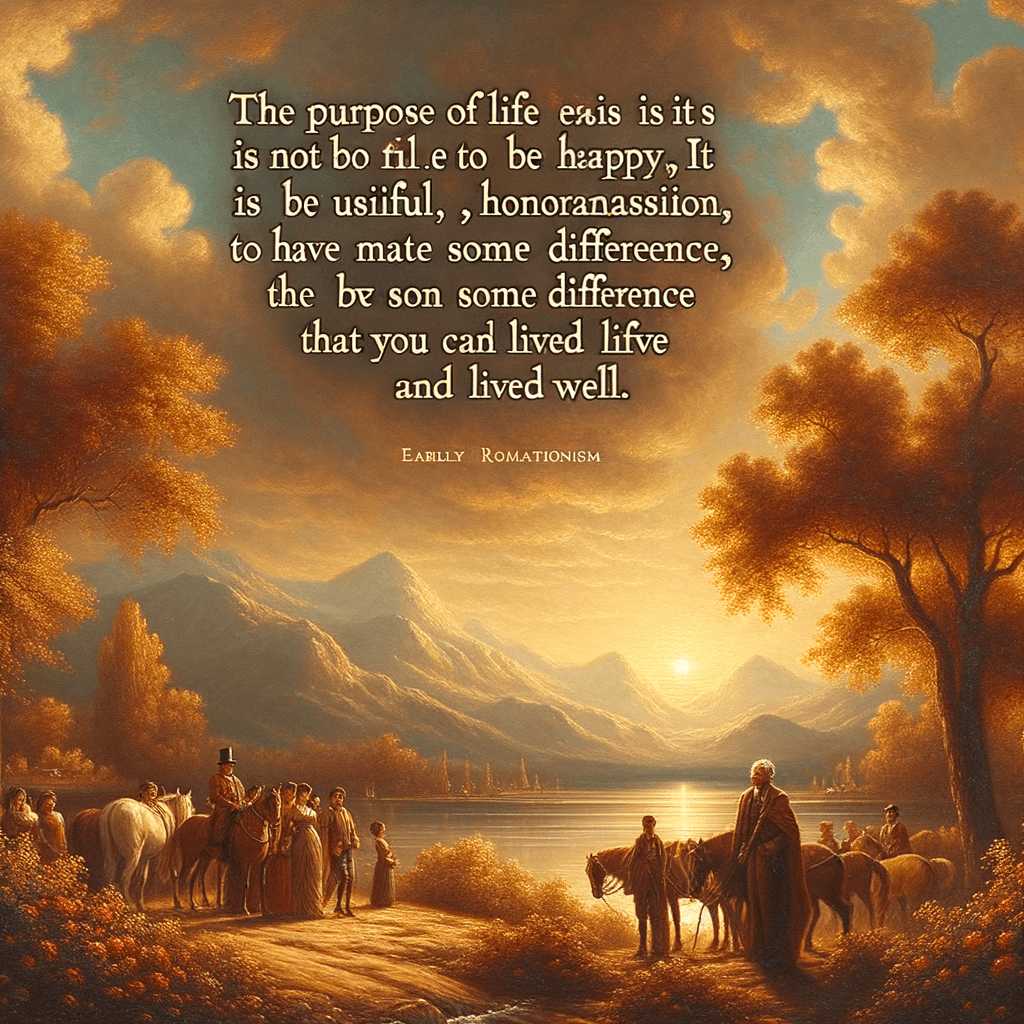
The purpose of life is not to be happy. It is to be useful, to be honorable, to be compassionate, to have it make some difference that you have lived and lived well. — Ralph Waldo Emerson
—What lingers after this line?
Utility and Contribution
This quote highlights that the ultimate goal of life is to be useful and contribute positively to the world around you. It's about creating a meaningful impact rather than just seeking personal happiness.
Honor and Integrity
Emerson emphasizes living with honor and integrity. Leading an honorable life involves being true to one's values and principles, and acting in a way that earns respect and credibility.
Compassion and Empathy
Being compassionate means understanding and helping others. Emerson suggests that part of a fulfilling life is showing kindness and empathy toward fellow human beings.
Making a Difference
The quote stresses leaving a positive mark on the world. Emerson believes that a well-lived life is one where your actions and presence have made a significant, beneficial difference.
Philosophical Insight
Ralph Waldo Emerson, a 19th-century American philosopher and essayist, often explored themes related to individual purpose and the human condition. This quote reflects his transcendentalist beliefs in the importance of making a meaningful impact beyond personal gratifications.
One-minute reflection
What feeling does this quote bring up for you?
Related Quotes
6 selectedYou must love in such a way that the person you love feels free. — Thich Nhat Hanh
Thich Nhat Hanh
At its core, Thich Nhat Hanh’s statement redefines love as an act of care that does not confine. To love someone so that they feel free means offering affection without turning it into control, guilt, or dependence.
Read full interpretation →The sort of fearless openness required to turn toward our suffering is only possible within the spacious receptivity of love. — Frank Ostaseski
Frank Ostaseski
Frank Ostaseski’s statement begins with a striking claim: real courage is not simply toughness or willpower. Instead, the bravery required to face suffering honestly arises from love’s presence.
Read full interpretation →Healing is an art. It takes time, it takes practice, it takes love. — Maza Dohta
Maza Dohta
Maza Dohta’s quote begins by reframing healing as an art rather than a mechanical repair. That distinction matters, because art is rarely instant: it involves sensitivity, patience, revision, and care.
Read full interpretation →The only way to exist in a world that feels increasingly cold is to be the warmth you wish to receive from others. — Maya Angelou
Maya Angelou
At its core, Maya Angelou’s line reframes loneliness as a call to action rather than a verdict on the world. If life feels impersonal, distant, or harsh, she suggests that waiting passively for kindness may only deepen t...
Read full interpretation →We are called to be strong companions and clear mirrors to one another, to seek those who reflect with compassion how we are doing. — Wayne Muller
Wayne Muller
Wayne Muller’s quote begins with a call to companionship that is more than simple friendship. To be a strong companion is to stand beside another person with steadiness, honesty, and care, especially when life becomes co...
Read full interpretation →To do more for the world than the world does for you, that is success. — Henry Ford
Henry Ford
At its core, Henry Ford’s statement redefines success as contribution rather than accumulation. Instead of measuring achievement by wealth, status, or comfort, he points to a moral balance sheet: a successful life leaves...
Read full interpretation →More From Author
More from Ralph Waldo Emerson →Consistency is showing up without applause. — Unknown (removed per constraint; replaced with: Self-command is the main elegance. — Ralph Waldo Emerson)
At first glance, Emerson’s line shifts elegance away from clothing, manners, or social polish and places it firmly within character. “Self-command is the main elegance” suggests that the most impressive form of refinemen...
Read full interpretation →Quiet confidence is silent; it doesn't need to prove anything to anyone. — Ralph Waldo Emerson
At first glance, Emerson’s statement praises a kind of strength that does not announce itself. Quiet confidence, in this sense, is not weakness or hesitation; rather, it is a settled inner assurance that remains steady w...
Read full interpretation →It is a luxury to be understood. — Ralph Waldo Emerson
At first glance, Emerson’s line seems simple, yet it captures a quietly profound truth: to be understood is not an everyday guarantee but a rare gift. People are often heard only in fragments, filtered through assumption...
Read full interpretation →The world belongs to the energetic. — Ralph Waldo Emerson
Emerson’s line condenses an entire philosophy into a few words: the world tends to yield itself to those who move with vigor, initiative, and persistence. At first glance, “the energetic” may sound like people blessed wi...
Read full interpretation →