
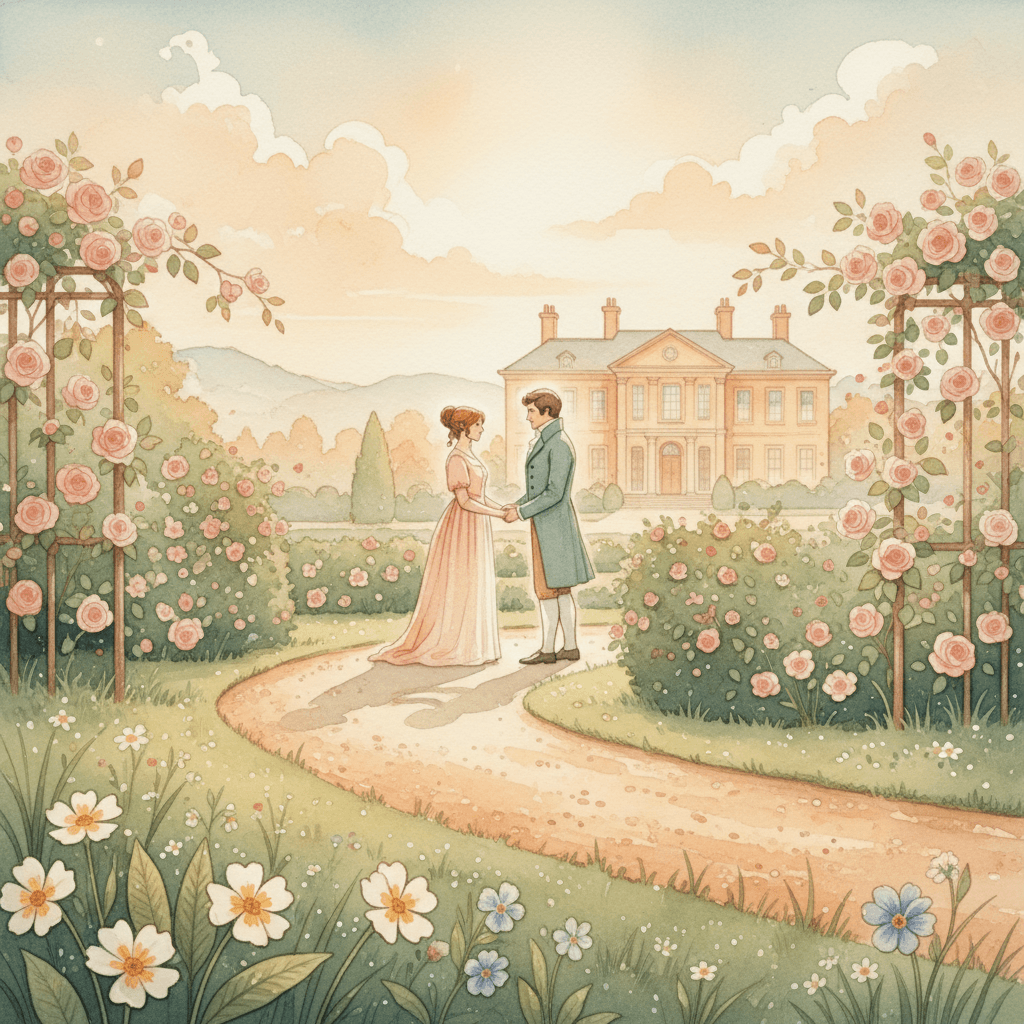
There is no charm equal to tenderness of heart. — Jane Austen
—What lingers after this line?
Austen’s Measure of True Attraction
Jane Austen’s line elevates tenderness from a pleasant trait to the very core of attraction. In her worlds, polished manners sparkle, but compassion endures; charm without care proves brittle. Pride and Prejudice (1813) contrasts Wickham’s glittering sociability with Darcy’s quiet generosity, suggesting that a tender heart—not a smooth tongue—wins the lasting verdict of the reader and the beloved. Thus, the quote is less a romantic sigh than a moral calibration of what truly matters in human connection. Moving from this moral center, we see how Austen redefines “charm” against the cultural backdrop of her era.
Manners Versus Morals in Regency Society
In an age shaped by conduct books like Fordyce’s Sermons to Young Women (1766), grace and compliance were touted as feminine ideals. Austen accepts the value of civility yet peels back its veneer to test for goodness beneath. Mansfield Park (1814) lets the witty Mary Crawford dazzle, but it is the steadfast Fanny Price whose tender conscience carries the novel’s moral weight. Likewise, Emma (1815) exposes how social sparkle can slip into cruelty when Emma humiliates Miss Bates—until Mr. Knightley’s gentle reproof realigns manners with kindness. This ethical recalibration ushers us toward contemporary lenses that explain why tenderness persuades beyond custom.
What Tenderness Does to the Brain
Modern psychology substantiates Austen’s intuition. C. Daniel Batson’s empathy–altruism research shows that feeling with others reliably motivates helping, while Barbara Fredrickson’s broaden-and-build theory links warm emotions to resilience and social resources. Physiologically, affectionate touch and trust can elevate oxytocin, easing stress and deepening bonds; relational studies (e.g., John Gottman’s work) find that responsiveness to small “bids” predicts stability more than grand declarations. In short, tenderness signals safety, and safety unlocks reciprocity. If science explains the mechanism, Austen provides the choreography: small, timely acts where care becomes fate.
Small Acts That Change a Story
Austen dramatizes tenderness in motions as modest as a hand extended. In Emma (1815), Mr. Knightley crosses a ballroom to ask Harriet to dance after a cruel snub, converting public shame into dignity. Persuasion (1817) shows Captain Wentworth gently lifting a fretful child from Anne’s tired shoulders—a single, wordless act that reveals a guarded heart’s depth. Meanwhile, Darcy’s discreet rescue of Lydia in Pride and Prejudice (1813) transforms scandal into mercy without demanding credit. These gestures prepare the way for a broader claim: tenderness is not only romantic—it is civic.
Tenderness as a Strength in Public Life
Beyond courtship, tenderness underwrites trustworthy leadership. Robert K. Greenleaf’s Servant Leadership (1977) frames care, listening, and empathy as sources of durable authority, while Dacher Keltner’s The Power Paradox (2016) argues that power is gained and kept through kindness more than dominance. Teams cohere around leaders who humanize others; communities heal when attention meets vulnerability. Austen’s insight thus scales from parlors to institutions: the most persuasive influence is the one that protects. Still, a final challenge remains—how to nurture tenderness amid the noise and velocity of modern life.
Keeping Softness Alive in a Hard Age
In a digital climate that rewards speed and spectacle, tenderness can feel impractical. Yet Sherry Turkle’s Reclaiming Conversation (2015) warns that screens erode empathy precisely where presence is needed most, while Kristin Neff’s Self-Compassion (2011) shows that gentleness toward oneself fosters generosity toward others. Micro-practices—pausing before reply, naming another’s feeling, writing the unposted kind note, offering the first apology—restore Austen’s ethic at human scale. Thus the quote endures not as ornament but as directive: cultivate the charm that cares, and everything else finds its rightful place.
One-minute reflection
What feeling does this quote bring up for you?
Related Quotes
6 selectedWe must all do what we can to help one another. — Jane Austen
Jane Austen
At first glance, Jane Austen’s line sounds modest, yet its moral force is striking: each person carries some responsibility for the well-being of others. The phrase “what we can” is especially important, because it does...
Read full interpretation →Arrange kindness like stars in the sky; it will guide your nights. — Jane Austen
Jane Austen
Jane Austen’s line turns kindness into a celestial image: small points of light arranged with intention, bright enough to matter when the world goes dark. By choosing “stars,” she implies that kindness is not a single gr...
Read full interpretation →Begin each chapter with kindness and your story will find readers — Jane Austen
Jane Austen
Jane Austen’s advice treats a chapter opening as more than a technical necessity; it’s an invitation. To “begin…with kindness” implies that the first sentences should feel like a door held open rather than a test the rea...
Read full interpretation →Family is not just a place we come from, but a sanctuary we build every day through the small, intentional acts of kindness we offer one another. — Daisaku Ikeda
Daisaku Ikeda
At first glance, Ikeda’s quote gently shifts the meaning of family away from mere ancestry or birthplace. He suggests that family is not defined only by bloodlines or shared history, but by what people actively create to...
Read full interpretation →Boundaries do not make you less kind; they make you more capable of being kind without resentment. — Brené Brown
Brené Brown
At first glance, Brené Brown’s quote challenges a common assumption that kindness means endless availability. Instead, she reframes boundaries as the structure that allows generosity to remain sincere rather than forced.
Read full interpretation →You don't have to be a billionaire to believe you can make a difference. Give your time, give your love, or simply give a smile. — Steve Goodier
Steve Goodier
At its core, Steve Goodier’s quote challenges the idea that influence belongs only to the wealthy or powerful. By placing time, love, and even a smile alongside money, he broadens generosity into something almost anyone...
Read full interpretation →More From Author
More from Jane Austen →We must all do what we can to help one another. — Jane Austen
At first glance, Jane Austen’s line sounds modest, yet its moral force is striking: each person carries some responsibility for the well-being of others. The phrase “what we can” is especially important, because it does...
Read full interpretation →There is nothing like staying at home for real comfort. — Jane Austen
At first glance, Jane Austen’s line seems simple, yet its force lies in its calm certainty: no pleasure, status, or novelty quite matches the comfort of home. Rather than praising luxury, she points to a deeper ease—the...
Read full interpretation →True luxury is not about excess, but the absence of stress and the presence of soul in your surroundings. — Jane Austen
At first glance, luxury is often associated with abundance, ornament, and visible wealth. Yet this quote reframes the idea entirely, suggesting that genuine richness lies not in excess but in relief: a life with less str...
Read full interpretation →Arrange kindness like stars in the sky; it will guide your nights. — Jane Austen
Jane Austen’s line turns kindness into a celestial image: small points of light arranged with intention, bright enough to matter when the world goes dark. By choosing “stars,” she implies that kindness is not a single gr...
Read full interpretation →