
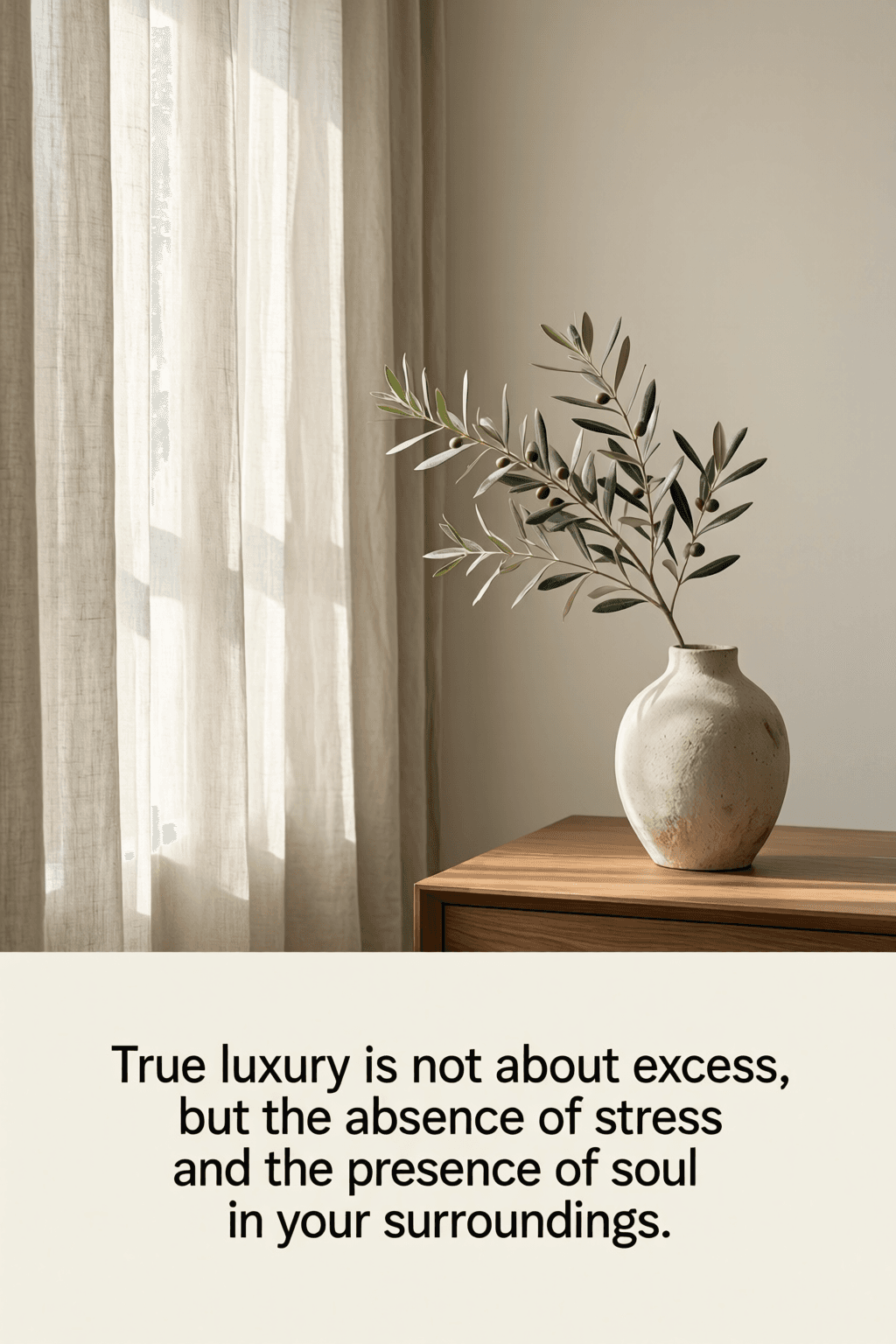
True luxury is not about excess, but the absence of stress and the presence of soul in your surroundings. — Jane Austen
—What lingers after this line?
Redefining What Luxury Means
At first glance, luxury is often associated with abundance, ornament, and visible wealth. Yet this quote reframes the idea entirely, suggesting that genuine richness lies not in excess but in relief: a life with less strain, fewer pressures, and more emotional ease. In that sense, luxury becomes an inward experience rather than a public display. This shift matters because it moves value away from possession and toward atmosphere. A calm room, an unhurried morning, or a home that feels deeply personal may offer more lasting satisfaction than any extravagant object. Thus, luxury is presented here as a quality of living that nourishes rather than overwhelms.
The Quiet Power of an Unstressed Life
From that foundation, the phrase “the absence of stress” introduces a powerful modern truth: peace itself has become precious. In a world shaped by constant urgency, uninterrupted rest and mental spaciousness can feel rarer than material indulgence. What the quote implies, therefore, is that serenity is not a secondary comfort but one of life’s highest forms of wealth. This idea echoes philosophical traditions that prize tranquility over accumulation. For example, Epicurus’s Letter to Menoeceus (c. 300 BC) argues that freedom from disturbance is central to happiness. In this light, luxury is not having more to manage, but having less that disturbs the mind.
Why Soul Matters in a Space
However, the quote does not stop at calm; it adds “the presence of soul in your surroundings,” giving luxury a human and emotional dimension. Soul suggests warmth, memory, character, and authenticity—the feeling that a place reflects a life truly lived rather than a style merely purchased. As a result, surroundings become meaningful not because they impress others, but because they resonate with the person dwelling within them. In practice, this may be a worn wooden table passed through generations, books annotated over years, or a corner filled with light and ritual. William Morris, in “The Beauty of Life” (1880), similarly argued that homes should contain things that are useful or beautiful, a principle closely aligned with soulful living.
Austen’s Social World and the Idea of Grace
Seen through the lens of Jane Austen’s literary world, this sentiment feels especially fitting. Austen’s novels repeatedly examine the difference between outward status and inward worth. In Pride and Prejudice (1813), grand estates may command admiration, yet true esteem rests on character, conversation, and moral steadiness rather than splendor alone. Consequently, the quote can be read as an extension of that moral sensibility. A refined life, in Austen’s universe, is not defined solely by riches but by proportion, restraint, and the cultivation of a gracious environment. Luxury, then, becomes inseparable from emotional intelligence and from the subtle art of making a space humane.
From Consumption to Care
Building on this, the quote quietly critiques a consumer culture that equates more with better. Excess often brings clutter, maintenance, and distraction, whereas a carefully tended environment can restore attention and well-being. The deeper suggestion is that luxury emerges through discernment—choosing what supports life rather than what merely fills space. This perspective also aligns with contemporary design movements that favor intentionality. The Japanese aesthetic discussed by Soetsu Yanagi in The Unknown Craftsman (1972) values simplicity, use, and spirit in ordinary objects. In that way, luxury becomes less about acquisition and more about the care embedded in what surrounds us.
Living Beautifully Without Excess
Ultimately, the quote offers a gentler vision of abundance. It proposes that the richest life may be the one in which the nervous system can soften and the home can speak with personality, memory, and quiet grace. Rather than chasing spectacle, one cultivates refuge. Therefore, true luxury is both practical and poetic: a reduction of needless strain and an increase of meaning. It is the candle lit at dusk, the chair that invites rest, the room that feels unmistakably yours. In the end, what appears modest from the outside may, from within, be the most luxurious life of all.
One-minute reflection
What's one small action this suggests?
Related Quotes
6 selectedTrue luxury is not about more; it is about the space to breathe and the peace to simply be. — Marie Kondo
Marie Kondo
Marie Kondo’s quote quietly overturns a common assumption: luxury is not endless accumulation, but relief from excess. Rather than linking wealth to possession, she associates it with spaciousness, calm, and the rare abi...
Read full interpretation →If it costs my peace, it's outside my boundary. — Adam J. Jackson
Adam J. Jackson
At its core, Adam J. Jackson’s line reframes boundaries as more than rules we impose on others; they become protections for our inner life.
Read full interpretation →Like water which can clearly mirror the sky and the trees only so long as its surface is undisturbed, the mind can only reflect the true image of the Self when it is tranquil and wholly relaxed. — Indra Devi
Indra Devi
Indra Devi begins with a simple natural image: calm water reflects the sky and trees only when its surface is still. In the same way, she suggests that the mind reveals truth not through strain or agitation, but through...
Read full interpretation →Sometimes, protecting your peace is the better choice. — Marcus Aurelius
Marcus Aurelius
At first glance, the saying frames peace not as passivity but as discipline. To protect one’s peace is to recognize that not every conflict deserves entry into the mind.
Read full interpretation →Never be in a hurry; do everything quietly and in a calm spirit. Do not lose your inner peace for anything whatsoever. — Saint Francis de Sales
Saint Francis de Sales
At first glance, Saint Francis de Sales offers simple advice about slowing down, yet his counsel reaches far beyond time management. In urging us never to be in a hurry, he frames haste as a spiritual danger: it scatters...
Read full interpretation →We are not rest-filled people who occasionally become restless; we are restless people who sometimes find rest. — Henri J. M. Nouwen
Henri J.M. Nouwen
Henri J. M.
Read full interpretation →More From Author
More from Jane Austen →We must all do what we can to help one another. — Jane Austen
At first glance, Jane Austen’s line sounds modest, yet its moral force is striking: each person carries some responsibility for the well-being of others. The phrase “what we can” is especially important, because it does...
Read full interpretation →There is nothing like staying at home for real comfort. — Jane Austen
At first glance, Jane Austen’s line seems simple, yet its force lies in its calm certainty: no pleasure, status, or novelty quite matches the comfort of home. Rather than praising luxury, she points to a deeper ease—the...
Read full interpretation →Arrange kindness like stars in the sky; it will guide your nights. — Jane Austen
Jane Austen’s line turns kindness into a celestial image: small points of light arranged with intention, bright enough to matter when the world goes dark. By choosing “stars,” she implies that kindness is not a single gr...
Read full interpretation →Begin each chapter with kindness and your story will find readers — Jane Austen
Jane Austen’s advice treats a chapter opening as more than a technical necessity; it’s an invitation. To “begin…with kindness” implies that the first sentences should feel like a door held open rather than a test the rea...
Read full interpretation →