
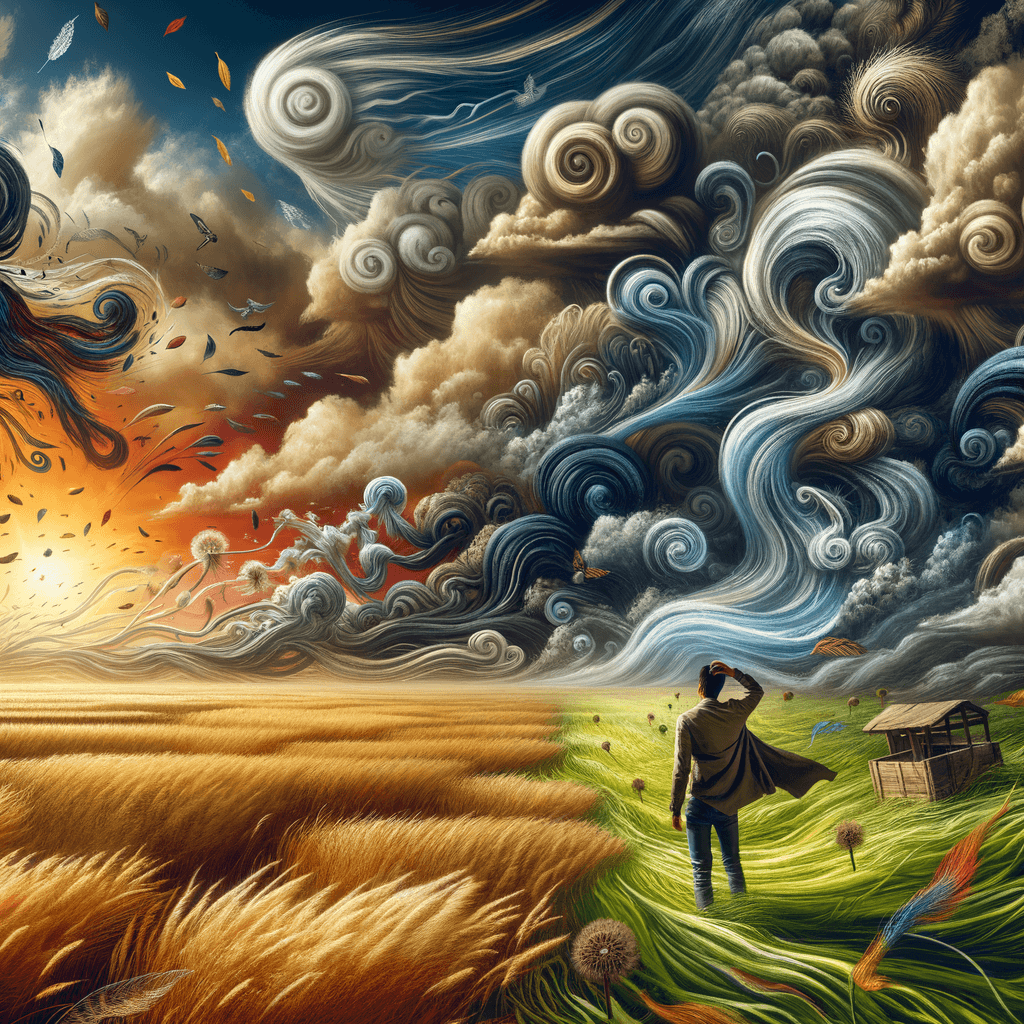
A great wind is blowing, and that gives you either imagination or a headache. — Catherine the Great
—What lingers after this line?
Dual Nature of Inspiration
This quote highlights the idea that powerful forces, like a strong wind, can provoke two very different reactions. It suggests that moments of inspiration can either uplift and ignite creativity or lead to confusion and discomfort.
Imagination vs. Overwhelm
Catherine the Great draws a distinction between the fruitful expansion of imagination and the overwhelming stress that can arise from overwhelming circumstances or thoughts. This reflects the thin line between creative inspiration and mental overload.
Symbolism of the Wind
The wind symbolizes change and uncontrollable forces in life. This metaphor implies that while change can inspire new ideas, it can also create chaos that may induce stress.
Historical Context of Catherine the Great
Catherine the Great was an influential Russian Empress known for her contributions to the arts and the expansion of the Russian Empire. Her perspective reflects the turbulent times she lived in, where powerful winds metaphorically represent the forces of change she navigated.
Personal Experience and Leadership
As a leader, Catherine's quote may reflect her own experiences with the pressures of governance, suggesting that the responsibility of leadership can be both an imaginative challenge and a source of considerable stress.
One-minute reflection
What feeling does this quote bring up for you?
Related Quotes
6 selectedThe moment a man begins to talk about technique, that's proof that he is fresh out of ideas. — Dylan Thomas
Dylan Thomas
Dylan Thomas’s remark begins with a sharp suspicion: when an artist talks too much about technique, the living impulse behind the work may already be gone. Technique, in this sense, becomes a substitute language, a way o...
Read full interpretation →Imperfection inspires invention, imagination, and creativity. — Mary Sharratt
Mary Sharratt
Mary Sharratt’s insight begins with a reversal of ordinary expectations: imperfection is not merely something to fix, but something that awakens possibility. When a plan fails, a surface cracks, or an idea refuses to fit...
Read full interpretation →Don't think. Thinking is the enemy of creativity. It's self-conscious, and anything self-conscious is lousy. — Ray Bradbury
Ray Bradbury
At first glance, Ray Bradbury’s line sounds almost rebellious: “Don’t think. Thinking is the enemy of creativity.” Yet his target is not intelligence itself, but the paralyzing kind of self-awareness that makes an artist...
Read full interpretation →You can be cautious or you can be creative, but there's no such thing as a cautious creative. — George Lois
George Lois
George Lois draws a sharp line between two mindsets: caution protects what already exists, while creativity risks making something new. At first glance, the statement sounds absolute, yet that severity is exactly its poi...
Read full interpretation →Almost always, the creative dedicated minority has made the world better. — Martin Luther King, Jr.
Martin Luther King Jr.
Martin Luther King, Jr. distills a sweeping historical truth into a single sentence: progress is often driven not by the passive majority but by a small, committed group willing to imagine a better order.
Read full interpretation →What keeps life fascinating is the constant creativity of the soul. — Deepak Chopra
Deepak Chopra
At its core, Deepak Chopra’s line suggests that life stays interesting not because the world is fixed and exciting on its own, but because the inner self continually reinterprets it. The phrase “creativity of the soul” p...
Read full interpretation →More From Author
More from Catherine the Great →