
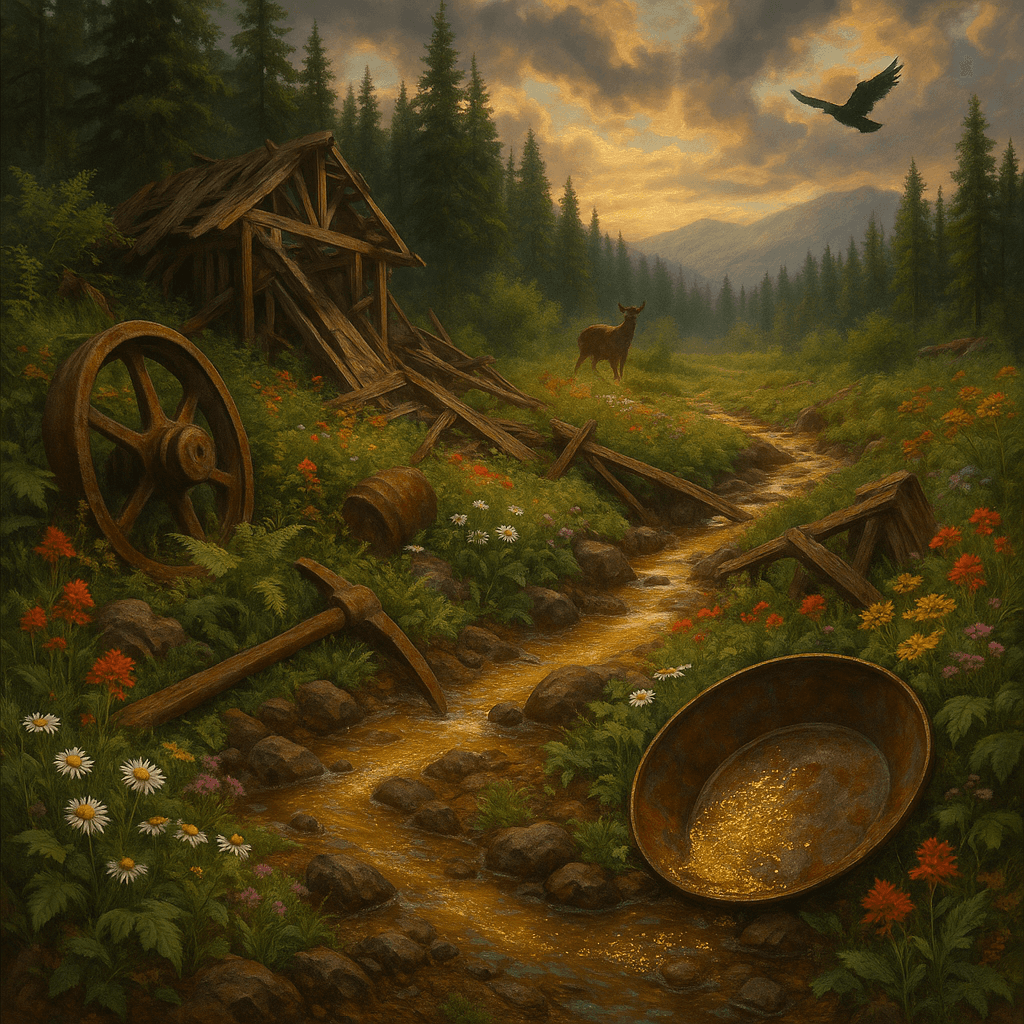
All the gold in California can't buy you back your soul. — Native American Proverb
—What lingers after this line?
The Limits of Material Wealth
This Native American proverb opens with a striking illustration: even the fabled wealth associated with California's gold rush pales beside the value of one's soul. The message is unequivocal—no amount of external riches can reclaim what's lost at the core of a person's being. This sentiment sets a powerful stage for reflecting on what cannot be purchased or restored by mere financial means.
Historical Warnings from Greed
Transitioning from the metaphor, history provides cautionary tales about the dangers of prioritizing wealth over integrity. The California Gold Rush (1848–1855), for example, led thousands to seek fortune, but also brought displacement, exploitation, and broken communities. These events reinforce the proverb’s wisdom: in the rush for riches, people often lose sight of deeper values, sometimes irretrievably.
Spirituality Versus Materialism
In a broader sense, Native American cultures have long emphasized the spirit’s primacy over possessions. Their worldviews typically stress balance, stewardship, and respect for all life—contrasting with consumerist mindsets. This worldview echoes classics like the Christian biblical passage: 'What does it profit a man to gain the whole world, yet forfeit his soul?' (Mark 8:36), highlighting a universal human concern.
Modern Echoes in Well-Being
Contemporary research agrees that financial gain alone cannot buy meaning or happiness. Studies by psychologists such as Ed Diener have shown that beyond a moderate threshold, increases in income do not significantly boost well-being. Instead, fulfillment derives from relationships, purpose, and self-respect—all elements closely linked to the soul, as the proverb suggests.
The Enduring Call to Integrity
Ultimately, the proverb serves as an enduring reminder for future generations. Amid a world that may prize gold and status, it urges individuals to safeguard their inner selves. Like a compass pointing true north, it warns against short-term gain at the cost of lasting dignity and harmony within. In heeding this wisdom, both communities and individuals preserve what is truly invaluable.
One-minute reflection
Why might this line matter today, not tomorrow?
Related Quotes
6 selectedHappiness resides not in possessions, and not in gold, happiness dwells in the soul. — Democritus
Democritus
Democritus suggests that true happiness comes from within oneself and the state of one's soul rather than external possessions or wealth. Material goods alone cannot provide lasting satisfaction.
Read full interpretation →The things you own end up owning you. It is only after you lose everything that you're free to do anything. — Chuck Palahniuk
Chuck Palahniuk
At first glance, Palahniuk’s line appears to criticize materialism, yet it goes further by describing a reversal of power. We believe we possess objects, but gradually those objects begin to dictate our time, anxiety, an...
Read full interpretation →You are not your job, you're not how much money you have in the bank. — Chuck Palahniuk
Chuck Palahniuk
Chuck Palahniuk’s line works like a quick jolt: it challenges the habit of answering “Who are you?” with a title, salary, or résumé. By insisting you are not your job or your bank balance, he separates a human life from...
Read full interpretation →Spending money to show people how much money you have is the fastest way to have less money. — Morgan Housel
Morgan Housel
Morgan Housel’s line hinges on a simple contradiction: the more you spend trying to look wealthy, the less wealth you keep. Status purchases feel like proof of success, but they often function as withdrawals from the ver...
Read full interpretation →When I was young I thought that money was the most important thing in life; now that I am old I know that it is. — Oscar Wilde
Oscar Wilde
Oscar Wilde’s line begins like a tidy moral fable: youth mistakenly worships money, while age brings wiser priorities. Yet the sentence swivels on its final clause—“now that I am old I know that it is”—turning expected g...
Read full interpretation →It is not the man who has too little, but the man who craves more, that is poor. — Seneca
Seneca
Seneca overturns the usual definition of poverty by shifting it from external possessions to internal appetite. In his view, the person with modest means can be rich if their desires are proportioned to what they have, w...
Read full interpretation →More From Author
More from Native American Proverb →We do not inherit the earth from our ancestors, we borrow it from our children. — Native American Proverb
This proverb highlights the idea that we are stewards of the earth for future generations. Our actions today should be guided by their impact on the environment and resources available to our descendants.
Read full interpretation →No river can return to its source, yet all rivers must have a beginning. — Native American Proverb
The proverb highlights that, like rivers, life moves forward and things cannot return to their exact starting points.
Read full interpretation →The soul would have no rainbow if the eyes had no tears. — Native American Proverb
This proverb illustrates that experiencing sadness is necessary to fully appreciate happiness and beauty in life.
Read full interpretation →Warriors are not born and not made until they have awakened the spirit of the mountain within. — Native American Proverb
This Native American proverb begins by rejecting simplistic notions of heroic birthright or mere training. Instead, it points to an inner awakening—a transformation that separates true warriors from those who simply inhe...
Read full interpretation →