
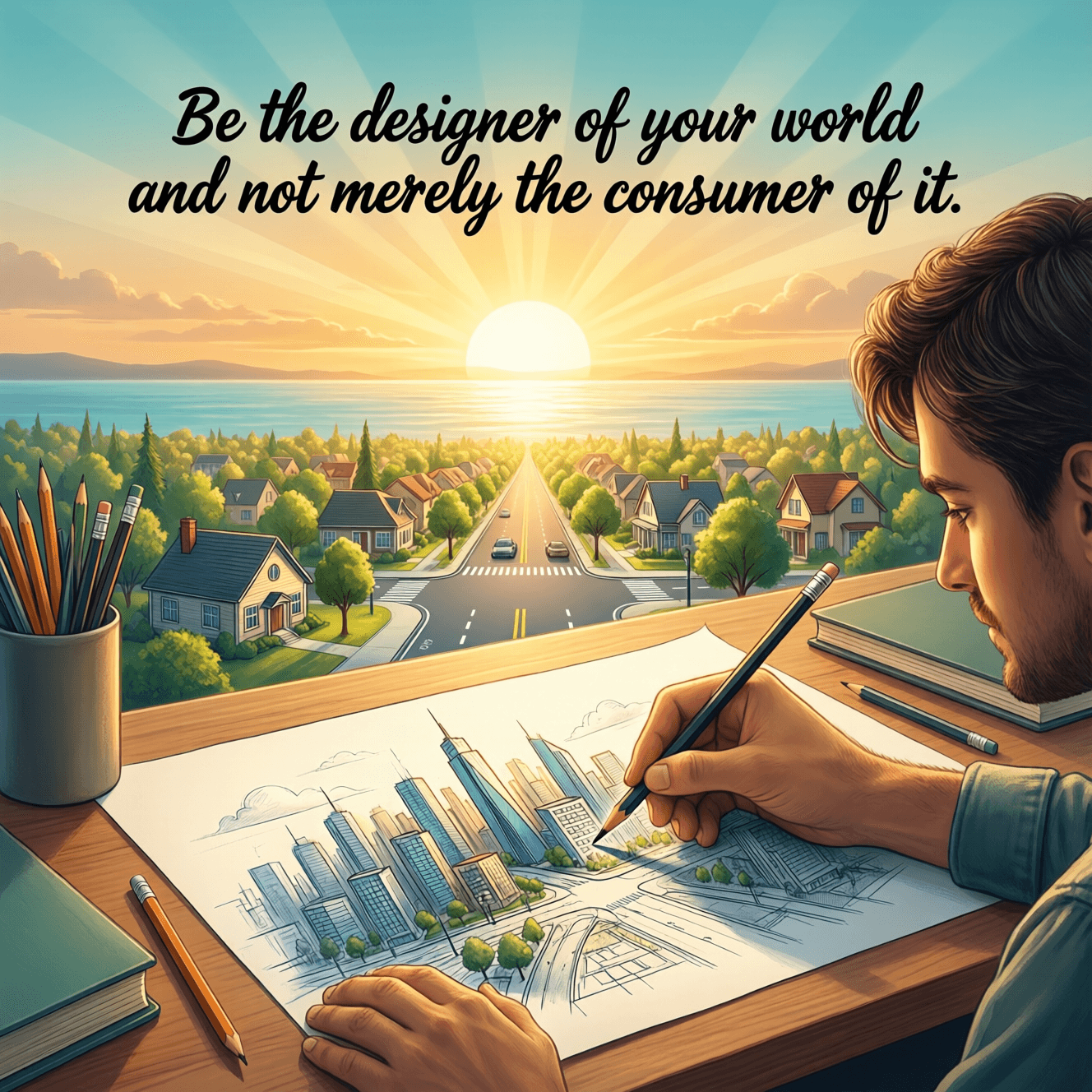
Be the designer of your world and not merely the consumer of it. — James Clear
—What lingers after this line?
From Passive Living to Active Creation
James Clear’s line draws a sharp distinction between drifting through what’s offered and intentionally shaping what’s possible. To “consume” is to accept default options—default schedules, default opinions, default ambitions—largely chosen by someone else. To “design,” by contrast, is to decide what you want your days to look like and then build toward it with purpose. This shift matters because most environments are optimized for engagement, not fulfillment. Once you notice that, the quote becomes less motivational and more diagnostic: if your life feels crowded but oddly empty, it may be because consumption has quietly replaced creation.
The Power of Defaults and Invisible Scripts
Building on that idea, the quote points to how strongly defaults shape behavior. “World” here isn’t just the planet; it’s your social feeds, workplace norms, friendships, and routines—an ecosystem that hands you an implicit script. Sociologist Erving Goffman’s *The Presentation of Self in Everyday Life* (1956) highlights how people often perform roles expected of them, which can make living by default feel normal. However, recognizing these scripts is the first act of design. When you can name the forces nudging you—algorithms, peer expectations, organizational culture—you regain the ability to choose, rather than simply react.
Habits as the Tools of a Designer
From awareness, the next step is construction, and Clear’s broader work repeatedly emphasizes that habits are the most practical building blocks. A designer doesn’t rely on sudden inspiration; they create systems that make desired actions easier and unwanted ones harder. In that sense, “design your world” can mean designing your cues, your environment, and your friction points. For example, someone who wants to read more might place a book on their pillow and keep the phone charging in another room. The goal isn’t willpower; it’s architecture—small, repeatable choices that quietly turn intention into reality.
Attention: The Currency You’re Spending
Yet design isn’t only about time management; it’s about attention management. Consumption-heavy living often spends attention reactively, one notification or trend at a time. Philosopher William James argued in *The Principles of Psychology* (1890) that experience is shaped by what we attend to, implying that attention is not merely a tool but a creator of reality. Consequently, designing your world means choosing what gets your focus before someone else chooses for you. Curating inputs—news, entertainment, conversations—becomes a form of authorship over your inner life.
Meaning Comes from Making, Not Just Taking
As the quote unfolds, it suggests that fulfillment tends to follow production more than consumption. Consuming can be restorative, but it rarely builds identity on its own; making things—writing, cooking, mentoring, building a skill—creates evidence of agency. Psychologist Mihaly Csikszentmihalyi’s *Flow* (1990) describes how deep engagement in challenging creation often yields a lasting sense of satisfaction. This is why even small acts of making can change how life feels. A person who starts a modest garden, publishes short essays, or learns a craft often reports a renewed sense of ownership over their days.
Design Without Perfectionism
Finally, the quote doesn’t require total control; it asks for intentional direction. Designing your world can be iterative—more like prototyping than delivering a flawless master plan. You test a routine, learn what breaks, and adjust, much as designers refine drafts based on feedback. In practice, this means choosing one or two areas to redesign—morning habits, friendships, work boundaries—rather than attempting a life overhaul. Over time, those deliberate edits compound, and the “world” you inhabit becomes less like something you endure and more like something you’ve consciously authored.
One-minute reflection
Why might this line matter today, not tomorrow?
Related Quotes
6 selectedIntentional living is the art of making our own choices before others' choices make us. — Richie Norton
Richie Norton
Richie Norton’s quote frames intentional living as an active rather than passive way of being. At its core, it argues that a meaningful life is shaped by deliberate decisions made in advance, not by drifting along with e...
Read full interpretation →Create the life you can't wait to wake up to. — Unknown
Unknown
This quote encourages individuals to actively pursue their passions and interests in life. By aligning daily activities and long-term goals with what truly excites them, people can build a life that they eagerly look for...
Read full interpretation →Clutter is not just the stuff on your floor; it's anything that stands between you and the life you want to be living. — Peter Walsh
Peter Walsh
At first glance, Peter Walsh’s quote seems to address physical mess, yet it quickly expands into something much broader. Clutter, in his view, is not merely a pile of objects on the floor; rather, it is any obstacle—mate...
Read full interpretation →Do the work of naming the highest, eulogy-worthy priorities in your life. Then do the work of putting them at the center of your life, every day. — Brooke McAlary
Brooke McAlary
Brooke McAlary’s quote begins with a difficult but clarifying task: identifying the priorities so important they would belong in your eulogy. In other words, she asks us to look beyond errands, ambitions, and social nois...
Read full interpretation →Instead of hustling to build a life that looks good, what if you slowed down and cultivated a life that feels good. — Erica Layne
Erica Layne
Erica Layne’s quote begins by challenging a familiar modern reflex: the urge to “hustle” toward a life that looks impressive from the outside. In doing so, she contrasts external validation with internal well-being, sugg...
Read full interpretation →Edit your life frequently and ruthlessly. It's your masterpiece after all. — Nathan W. Morris
Nathan W. Morris
Morris frames life not as a fixed identity but as an ongoing creation—something drafted, tested, and refined over time. By calling it a “masterpiece,” he implies both ownership and intention: you are not merely living th...
Read full interpretation →More From Author
More from James Clear →You cannot fully reset your life without adjusting your environment. — James Clear
James Clear’s observation begins with a simple but often overlooked truth: personal change is rarely just a matter of willpower. Our habits are shaped by the rooms we live in, the people we spend time with, the apps we o...
Read full interpretation →Consistency is the quiet answer to overwhelm. — James Clear
At first glance, James Clear’s line reframes overwhelm not as a dramatic crisis but as a condition that can be softened by steady action. Rather than calling for bursts of motivation, he points to consistency as a quiete...
Read full interpretation →Don't worry about being brilliant; just be consistent. The world is built by people who showed up even when they didn't feel like it. — James Clear
At its core, James Clear’s quote pushes back against the modern obsession with exceptional talent. Rather than glorifying brilliance, it elevates consistency—the humble act of returning to the work again and again.
Read full interpretation →Consistency is the quiet, daily hum of progress that eventually drowns out the noise of doubt and external expectations. — James Clear
At first glance, James Clear’s quote shifts attention away from dramatic breakthroughs and toward something far less glamorous: repetition. By calling consistency a “quiet, daily hum,” he suggests that meaningful progres...
Read full interpretation →