
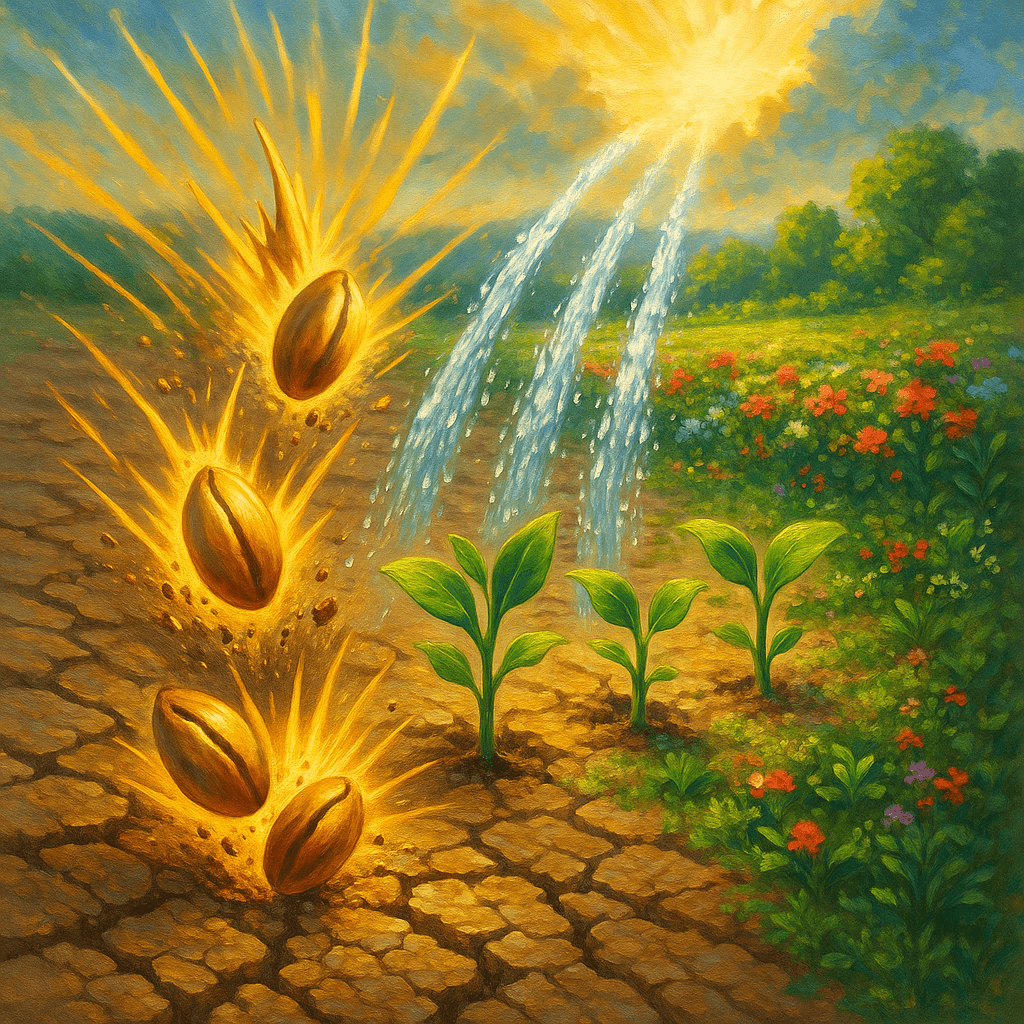
Boldness plants the seeds that wisdom waters. — Khaled Hosseini
—What lingers after this line?
The Seed of Initiative
Khaled Hosseini’s metaphor casts boldness as the vital starting point in any journey of achievement. Just as seeds remain inert without the act of planting, ideas and dreams need the initial courage to take root in reality. This first step often defies fear and uncertainty, echoing tales throughout history—such as Columbus’s audacious voyage across an uncharted ocean—that demonstrate the indispensable role of daring action in the pursuit of progress.
Wisdom as the Nurturing Force
Once boldness has acted, wisdom enters as the sustaining and shaping force. Like water drawn by a gardener, it nourishes and guides burgeoning efforts, ensuring they mature rather than wither. In practical terms, wisdom refines initial impulses, steering them away from recklessness. For example, Steve Jobs’s innovative leaps at Apple thrived because they were paired with calculated adjustments and learning from past missteps, thus turning raw boldness into resilient success.
The Interdependence of Action and Reflection
Important to note is the symbiotic relationship between boldness and wisdom. Actions without thoughtful guidance may lead to burnout or failure, while wisdom without risk-taking can become stagnation. This interplay mirrors the theme in Aesop’s fable 'The Tortoise and the Hare': haste needs forethought, and deliberation benefits from initiative. Together, they foster progress marked by both innovation and sustainability.
Lessons from Literature and Life
Literature is rich with examples in which protagonists blend fearlessness with prudence. In J.K. Rowling’s *Harry Potter* series, Harry often acts boldly, but it is Hermione’s wisdom that ensures their success. Likewise, in business and science, breakthroughs occur where pioneers are willing to take risks—but only thrive when paired with learning, adaptation, and strategic thinking.
The Path to Personal Growth
Ultimately, Hosseini’s saying encapsulates a roadmap for personal development. Embracing bold action sows the potential for greatness, but only when tended by continual learning—wisdom—does that potential flourish. By uniting courage and insight, individuals can navigate life’s challenges with confidence and achieve growth that is both ambitious and enduring.
One-minute reflection
Where does this idea show up in your life right now?
Related Quotes
6 selectedBegin, be bold, and venture to be wise. — Horace
Horace
This quote encourages individuals to take the first step towards their goals. It suggests that the hardest part of any journey is often just beginning, and taking that initial step requires courage.
Read full interpretation →Wisdom is knowing when to have rest, when to have activity, and how much of each to have. — Etty Hillesum
Etty Hillesum
Etty Hillesum’s insight begins with a simple but demanding idea: wisdom is not merely knowing what is good, but knowing when it is good. Rest and activity are both necessary, yet either can become harmful when taken at t...
Read full interpretation →Wisdom comes only to the silent mind. — Krishnamurti
Krishnamurti
Krishnamurti’s statement begins with a simple but demanding insight: wisdom is not merely accumulated information, nor is it the reward for constant thinking. Instead, it arises when the mind becomes quiet enough to perc...
Read full interpretation →Never call yourself a philosopher; show it. — Epictetus
Epictetus
Epictetus compresses an entire ethical program into a sharp command: do not claim the title, demonstrate the life. In other words, wisdom is not a badge one pins on oneself but a pattern others can recognize in conduct.
Read full interpretation →You are not starting over. You're starting wiser. — Meredith Eastwood
Meredith Eastwood
At first glance, Meredith Eastwood’s line gently challenges the fear that often accompanies change. To say, “You are not starting over,” is to reject the idea that every setback erases what came before.
Read full interpretation →The wise do things slowly, because they love it. — David Fell
David Fell
At first glance, David Fell’s line seems to praise caution, yet it reaches further than mere hesitation. To do something slowly, in this view, is not to be indecisive but to be fully present.
Read full interpretation →More From Author
More from Khaled Hosseini →Sow a generous deed and watch a landscape change. — Khaled Hosseini
Khaled Hosseini’s line begins with an agricultural metaphor that quietly widens into a moral vision. A “generous deed” is treated like a seed: small, ordinary, and easy to overlook at the moment it is planted.
Read full interpretation →For you, a thousand times over. — Khaled Hosseini
Hosseini’s line, “For you, a thousand times over,” condenses an entire relationship into one unflinching promise. Uttered by Hassan in *The Kite Runner* (2003), it captures loyalty so deep that repetition—“a thousand tim...
Read full interpretation →Your life is a story, and every story needs a plot twist to make it interesting. — Khaled Hosseini
This quote emphasizes viewing life as a personal story, suggesting that individuals are authors of their own journeys.
Read full interpretation →Every step forward is a victory over yesterday’s doubts. — Khaled Hosseini
Khaled Hosseini’s statement encapsulates an empowering philosophy: every advance we make, no matter how minor, represents a triumph over the uncertainties that once held us back. This outlook transforms progress into a p...
Read full interpretation →