
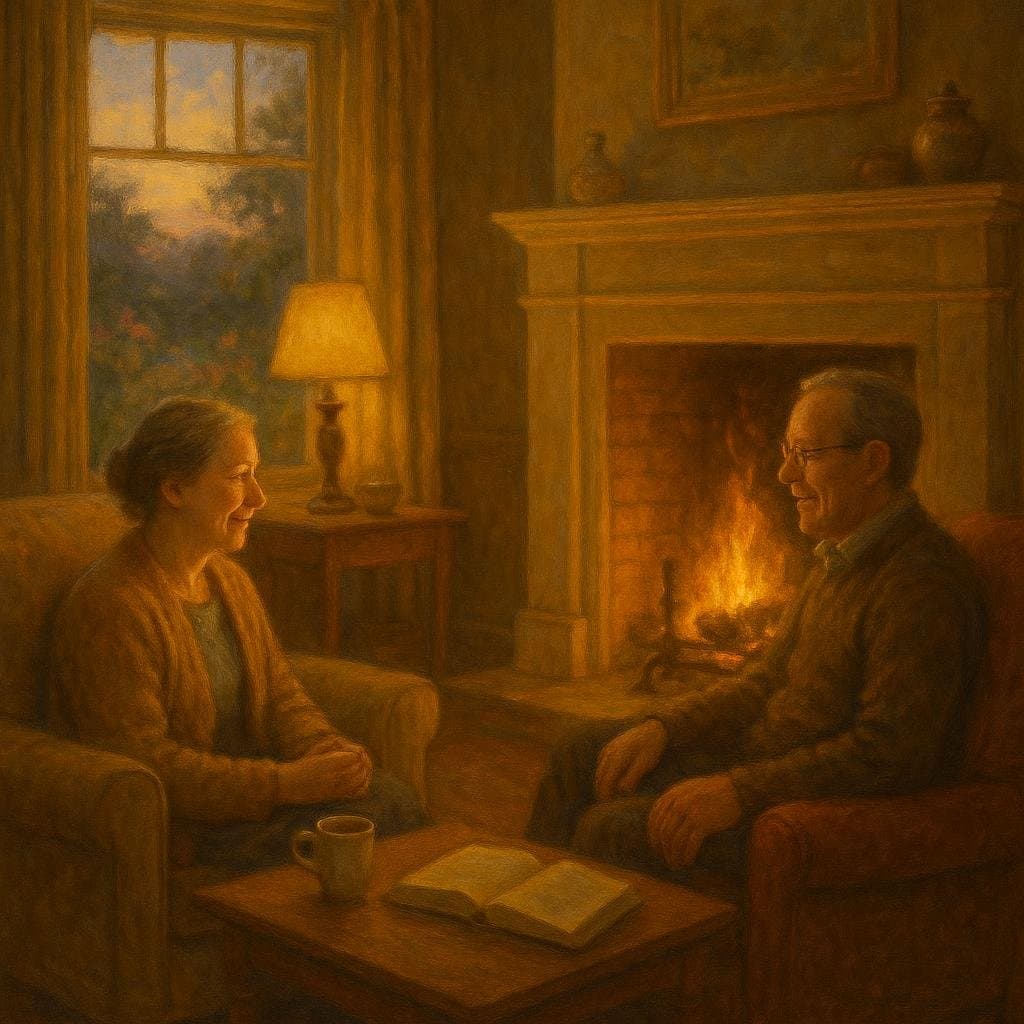
Happiness grows at our own firesides, and is not to be picked in strangers’ gardens. — Douglas Jerrold
—What lingers after this line?
The Meaning Behind Jerrold’s Fireside
Douglas Jerrold’s evocative metaphor draws on the warmth and familiarity of one’s own fireside to represent the essence of true happiness. Rather than viewing happiness as an external commodity, Jerrold suggests it is cultivated within our own surroundings and relationships. The notion of the fireside as a symbol of comfort and belonging underscores the importance of cherishing what is close at hand.
Contrasting Familiarity and Novelty
Transitioning from the comforts of home, Jerrold contrasts this with the allure of ‘strangers’ gardens.’ These unknown gardens symbolize the temptation to seek joy in foreign or superficial places—an impulse as old as Odysseus’ wanderings in Homer’s *Odyssey* (c. 8th century BC). The quote reminds us that while novelty can be exciting, enduring contentment is often rooted in the familiar and the intimate.
Lessons from Literature and History
This perspective finds echoes in literary works across eras. For example, Tolstoy’s *Anna Karenina* examines the consequences of seeking happiness outside of one’s essential sphere. Similarly, in Confucian philosophy, there’s emphasis on harmony within the household as the wellspring of broader well-being. These examples reinforce Jerrold’s conviction that happiness flourishes where there is connection and authenticity.
The Psychology of Belonging
Delving deeper, modern psychology supports the idea that belonging and familiar bonds are key drivers of personal happiness. Studies by researchers such as Martin Seligman emphasize that relationships and experiences within our close circles largely determine our sense of well-being. Thus, Jerrold’s insight aligns closely with contemporary findings on the importance of social connection over material pursuits or distant thrills.
Practical Wisdom for Daily Life
Bringing the discussion full circle, Jerrold’s counsel encourages cultivating gratitude and warmth within everyday life. Whether it means investing in family relationships or tending to a personal hobby, his words suggest that fulfillment is a product of nurturing what is uniquely our own. Ultimately, it serves as a gentle reminder that chasing happiness elsewhere may lead us to overlook the quiet joys waiting by our own fireside.
One-minute reflection
Why might this line matter today, not tomorrow?
Related Quotes
6 selectedThere is nothing like staying at home for real comfort. — Jane Austen
Jane Austen
At first glance, Jane Austen’s line seems simple, yet its force lies in its calm certainty: no pleasure, status, or novelty quite matches the comfort of home. Rather than praising luxury, she points to a deeper ease—the...
Read full interpretation →Your home should be the place where the day softens around the edges. — Unknown (removed per constraints) -> Let's use: "Home is not a place; it is a feeling of being able to handle whatever the world throws at you." — Cheryl Richardson
Cheryl Richardson
At first glance, Cheryl Richardson’s quote shifts the meaning of home away from geography and architecture. Home is no longer merely a house, apartment, or hometown; instead, it becomes an emotional condition—a steady in...
Read full interpretation →The ultimate luxury is being able to relax and enjoy your home. — Billy Baldwin
Billy Baldwin
Billy Baldwin’s remark shifts the idea of luxury away from expensive objects and toward a deeply personal experience: ease. Rather than defining wealth by grand décor or rare materials, he suggests that true refinement a...
Read full interpretation →There is a special kind of peace that comes from being home alone, where you can truly be yourself. — John Ed Pearce
John Ed Pearce
At its heart, John Ed Pearce’s reflection captures a calm that is difficult to reproduce anywhere else: the peace of having a space entirely to oneself. Home alone, a person is briefly released from social performance, e...
Read full interpretation →It is not my wish to stay home so much that I become isolated, but to use the comforting influence of my home to restore and gather myself. — Maureen Brady
Maureen Brady
Maureen Brady draws an important distinction at the very beginning: staying home is not necessarily an act of avoidance. Instead, she frames home as a place of renewal, where a person can recover energy and emotional cla...
Read full interpretation →Joy is not in things; it is in us. — Richard Wagner
Richard Wagner
This quote emphasizes that true joy comes from within ourselves rather than from external objects or possessions. It encourages an inward reflection to find happiness.
Read full interpretation →More From Author
More from Douglas Jerrold →