
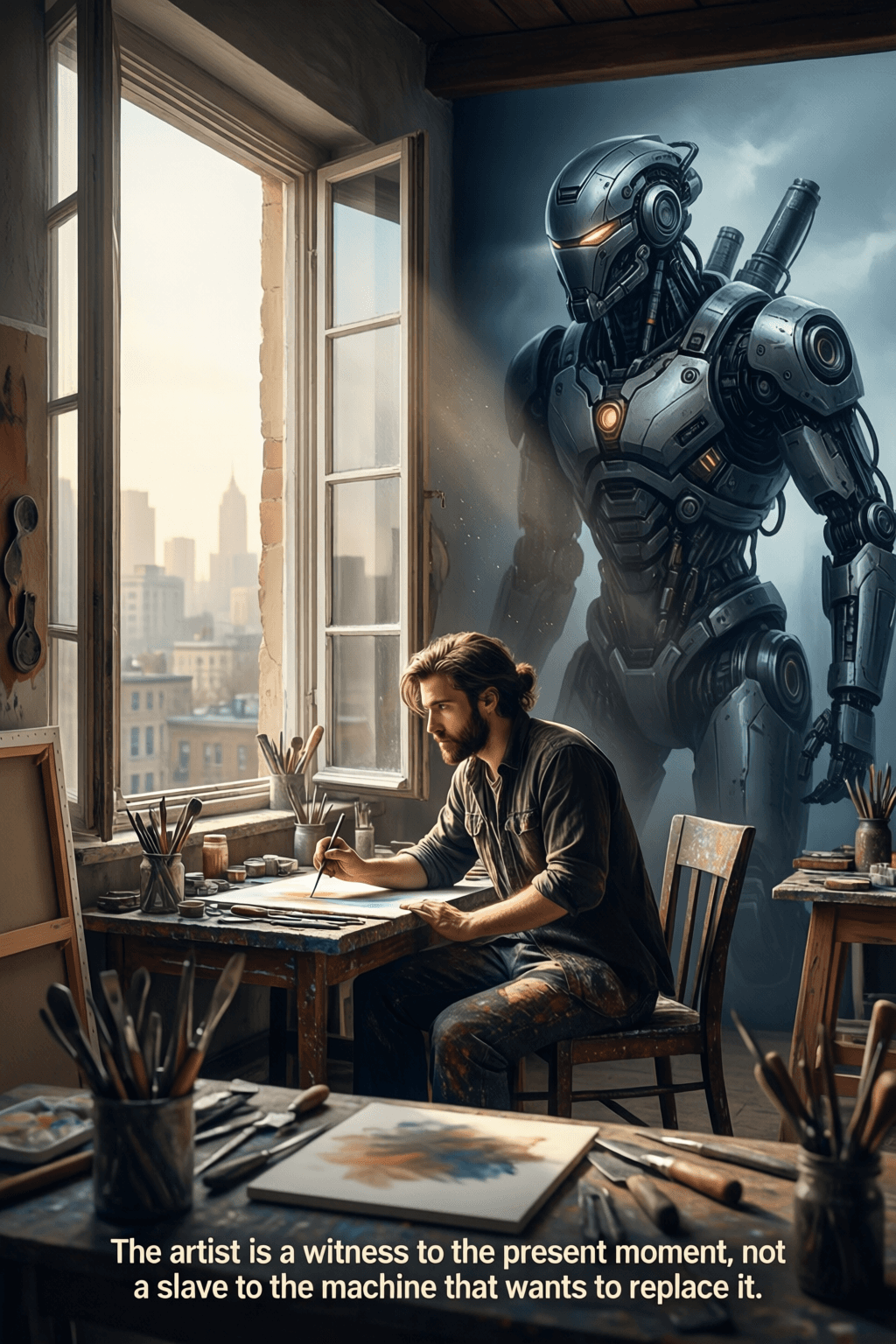
The artist is a witness to the present moment, not a slave to the machine that wants to replace it. — bell hooks
—What lingers after this line?
Presence Over Mechanization
At its core, bell hooks’s statement insists that art begins with presence. To be a witness to the present moment is to attend closely to lived reality—its tensions, beauties, wounds, and contradictions—rather than merely producing output on command. In this sense, the artist’s task is not passive reproduction but active attention, a form of seeing that resists numbness. From there, the contrast with the machine becomes sharper. A machine may replicate patterns, accelerate production, or imitate style, yet hooks suggests that it cannot bear witness in the moral and emotional sense. Witnessing requires consciousness, accountability, and a relationship to the world being described.
The Ethical Role of the Artist
Seen this way, the quote is not only about creativity but also about responsibility. The artist does more than make objects; the artist records the spirit of an era and gives shape to what others may feel but cannot yet name. James Baldwin’s essays, especially in The Fire Next Time (1963), exemplify this role by turning personal and political observation into testimony. Consequently, hooks frames art as an ethical practice. The artist must remain responsive to injustice, change, and human complexity instead of surrendering to systems that reward speed, sameness, or market efficiency. In that resistance, art keeps its conscience.
Resistance to Dehumanizing Systems
At the same time, the phrase “not a slave” introduces a powerful political warning. bell hooks, throughout works such as Teaching to Transgress (1994), challenged structures that diminish human agency, and this quote extends that critique into the realm of artistic labor. The danger is not simply technology itself, but the demand that human creators conform to machine logic: endless productivity, standardization, and replaceability. Therefore, the artist’s refusal becomes essential. To resist becoming machine-like is to defend slowness, vulnerability, and the unruly depth of human expression. What is protected here is not nostalgia, but the dignity of creation rooted in lived experience.
Why the Present Moment Matters
Moreover, hooks emphasizes the present moment because art gains power when it is historically awake. Witnessing the present means noticing what this particular time is doing to bodies, relationships, language, and imagination. Virginia Woolf’s Mrs Dalloway (1925), for example, captures a single day while revealing the psychic aftershocks of war, showing how the immediate moment can hold an entire social world. In turn, this attentiveness prevents art from becoming detached formula. The present is always unstable and unfinished, and the artist who engages it honestly offers more than commentary: they preserve the texture of reality as it is being lived.
Human Creativity Beyond Replication
Finally, the quote points toward a distinction between creation and replacement. A machine that “wants to replace” the artist symbolizes any force that treats art as interchangeable production rather than singular expression. Yet the artist’s value lies precisely in what cannot be fully replicated: situated perception, emotional risk, memory, and moral vision. For that reason, hooks’s words remain especially resonant in technological times. They remind us that while tools may assist making, they cannot substitute for the human act of witnessing. Art endures not because it is efficient, but because someone was truly there to see, to feel, and to tell.
One-minute reflection
What's one small action this suggests?
Related Quotes
6 selectedYour presence is a form of resistance against a culture that profits from your isolation. Show up for those you love, even when it is inconvenient. — bell hooks
bell hooks
At first glance, bell hooks reframes something ordinary—being present for others—as a political and moral act. Her words suggest that care is not merely private sentiment; rather, it pushes back against a social order th...
Read full interpretation →Do not let the noise of the world drown out the quiet necessity of showing up for the people who matter most. — bell hooks
bell hooks
bell hooks frames love not as a vague feeling but as a deliberate act of presence. Her words suggest that the world is full of distractions—demands, anxieties, public performance—yet beneath that clamor remains a quiet m...
Read full interpretation →There is a quiet power in the ability to simply be, to exist without the need for constant performance. — Eileen Caddy
Eileen Caddy
Eileen Caddy’s words begin with a gentle challenge to modern restlessness: we often feel compelled to prove our worth through productivity, charm, achievement, or constant visibility. Yet her phrase “quiet power” suggest...
Read full interpretation →The artist is not a solid, static being. The artist is fluid, like water, moving with the tides and changing form. — James McCrae
James McCrae
James McCrae’s image of the artist as fluid immediately challenges the common idea that creative people possess a single, fixed essence. Instead, he suggests that artistry is a process of becoming, not a stable condition...
Read full interpretation →I will get there, but now I'm here, and here is wonderful. — Jenny Offill
Jenny Offill
Jenny Offill’s line gently overturns the modern obsession with destinations. At first, “I will get there” acknowledges ambition and movement, yet the sentence immediately returns us to the present: “but now I’m here.” In...
Read full interpretation →The artist works by locating the world in himself. — Gertrude Stein
Gertrude Stein
At first glance, Gertrude Stein’s line suggests that art does not begin with the outer world alone, but with the artist’s inner ability to absorb and reinterpret it. To ‘locate the world in himself’ means that experience...
Read full interpretation →More From Author
More from bell hooks →But many of us seek community solely to escape the fear of being alone. Knowing how to be solitary is central to the art of loving. — bell hooks
Bell hooks begins with a quiet but difficult observation: not every search for community is rooted in love. Sometimes, we reach for others because solitude feels threatening, as though being alone exposes a lack within u...
Read full interpretation →Your presence is a form of resistance against a culture that profits from your isolation. Show up for those you love, even when it is inconvenient. — bell hooks
At first glance, bell hooks reframes something ordinary—being present for others—as a political and moral act. Her words suggest that care is not merely private sentiment; rather, it pushes back against a social order th...
Read full interpretation →If you don't build your own sanctuary, you will spend your life living in the wreckage of someone else's expectations. — Bell Hooks
Bell hooks frames sanctuary as more than a physical refuge; it is an inner and outer space where a person can live by values they have consciously chosen. At first glance, the quote sounds like a warning about independen...
Read full interpretation →The art of living is a constant process of refining one's own sanctuary against the tide of external expectations. — bell hooks
At its core, bell hooks presents living not as a finished achievement but as a continuous act of shaping and reshaping the self. The phrase “constant process” suggests that identity, peace, and integrity are never perman...
Read full interpretation →