
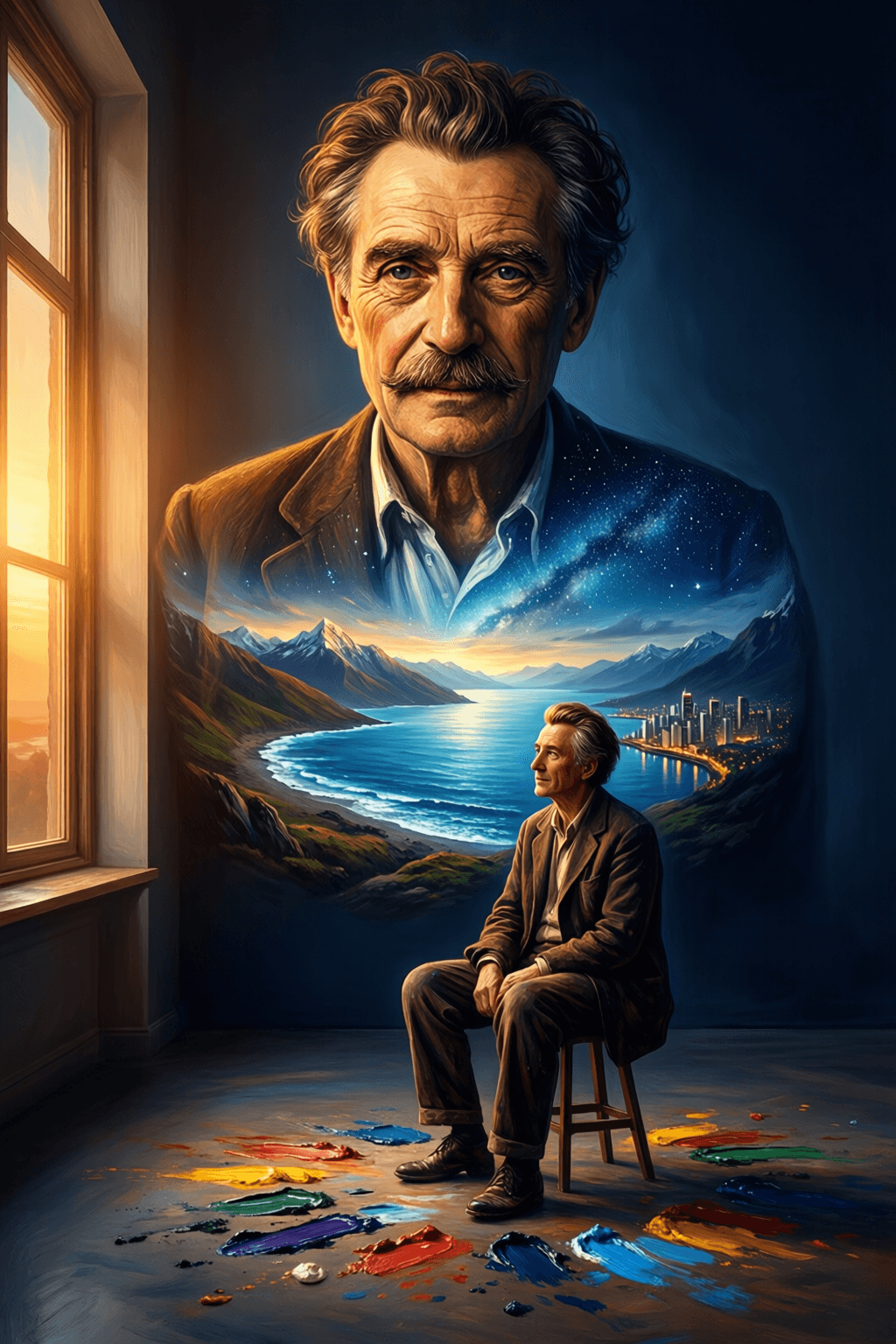
The artist works by locating the world in himself. — Gertrude Stein
—What lingers after this line?
The Inward Source of Creation
At first glance, Gertrude Stein’s line suggests that art does not begin with the outer world alone, but with the artist’s inner ability to absorb and reinterpret it. To ‘locate the world in himself’ means that experience must pass through perception, memory, emotion, and thought before it becomes meaningful creation. In this way, Stein shifts attention from imitation to transformation. Rather than copying reality as a camera might, the artist remakes it from within. Consequently, even when two artists observe the same street, face, or historical event, they produce radically different works. Stein’s insight reminds us that what matters in art is not merely what is seen, but how deeply it is inwardly lived.
Beyond Simple Representation
From this starting point, Stein’s remark also challenges the old idea that art’s highest task is faithful representation. Plato’s Republic (c. 375 BC) treated art with suspicion partly because it imitates appearances, yet Stein implies that true art is not a secondhand copy of the world. Instead, it is a reassembled reality shaped by consciousness. Accordingly, a painting of a bowl of fruit or a poem about rain is never just about fruit or rain. It carries the artist’s rhythm of attention, private associations, and emotional weather. What emerges, then, is not the world as a neutral object, but the world as intensely encountered by a singular mind.
Modernism and the Personal Lens
This idea fits naturally with Stein’s modernist context, which prized perception over convention. In works such as Tender Buttons (1914), Stein fractured ordinary language so that familiar objects appeared strange and freshly seen. Her method suggests that the artist does not merely report reality; instead, he discovers its hidden textures by filtering it through a personal lens. Likewise, painters like Cézanne, whom Stein admired, turned landscapes and still lifes into studies of inner structure rather than simple scenes. As a result, modernism often asks audiences to enter the artist’s way of seeing. Stein’s statement becomes, therefore, both a theory of art and a guide to how modern art should be read.
Experience as Artistic Material
Furthermore, Stein’s quotation implies that the artist’s life is not separate from his subject matter; it is the medium through which subject matter gains form. James Joyce’s A Portrait of the Artist as a Young Man (1916), for example, shows artistic consciousness developing by turning ordinary experience into imaginative substance. The world becomes art only after it has been metabolized by the self. This helps explain why biography, place, and temperament matter so much in creative work. A war, a childhood room, or a fleeting conversation may seem external, yet in art they reappear colored by private feeling. Thus the artist’s inner world is not a retreat from reality, but the workshop where reality is reshaped.
The Universal Through the Particular
Yet Stein’s point is not merely solipsistic, as though the artist cares only about himself. On the contrary, by locating the world within, the artist often reaches what is most widely human. Vincent van Gogh’s letters (1880s) reveal how deeply personal struggle informed his paintings, and nevertheless viewers across cultures recognize loneliness, hope, and intensity in his work. In other words, the more honestly the artist renders his inward encounter with life, the more others may find themselves reflected there. What begins as private sensation can become shared recognition. Stein’s sentence therefore captures a paradox at the heart of art: the personal is often the doorway to the universal.
A Lasting Definition of Artistic Vision
Finally, Stein offers a compact definition of artistic vision itself. The artist is not simply a collector of facts or scenes, but someone who internalizes reality so fully that it can be born again in another form. This is why great art often feels both intimate and expansive at once: it comes from one person’s depths, yet seems to contain an entire world. Seen this way, Stein’s statement remains enduring because it explains why art matters. It is one of the clearest proofs that reality is never merely out there; it becomes meaningful through consciousness. The artist’s task, then, is to turn inward not to escape the world, but to reveal it more completely.
One-minute reflection
Where does this idea show up in your life right now?
Related Quotes
6 selectedWhen you are offended at any man's fault, turn to yourself and study your own failings. Then you will forget your anger. — Epictetus
Epictetus
At its core, Epictetus urges a decisive change in direction: instead of fixing our attention on another person’s fault, we should examine our own weaknesses. This inward turn reflects the heart of Stoic ethics, especiall...
Read full interpretation →The artist must be a master of what he rejects. — Carlos Fuentes
Carlos Fuentes
At first glance, Carlos Fuentes’s remark suggests that artistic refusal is not mere negation but an act of deep knowledge. An artist earns the right to reject a style, convention, or influence only after understanding it...
Read full interpretation →It is a beautiful thing to be able to pause, to breathe, and to remember who you are. — Haemin Sunim
Haemin Sunim
Haemin Sunim’s words begin with something deceptively simple: the ability to pause. In a culture that often rewards speed, reaction, and constant productivity, stopping can feel almost radical.
Read full interpretation →The artist's duty is to stay in the fire, to keep the question alive long after the answers have gone cold. — Adrienne Rich
Adrienne Rich
Adrienne Rich presents the artist not as a maker of neat conclusions, but as someone willing to remain inside uncertainty. The image of “staying in the fire” suggests discomfort, risk, and sustained attention; in other w...
Read full interpretation →The artist must elect to fight for the beauty of the work, stitch by patient stitch, against the rush of the world. — Ursula K. Le Guin
Ursula K. Le Guin
Ursula K. Le Guin’s line begins with a deliberate verb: the artist must “elect.” In other words, beauty is not an accident or a luxury but a conscious choice made in resistance to haste.
Read full interpretation →The artist is a witness to the present moment, not a slave to the machine that wants to replace it. — bell hooks
bell hooks
At its core, bell hooks’s statement insists that art begins with presence. To be a witness to the present moment is to attend closely to lived reality—its tensions, beauties, wounds, and contradictions—rather than merely...
Read full interpretation →More From Author
More from Gertrude Stein →I'm not a mess but a deeply colored chaos. — Gertrude Stein
Gertrude Stein’s line begins by refusing a familiar label: “mess.” A mess implies carelessness, failure, or something in need of quick correction. By rejecting that word, she shifts the frame from judgment to self-defini...
Read full interpretation →To know what you prefer instead of finding it is always a joy. — Gertrude Stein
This quote emphasizes the joy and satisfaction that come with self-awareness. Knowing what you truly prefer or desire, rather than seeking it aimlessly, brings a sense of contentment.
Read full interpretation →