
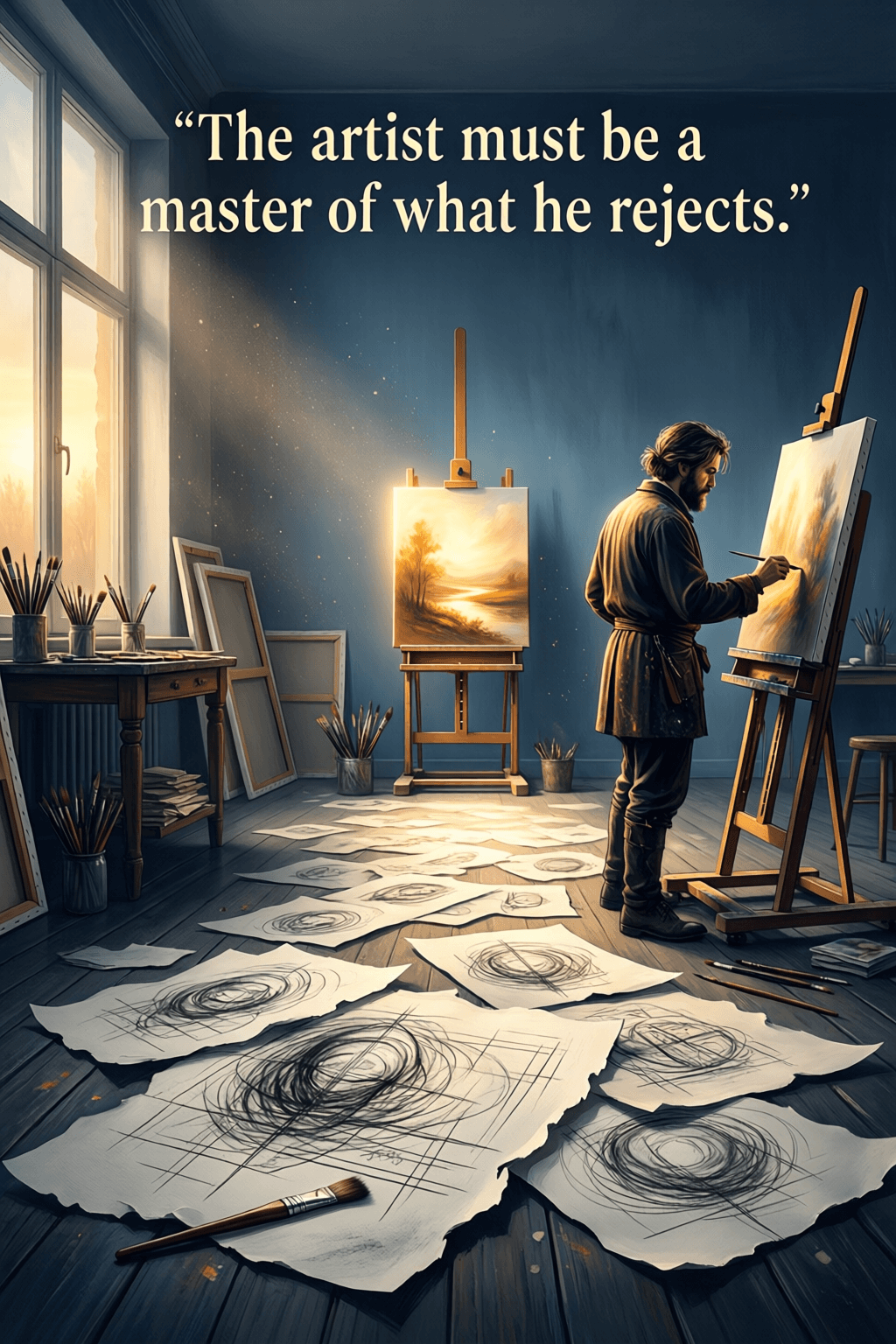
The artist must be a master of what he rejects. — Carlos Fuentes
—What lingers after this line?
Rejection as Informed Choice
At first glance, Carlos Fuentes’s remark suggests that artistic refusal is not mere negation but an act of deep knowledge. An artist earns the right to reject a style, convention, or influence only after understanding its inner logic. In this sense, refusal becomes more meaningful than rebellion for its own sake, because it grows from discipline rather than impulse. From there, the quote points to a larger truth about creative maturity: every strong artistic voice is shaped not only by what it embraces, but also by what it deliberately leaves behind. The artist who rejects without mastery risks sounding shallow; the artist who rejects from knowledge, however, transforms criticism into creation.
Tradition Before Innovation
Seen this way, innovation usually begins inside tradition rather than outside it. Pablo Picasso’s early academic drawings, produced before Cubism, show formidable command of anatomy and classical form; only after mastering representation could he convincingly fracture it. His later departures feel powerful precisely because they are informed, not accidental. Likewise, Igor Stravinsky’s musical revolutions did not emerge from ignorance of harmony or structure. Instead, works like The Rite of Spring (1913) startled audiences because they bent established rules with precision. Fuentes’s insight therefore reminds us that artistic breakthroughs often depend on intimate familiarity with what is being overturned.
The Discipline Behind Defiance
As a result, artistic defiance is often far more disciplined than it appears. What seems spontaneous or radical on the surface may rest on years of study, imitation, and refinement. Even movements that advertised themselves as anti-establishment, from Dada to abstract expressionism, were populated by figures deeply engaged with the histories they resisted. This matters because refusal without structure can collapse into vagueness. By contrast, when an artist knows exactly what is being denied—whether realism, tonal harmony, or linear narrative—the act of rejection gains form and force. Defiance then becomes a conscious aesthetic decision rather than a decorative pose.
A Dialogue with Influence
Furthermore, Fuentes implies that artists remain in conversation with the very influences they oppose. T. S. Eliot’s essay “Tradition and the Individual Talent” (1919) argues that new art reshapes its relation to the past rather than simply escaping it. In that light, rejection is not silence but dialogue: the artist answers predecessors by absorbing, testing, and revising them. This is why strong artistic identities often contain traces of what they resist. A novelist rejecting realism may still depend on realist detail to ground experimentation; a painter abandoning perspective may still use spatial tension inherited from it. What is refused continues to structure what is made.
The Ethics of Artistic Authority
Finally, the quote carries an ethical dimension. To dismiss a form carelessly is easy, but to reject it responsibly requires humility, labor, and competence. Fuentes suggests that authority in art does not come from loud opposition; it comes from having learned enough to choose differently with credibility. In the end, the artist’s refusal becomes a test of seriousness. Mastery proves that rejection is not based on ignorance or fashion, but on earned conviction. Thus the most compelling artists do not destroy tradition from afar—they confront it closely, master it fully, and only then move beyond it.
One-minute reflection
Where does this idea show up in your life right now?
Related Quotes
6 selectedThe artist must elect to fight for the beauty of the work, stitch by patient stitch, against the rush of the world. — Ursula K. Le Guin
Ursula K. Le Guin
Ursula K. Le Guin’s line begins with a deliberate verb: the artist must “elect.” In other words, beauty is not an accident or a luxury but a conscious choice made in resistance to haste.
Read full interpretation →The artist's duty is to stay in the fire, to keep the question alive long after the answers have gone cold. — Adrienne Rich
Adrienne Rich
Adrienne Rich presents the artist not as a maker of neat conclusions, but as someone willing to remain inside uncertainty. The image of “staying in the fire” suggests discomfort, risk, and sustained attention; in other w...
Read full interpretation →The artist is a witness to the present moment, not a slave to the machine that wants to replace it. — bell hooks
bell hooks
At its core, bell hooks’s statement insists that art begins with presence. To be a witness to the present moment is to attend closely to lived reality—its tensions, beauties, wounds, and contradictions—rather than merely...
Read full interpretation →It is not enough to know your craft – you have to have feeling. — Edouard Manet
Edouard Manet
At first glance, Manet’s remark seems simple: skill matters, but skill by itself is incomplete. To know one’s craft is to understand the mechanics—composition, color, timing, form, structure.
Read full interpretation →The position of the artist is humble. He is essentially a channel. — Piet Mondrian
Piet Mondrian
Mondrian’s statement begins by stripping away the romantic myth of the artist as an all-powerful genius. Instead, he places humility at the center of creation, suggesting that the artist does not dominate inspiration but...
Read full interpretation →Fine art is that in which the hand, the head, and the heart of man go together. — John Ruskin
John Ruskin
John Ruskin’s remark defines fine art as a union rather than a single talent. The hand represents skilled execution, the head stands for thought and judgment, and the heart brings feeling and moral sincerity.
Read full interpretation →More From Author
More from Carlos Fuentes →