
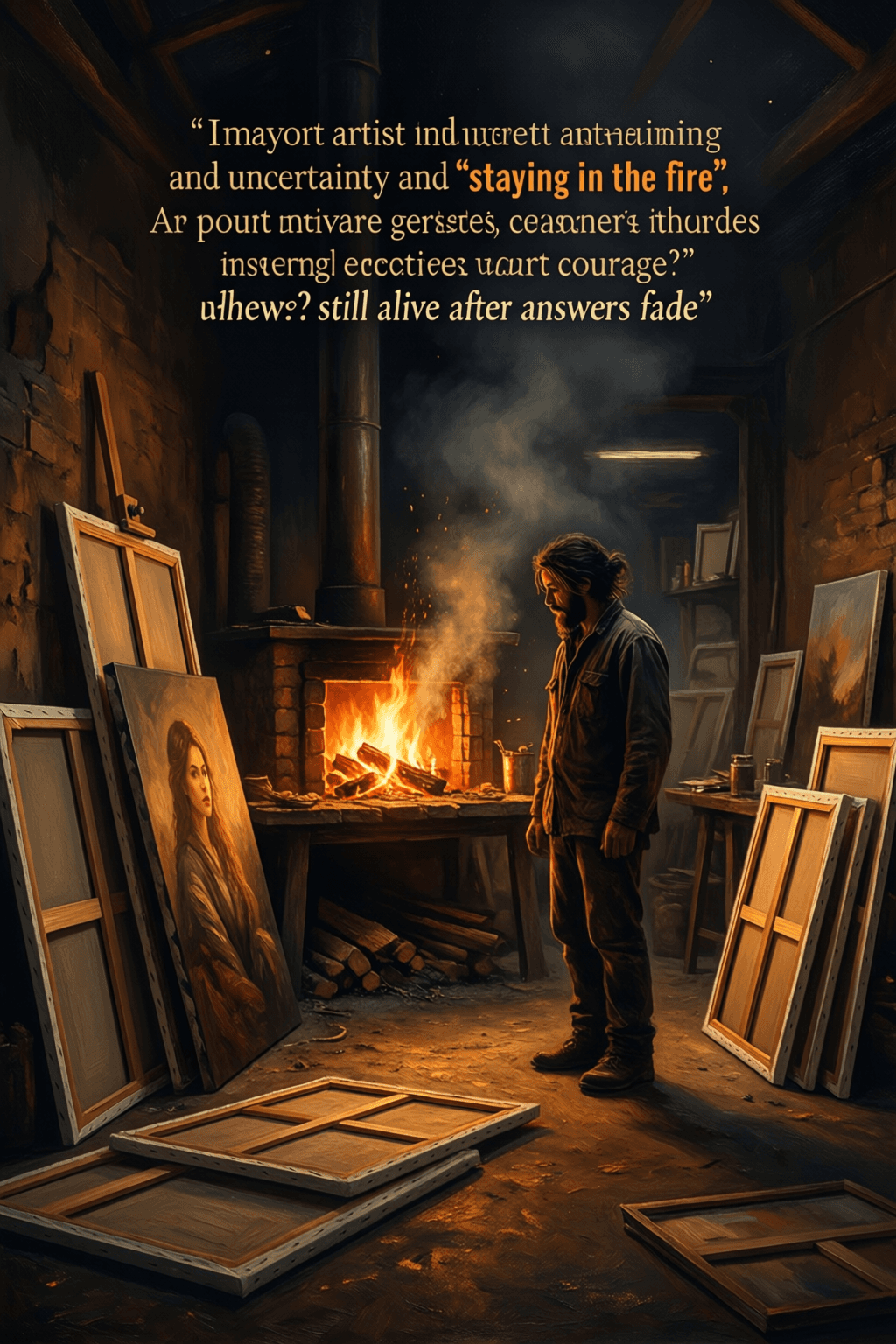
The artist's duty is to stay in the fire, to keep the question alive long after the answers have gone cold. — Adrienne Rich
—What lingers after this line?
Art as a Practice of Endurance
Adrienne Rich presents the artist not as a maker of neat conclusions, but as someone willing to remain inside uncertainty. The image of “staying in the fire” suggests discomfort, risk, and sustained attention; in other words, real art does not flee the heat of conflict or ambiguity. Instead, it endures them long enough to reveal what easy certainty tends to hide. From the outset, then, Rich reframes artistic duty as an ethical discipline. The artist must resist the cultural temptation to settle quickly, because many public answers harden into slogans and lose their vitality. By remaining with the unresolved question, art preserves human complexity and keeps inquiry alive where convention would prefer closure.
Why Questions Matter More Than Conclusions
Building on that idea, Rich elevates the question itself to something almost sacred. Answers, she implies, can “go cold”: they age, calcify, or become inadequate to changing realities. Questions, by contrast, remain generative. They provoke reflection, invite dissent, and create space for new meanings to emerge across time. This view places art closer to philosophy than propaganda. Socrates in Plato’s Apology (c. 399 BC) is remembered less for final doctrines than for relentless inquiry, and Rich’s artist inherits a similar role. Rather than delivering comfort, the artist keeps society intellectually awake, insisting that what seems settled may still conceal injustice, grief, or possibility.
The Fire of Moral and Political Witness
The metaphor of fire also carries a moral charge. To stay in it is to remain present to suffering, contradiction, and social struggle rather than turning away. Rich, whose poetry often confronted feminism, power, and political violence, suggests that the artist’s work includes witnessing what others would rather forget. In that sense, artistic duty is not passive sensitivity but active perseverance. Accordingly, this idea echoes works like Picasso’s Guernica (1937), which refuses to let the atrocity of war cool into abstraction. The painting does not solve violence; instead, it keeps the wound visible. Rich’s insight helps explain why enduring art often unsettles: it preserves the heat of reality long after official narratives have tried to extinguish it.
Creativity Beyond Easy Resolution
From there, Rich’s statement also speaks to the creative process itself. Many artists discover that their strongest work begins not with certainty but with a troubling, persistent problem—something they cannot fully explain. To “keep the question alive” is to trust that unresolved tension can generate form, voice, and imagination more powerfully than premature answers ever could. Virginia Woolf’s A Room of One’s Own (1929), for example, does not simply conclude the matter of women and creativity; it opens a field of ongoing inquiry about voice, freedom, and structural exclusion. Likewise, Rich reminds us that art remains alive when it refuses to tidy experience into formulas. The unfinished, the difficult, and the searching are often where originality begins.
Resisting a Culture of Quick Certainty
In a world saturated with instant opinions, Rich’s words feel especially urgent. Contemporary culture often rewards speed, confidence, and simplified conclusions, yet those habits can flatten thought. The artist, by contrast, serves as a counterforce, slowing perception and asking audiences to remain with what is inconvenient, painful, or unresolved. Therefore, the quote is also a warning against superficial clarity. When answers “have gone cold,” they may still circulate as familiar talking points, but they no longer illuminate lived experience. Art renews public conversation by restoring intensity to neglected questions, making us feel again the stakes of issues we assumed were already settled.
An Ongoing Responsibility to Human Truth
Ultimately, Rich defines art not as decoration but as fidelity to living truth. The artist’s duty is ongoing because human life itself is unfinished: identity changes, injustice mutates, memory deepens, and language must keep reaching for what it cannot fully contain. To remain in the fire is, finally, to accept that truth is often encountered through tension rather than resolution. Seen this way, the quote offers both challenge and encouragement. It asks artists to cultivate courage, patience, and intellectual honesty, but it also grants them a profound purpose. Even when old explanations fail, the artist can keep alive the questions that make renewal possible.
Recommended Reading
As an Amazon Associate, we earn from qualifying purchases.
One-minute reflection
What's one small action this suggests?
Related Quotes
6 selectedThe artist must elect to fight for the beauty of the work, stitch by patient stitch, against the rush of the world. — Ursula K. Le Guin
Ursula K. Le Guin
Ursula K. Le Guin’s line begins with a deliberate verb: the artist must “elect.” In other words, beauty is not an accident or a luxury but a conscious choice made in resistance to haste.
Read full interpretation →The artist must be a master of what he rejects. — Carlos Fuentes
Carlos Fuentes
At first glance, Carlos Fuentes’s remark suggests that artistic refusal is not mere negation but an act of deep knowledge. An artist earns the right to reject a style, convention, or influence only after understanding it...
Read full interpretation →The artist is a witness to the present moment, not a slave to the machine that wants to replace it. — bell hooks
bell hooks
At its core, bell hooks’s statement insists that art begins with presence. To be a witness to the present moment is to attend closely to lived reality—its tensions, beauties, wounds, and contradictions—rather than merely...
Read full interpretation →It is not enough to know your craft – you have to have feeling. — Edouard Manet
Edouard Manet
At first glance, Manet’s remark seems simple: skill matters, but skill by itself is incomplete. To know one’s craft is to understand the mechanics—composition, color, timing, form, structure.
Read full interpretation →The position of the artist is humble. He is essentially a channel. — Piet Mondrian
Piet Mondrian
Mondrian’s statement begins by stripping away the romantic myth of the artist as an all-powerful genius. Instead, he places humility at the center of creation, suggesting that the artist does not dominate inspiration but...
Read full interpretation →Fine art is that in which the hand, the head, and the heart of man go together. — John Ruskin
John Ruskin
John Ruskin’s remark defines fine art as a union rather than a single talent. The hand represents skilled execution, the head stands for thought and judgment, and the heart brings feeling and moral sincerity.
Read full interpretation →More From Author
More from Adrienne Rich →The moment of change is the only poem. — Adrienne Rich
Adrienne Rich’s line suggests that poetry does not merely describe transformation; rather, transformation itself is the deepest poetic event. By calling “the moment of change” the only poem, she strips poetry down to its...
Read full interpretation →Stand where doubts gather and teach them how to dissolve. — Adrienne Rich
Adrienne Rich’s line reads like a compass: do not flee uncertainty, inhabit it. To stand where doubts gather is to choose the charged threshold—classrooms, movements, draft pages—where confusion and possibility eddy toge...
Read full interpretation →Turn silence into action, and protest into repair. — Adrienne Rich
Adrienne Rich’s line marries urgency with responsibility: first convert silence into action, then transmute protest into repair. The pairing implies that speaking up and marching are not endpoints but bridges toward rebu...
Read full interpretation →Create the language you need for living; then speak it every day. — Adrienne Rich
Adrienne Rich’s imperative invites a shift from inheriting language to authoring it. Rather than letting received words confine experience, she urges us to coin names for what we actually live.
Read full interpretation →