
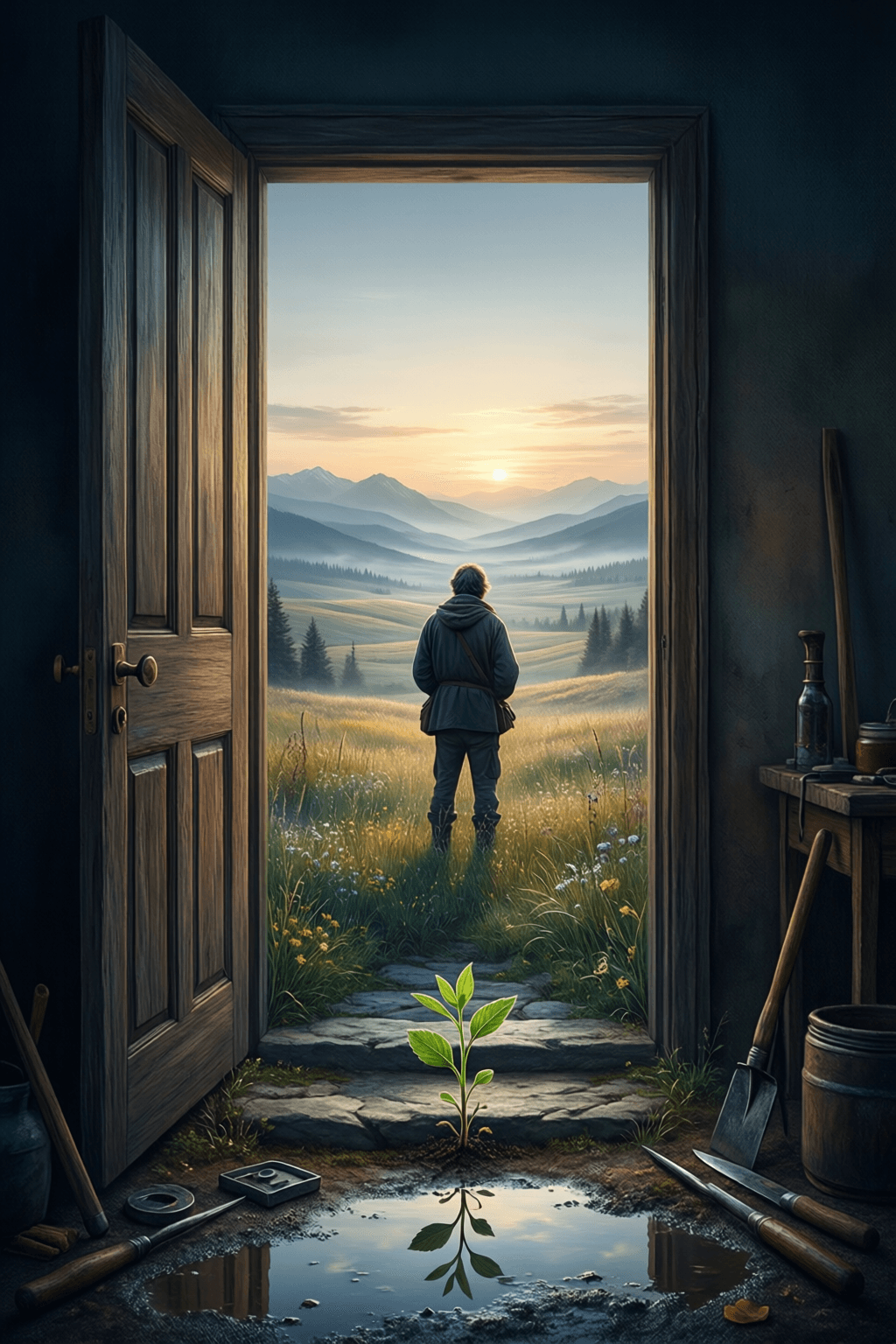
The artist's world is limitless. It can be found anywhere, far from where he lives or a few feet away. It is always on his doorstep. — Paul Strand
—What lingers after this line?
A World Without Borders
Paul Strand’s remark begins by dissolving the usual boundary between the near and the far. For the artist, the world is not limited by geography, prestige, or exotic distance; instead, it is limitless because perception itself is limitless. In that sense, creative vision does not wait for permission from place. It can discover meaning in a foreign city, yet equally in a familiar hallway, a street corner, or the light falling across a kitchen table. This idea immediately shifts the burden from travel to attention. Rather than asking where inspiration lives, Strand suggests that inspiration appears wherever the artist is willing to truly look. The doorstep becomes symbolic: it marks the threshold where ordinary life, once observed deeply, opens into inexhaustible artistic possibility.
The Discipline of Seeing Nearby
From that premise, Strand leads us toward a harder truth: what is close at hand is often the most difficult to see. Familiar surroundings can become invisible through habit, yet the artist trains against that numbness. A weathered fence, a neighbor’s face, or the geometry of shadows on a wall may seem trivial until attentive seeing restores their mystery and form. Here Strand’s own photography offers an implicit example. In works such as his street portraits and studies of everyday structures, he treated common subjects with a gravity usually reserved for monuments. Consequently, the nearby world becomes not a limitation but a testing ground, where the artist proves that vision matters more than novelty.
Distance as Imagination, Not Escape
At the same time, Strand does not deny the value of distant places; rather, he refuses to romanticize them. The faraway can certainly nourish an artist, but it does not automatically produce insight. One may cross oceans and still see superficially, just as one may remain at home and perceive with extraordinary depth. Therefore, distance matters only when it awakens consciousness rather than serving as a substitute for it. This perspective recalls Marcel Proust’s idea in In Search of Lost Time (1913–1927) that the real voyage of discovery lies not in seeking new landscapes, but in having new eyes. Strand’s statement belongs to that tradition. It reminds us that imagination is not an escape from reality, but a way of entering reality more completely.
The Democratic Nature of Inspiration
Because the artist’s world is ‘always on his doorstep,’ Strand’s thought also carries a quietly democratic message. Artistic material is not reserved for those with wealth, mobility, or access to celebrated cultural centers. Instead, every life is surrounded by forms, stories, textures, and human presences worthy of attention. A rural road, a crowded stoop, or a laundry line can hold as much artistic significance as any famous landmark. In this way, Strand resists the notion that art depends on rare settings. His philosophy aligns with painters and writers who found universes in local life—William Carlos Williams’s Paterson (1946–1958), for example, builds poetry from one American city and its textures. The artist’s task, then, is less to acquire a glamorous world than to recognize the richness already given.
Presence as Creative Responsibility
Ultimately, the quotation becomes a statement about responsibility as much as freedom. If the artist’s world is everywhere, then the artist cannot excuse creative failure by blaming place. The challenge is to remain awake—to cultivate presence so that each encounter, whether mundane or distant, may disclose form, feeling, and meaning. What appears ordinary is often only insufficiently attended to. Thus Strand’s closing image of the doorstep feels both comforting and demanding. It assures the artist that inspiration is near, yet it also insists on a discipline of receptivity. Art begins when one stands at that threshold and truly sees. From there, the limitless world does not need to be chased; it needs to be recognized.
One-minute reflection
What's one small action this suggests?
Related Quotes
6 selectedBuild your future in deeds; imagination is the blueprint, labor the bricks. — George Eliot
George Eliot
George Eliot’s line frames the future as something constructed through action rather than awaited as fate. By saying we “build” with “deeds,” she shifts attention from abstract wishing to concrete doing, implying that pr...
Read full interpretation →Paint the present with the colors of your future. — Haruki Murakami
Haruki Murakami
Murakami’s line frames the present as a canvas that is never neutral; it is always being colored by what we expect, fear, or hope will come next. Rather than treating “the future” as a distant destination, the quote sugg...
Read full interpretation →Dare to sketch the life you crave, then color it with action. — Toni Morrison
Toni Morrison
At first encounter, this line—often attributed to Toni Morrison—summons the courage to draft a vision before the world drafts one for you. A sketch is permission: a rough, honest outline of what you desire without the pr...
Read full interpretation →Be daring, be different, be impractical, be anything that will assert integrity of purpose and imaginative vision against the play-it-safers, the creatures of the commonplace, the slaves of the ordinary. — Cecil Beaton
Cecil Beaton
This quote encourages people to embrace their uniqueness and stand out from the crowd. It highlights the importance of being true to oneself and pursuing one's passions rather than conforming to societal norms.
Read full interpretation →Dare to be different; the world needs your unique vision. — Sylvia Plath
Sylvia Plath
This quote encourages people to embrace their uniqueness rather than conform to societal expectations. Authenticity is valuable, and everyone has something special to contribute.
Read full interpretation →Everything starts as somebody's daydream. — Larry Niven
Larry Niven
This quote emphasizes the idea that all creations, innovations, and advancements originate from someone's imagination or daydream. Visionaries often imagine what doesn't yet exist before making it real.
Read full interpretation →More From Author
More from Paul Strand →