
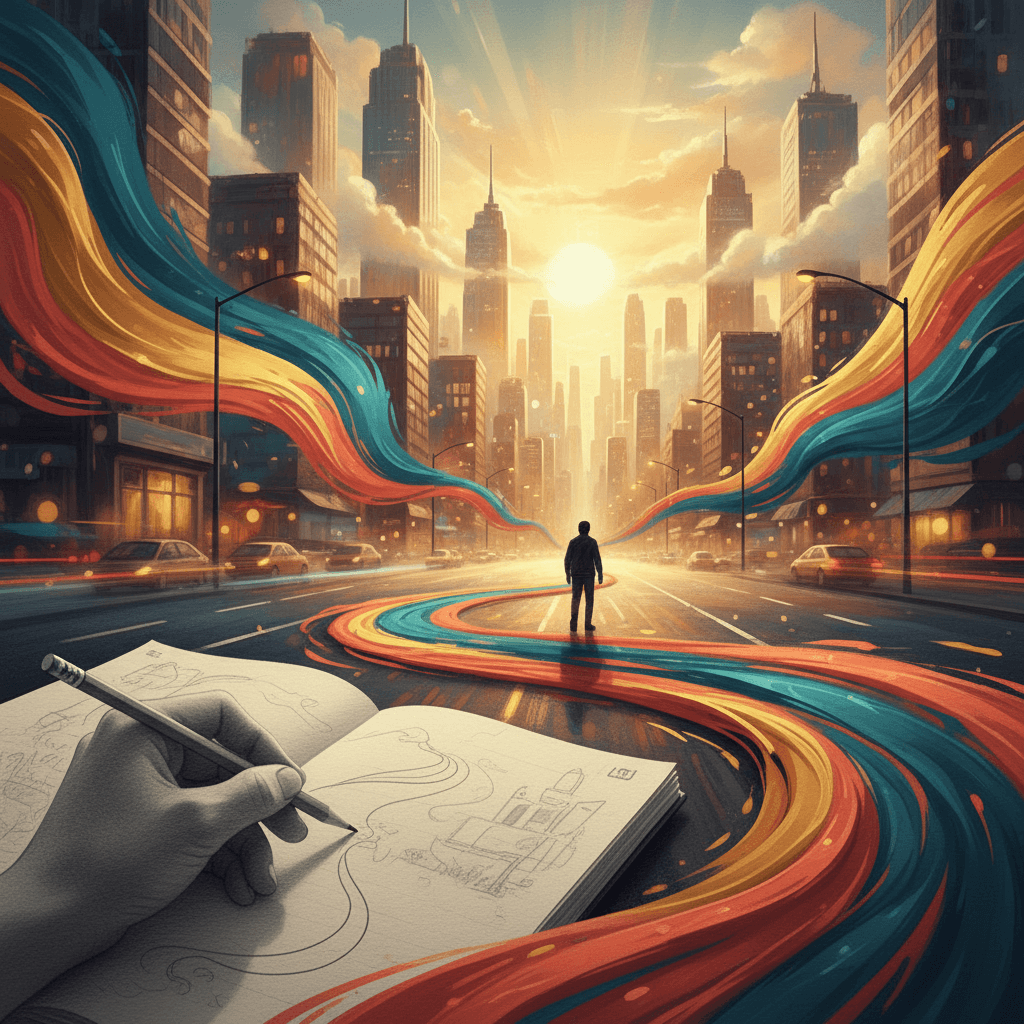
Dare to sketch the life you crave, then color it with action. — Toni Morrison
—What lingers after this line?
Imagining the First Lines
At first encounter, this line—often attributed to Toni Morrison—summons the courage to draft a vision before the world drafts one for you. A sketch is permission: a rough, honest outline of what you desire without the pressure of perfection. Morrison’s Nobel Lecture (1993) insists that language is our measure—“We die. That may be the meaning of life. But we do language. That may be the measure of our lives.” In other words, naming your longing is not idle talk; it is the first act of authorship. Yet outlines remain pale without pigment. The move from imagining to inhabiting depends on how boldly we take the next step, which is why the quote’s second clause shifts the metaphor from pencil to paint.
From Outline to Pigment: Action’s Demand
Color arrives with doing—texture, depth, and contrast appear only when brush meets canvas. The wisdom is old: Benjamin Franklin’s Poor Richard’s Almanack (1737) reminds, “Well done is better than well said.” Morrison’s fiction likewise marries vision to decisive movement; Sethe in Beloved (1987) acts, however painfully, to claim a future, and Milkman in Song of Solomon (1977) leaves home to pursue roots and responsibility. Even so, action is not a reckless splash. It is a series of deliberate strokes that respect the sketch while transforming it. Thus, the question becomes practical: how do we bridge the gap between craving and consistent doing?
The Psychology of Moving From Desire to Doing
Research offers sturdy scaffolding. Peter Gollwitzer’s work on implementation intentions (1999) shows that if-then plans—“If it’s 7 a.m., then I run”—significantly increase follow-through by pre-committing action to cues. Complementing this, Gabriele Oettingen’s mental contrasting and WOOP method (Rethinking Positive Thinking, 2014) pairs vivid wishing with obstacles and concrete next steps, preventing daydreams from draining energy. These tools turn hazy craving into executable habits. And as the first small actions lay down color, feedback arrives, guiding the next stroke. Which is why the creative life is less a single masterpiece than a portfolio of informed revisions.
Drafts, Revisions, and Lived Experiments
Artists and makers rarely trust a first pass. Beethoven’s sketchbooks (c. 1801–1825) reveal symphonies built through relentless revision—proof that greatness often looks like a messy margin before it sounds like music. Similarly, design thinking at IDEO and the Stanford d.school advocates prototype–test–learn cycles that turn guesses into grounded knowledge. In life, iteration means treating choices as experiments: try a course, gather data, refine the palette. Occasionally you will color outside the lines; that is not failure but discovery. And discovery, in turn, thrives in the company you keep.
Community as the Studio’s Good Light
We color more bravely when others hold the canvas steady. Morrison’s own editorial tenure at Random House (1967–1983) shows how vision becomes communal action: she championed Black writers such as Toni Cade Bambara and Gayl Jones, edited Angela Davis: An Autobiography (1974), and curated The Black Book (1974), stitching neglected histories into public view. Her studio was a network, not a room. Surrounding yourself with mentors, peers, and readers creates feedback, accountability, and momentum. And as momentum builds, another discipline becomes essential: choosing where not to paint.
Choosing What Not to Color
Constraints sharpen intention. John Maeda’s The Laws of Simplicity (2006) argues that simplicity “is about subtracting the obvious and adding the meaningful,” while Barry Schwartz’s The Paradox of Choice (2004) shows how excess options can paralyze decisions. By limiting your palette—time blocks, priority lists, clear noes—you amplify saturation where it counts. Thus the cycle completes: dare to sketch with language, color with aligned action, revise through evidence, lean on community, and prune for clarity. In this way, the life you crave stops being a picture on the wall and becomes a room you live in.
One-minute reflection
What does this quote ask you to notice today?
Related Quotes
6 selectedSketch the life you crave, then build the courage to live inside that sketch. — Frida Kahlo
Frida Kahlo
Often attributed to Frida Kahlo, the exhortation begins with a deliberate act of imagination: sketch the life you crave. A sketch is not a final verdict but a guiding outline, much like Kahlo’s self-portraits that mapped...
Read full interpretation →The artist's world is limitless. It can be found anywhere, far from where he lives or a few feet away. It is always on his doorstep. — Paul Strand
Paul Strand
Paul Strand’s remark begins by dissolving the usual boundary between the near and the far. For the artist, the world is not limited by geography, prestige, or exotic distance; instead, it is limitless because perception...
Read full interpretation →Act with care, move with purpose, and leave behind a trail people want to follow. — Viktor Frankl
Viktor Frankl
The opening directive—“Act with care”—frames life as something shaped by attention rather than impulse. Care here is not mere gentleness; it is the discipline of considering consequences, especially when other people’s d...
Read full interpretation →Build your future in deeds; imagination is the blueprint, labor the bricks. — George Eliot
George Eliot
George Eliot’s line frames the future as something constructed through action rather than awaited as fate. By saying we “build” with “deeds,” she shifts attention from abstract wishing to concrete doing, implying that pr...
Read full interpretation →Arrive at your future by stepping into the present with purpose. — Sappho
Sappho
Sappho’s line turns the usual timeline on its head: instead of chasing the future as a distant place, she frames it as something we “arrive at” by how we inhabit today. The future becomes less like a destination you stum...
Read full interpretation →Paint the present with the colors of your future. — Haruki Murakami
Haruki Murakami
Murakami’s line frames the present as a canvas that is never neutral; it is always being colored by what we expect, fear, or hope will come next. Rather than treating “the future” as a distant destination, the quote sugg...
Read full interpretation →More From Author
More from Toni Morrison →The building of the architecture of a novel - the craft of it - is something I never tire of. — Toni Morrison
At its core, Toni Morrison’s remark celebrates not merely storytelling, but the deliberate construction behind it. By speaking of the “architecture of a novel,” she shifts attention from inspiration alone to design, sugg...
Read full interpretation →The role of art has never been to escape reality, but to help us understand it. — Toni Morrison
At first glance, art is often treated as a refuge from hardship, a private world where pain can be softened or forgotten. Toni Morrison overturns that expectation by arguing that art’s deeper purpose is not avoidance but...
Read full interpretation →The ability to endure is the discipline of the soul. — Toni Morrison
Toni Morrison’s line shifts endurance from a mere survival trait into a deliberate inner practice: a discipline cultivated in the soul. Rather than glorifying pain for its own sake, she suggests that the capacity to cont...
Read full interpretation →You are your best thing. — Toni Morrison
Toni Morrison’s line, “You are your best thing,” quietly overturns a common habit: looking outward for proof of worth. Instead of treating love, status, or achievement as the final measure, the quote plants value inside...
Read full interpretation →