
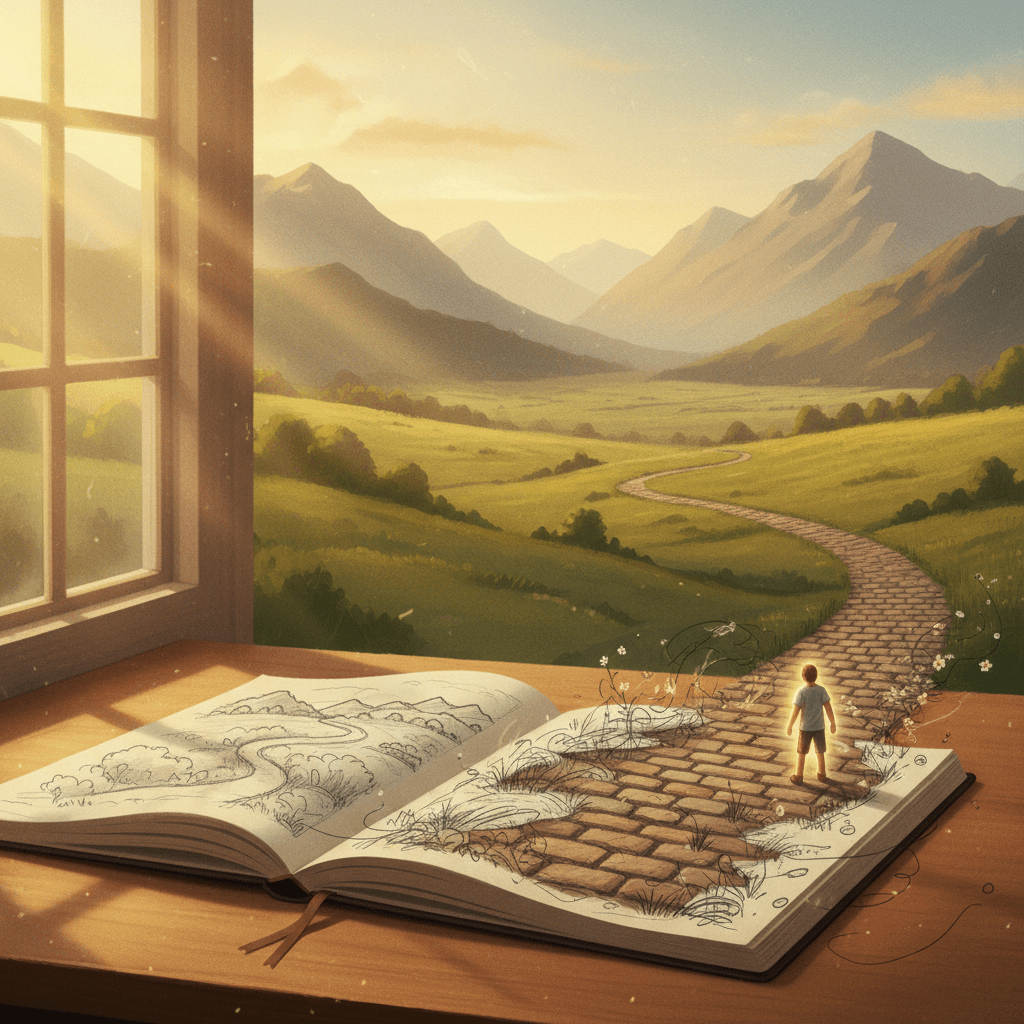
Sketch the life you crave, then build the courage to live inside that sketch. — Frida Kahlo
—What lingers after this line?
Sketching as a Blueprint for Becoming
Often attributed to Frida Kahlo, the exhortation begins with a deliberate act of imagination: sketch the life you crave. A sketch is not a final verdict but a guiding outline, much like Kahlo’s self-portraits that mapped identity as a work in progress. Her Self-Portrait with Cropped Hair (1940), painted after a rupture with Diego Rivera, reframed her image with masculine attire and shears, announcing a chosen reinvention. In this sense, the sketch is a commitment device; by seeing it, you begin to become it. The paper becomes a mirror that reflects possibility rather than just the present.
Courage as a Structure You Build
Building on that vision, courage does not arrive fully furnished; it is assembled through repeated acts. Psychology calls this self-efficacy, the confidence gained from mastery experiences that Albert Bandura (1977) describes as the engine of agency. Micro-bravery—small, specific risks like sharing a draft, asking for feedback, or booking a first show—stacks into sturdier beams. As each beam holds, a person trusts the structure more, and the sketch ceases to be fantasy. Thus courage becomes carpentry: measured cuts, reliable joints, and load-bearing habits that keep your imagined life standing.
Transforming Pain into Architecture
Yet sketches meet reality’s weight, and here Kahlo’s life offers a stark instruction manual. After a bus accident left her with chronic pain, she converted suffering into form: The Broken Column (1944) depicts her body fissured yet upright; Henry Ford Hospital (1932) renders grief with surreal clarity. Rather than abandon the drawing, she reinforced it with truth, making room for hardship inside the design. Therefore, courage is not the absence of injury but the art of load distribution. When pain is acknowledged and integrated, the structure flexes without collapsing.
From Vision to Practice: Implementation
Consequently, the passage from sketch to dwelling runs through precise plans. Peter Gollwitzer’s research on implementation intentions (1999) shows that if-then scripts turn vague aims into reliable action: If it is 7 a.m., then I draft for 25 minutes. Prototyping also matters; test a gallery pitch by showing two pieces to a friend, then to a local curator, before a full submission. By shrinking the risk and sequencing the steps, you transform walls into doorways. The sketch gains contours because you give it calendar space, social witnesses, and repeatable cues.
The Courage of Companionship
Moreover, few structures stand alone. Casa Azul, Kahlo’s home, functioned as a creative nexus, hosting dialogue with Diego Rivera and even sheltering Leon Trotsky in 1937, showing how rooms fill with shared momentum. Social support, as Cohen and Wills (1985) argue, buffers stress and emboldens action. When others hold a corner of your blueprint, your courage spreads across more hands and wobbles less. Communities lend scaffolding: critique sessions, shared studios, and mentors who normalize stumbles. In such company, fear becomes a manageable load rather than a solitary burden.
Redrawing the Lines: Iteration and Integrity
Finally, living inside your sketch requires periodic redrawing to keep integrity with evolving values. Kahlo’s Self-Portrait on the Borderline between Mexico and the United States (1932) places her between competing worlds, signaling that identity can be both bridge and boundary. Growth mindset research by Carol Dweck (2006) supports this ethos: revisions reflect learning, not failure. When you update proportions, swap materials, or open new windows, you protect the original promise while letting it breathe. In this way, you do not merely inhabit a design; you continually craft a home that fits the life you are brave enough to live.
One-minute reflection
What feeling does this quote bring up for you?
Related Quotes
6 selectedDare to live the life you have dreamed for yourself. Go forward and make your dreams come true. — Ralph Waldo Emerson
Ralph Waldo Emerson
This quote encourages individuals to have the bravery and determination to follow their dreams. It emphasizes the importance of stepping outside one's comfort zone to pursue what one truly desires in life.
Read full interpretation →The artist's world is limitless. It can be found anywhere, far from where he lives or a few feet away. It is always on his doorstep. — Paul Strand
Paul Strand
Paul Strand’s remark begins by dissolving the usual boundary between the near and the far. For the artist, the world is not limited by geography, prestige, or exotic distance; instead, it is limitless because perception...
Read full interpretation →Build your future in deeds; imagination is the blueprint, labor the bricks. — George Eliot
George Eliot
George Eliot’s line frames the future as something constructed through action rather than awaited as fate. By saying we “build” with “deeds,” she shifts attention from abstract wishing to concrete doing, implying that pr...
Read full interpretation →Paint the present with the colors of your future. — Haruki Murakami
Haruki Murakami
Murakami’s line frames the present as a canvas that is never neutral; it is always being colored by what we expect, fear, or hope will come next. Rather than treating “the future” as a distant destination, the quote sugg...
Read full interpretation →Dare to sketch the life you crave, then color it with action. — Toni Morrison
Toni Morrison
At first encounter, this line—often attributed to Toni Morrison—summons the courage to draft a vision before the world drafts one for you. A sketch is permission: a rough, honest outline of what you desire without the pr...
Read full interpretation →Be daring, be different, be impractical, be anything that will assert integrity of purpose and imaginative vision against the play-it-safers, the creatures of the commonplace, the slaves of the ordinary. — Cecil Beaton
Cecil Beaton
This quote encourages people to embrace their uniqueness and stand out from the crowd. It highlights the importance of being true to oneself and pursuing one's passions rather than conforming to societal norms.
Read full interpretation →More From Author
More from Frida Kahlo →I paint flowers so they will not die. — Frida Kahlo
Frida Kahlo’s line reads like a gentle spell: by painting flowers, she resists the most ordinary tragedy—things fading despite our care. A bouquet wilts, a season ends, a beloved moment slips away; the canvas, however, o...
Read full interpretation →I tried to drown my sorrows, but the bastards learned how to swim. — Frida Kahlo
Frida Kahlo’s line opens with the familiar promise of escape—“I tried to drown my sorrows”—and then snaps into a punchline that refuses sentimentality. The sudden insult, “the bastards,” is more than comic shock; it’s a...
Read full interpretation →I used to think I was the strangest person in the world, but there must be someone just like me who feels bizarre and flawed. — Frida Kahlo
Frida Kahlo’s reflection begins in a familiar loneliness: the belief that one’s inner life is uniquely strange, even irredeemably flawed. That kind of self-story can make ordinary differences feel like permanent exile.
Read full interpretation →Embrace risk as the price of progress; comfort keeps the clock of your life frozen. — Frida Kahlo
Frida Kahlo’s line frames progress as a purchase: you pay for it with risk. In that sense, “embrace” is not a motivational flourish but an instruction to stop treating uncertainty as an error and start treating it as a t...
Read full interpretation →