
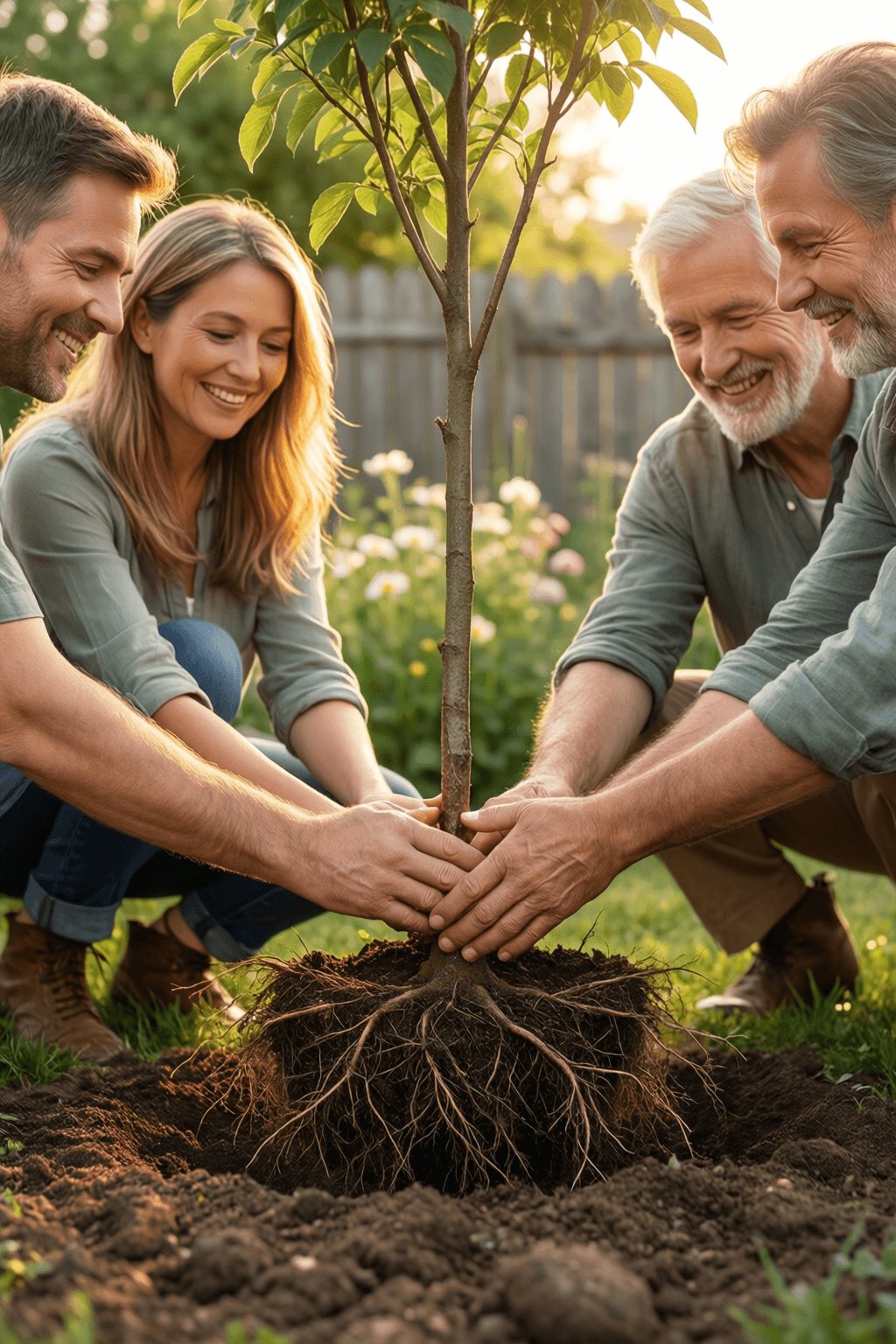
The beauty of a life well-lived is measured by the depth of the roots you grow into the lives of those standing right beside you. — Wendell Berry
—What lingers after this line?
Beauty Measured by Connection
At first glance, Wendell Berry shifts our idea of a successful life away from personal achievement and toward human closeness. The beauty of living well, he suggests, is not counted in status, wealth, or visibility, but in the quiet depth of the bonds we cultivate with the people beside us. In this way, a meaningful life becomes something relational rather than solitary. Just as roots are hidden yet essential, our strongest contributions often take place in ordinary companionship: showing up, listening well, and remaining present over time. Berry’s image reminds us that the richest forms of influence are often invisible from a distance, even as they sustain entire lives.
The Meaning of Roots
Building on that image, the metaphor of roots carries unusual force because roots do not merely touch the ground—they anchor, nourish, and hold. To grow roots into another person’s life is to become part of their stability, offering care that is steady rather than dramatic. Berry’s language implies endurance: a life well-lived is one that stays, supports, and strengthens. This idea echoes the moral imagination found throughout Berry’s essays, especially in works like The Unsettling of America (1977), where he argues that health—whether of land or community—depends on long-term belonging. In that sense, roots symbolize more than affection; they represent commitment embodied over years.
The Value of Those Beside You
From there, the phrase “those standing right beside you” becomes especially important. Berry does not direct our attention toward distant crowds or abstract humanity first; instead, he points to the immediate people who share our daily world. The quote gently corrects the temptation to seek meaning in grand gestures while neglecting family, friends, neighbors, and companions. Indeed, many ethical traditions make the same turn toward nearness. In Luke 10, the parable of the Good Samaritan locates moral action in response to the person directly before us. Likewise, Berry suggests that the measure of our lives may be found less in how widely we are known than in how faithfully we attend to those closest at hand.
Ordinary Presence as Legacy
Consequently, Berry redefines legacy in humble but profound terms. A person may leave no monument and still have lived beautifully if they have given others courage, belonging, and memory. The roots we grow into other lives become part of what remains after us: habits of kindness, resilience learned through love, and a sense of being accompanied. This perspective brings to mind George Eliot’s closing line in Middlemarch (1871), which honors the “unhistoric acts” on which much of the world depends. Berry’s thought moves in a similar direction, praising the unnoticed forms of devotion that quietly shape generations.
A Challenge to Modern Individualism
At the same time, the quotation offers a subtle critique of modern individualism. Contemporary culture often celebrates independence, self-invention, and personal distinction, yet Berry reminds us that a life cut off from mutual obligation may appear impressive while remaining spiritually shallow. To be deeply rooted in others requires vulnerability, patience, and a willingness to let one’s life be entwined with theirs. Therefore, the quote resists the fantasy of the self-made person. Like a tree that cannot thrive without soil, water, and surrounding ecology, no human life becomes beautiful in isolation. Berry’s wisdom invites us to see interdependence not as weakness, but as the very condition of flourishing.
Living the Quote in Daily Life
Finally, Berry’s words become most powerful when treated not merely as reflection but as instruction. They ask us to consider whether we are growing shallow networks of contact or deep roots of care. The answer may lie in simple practices: keeping promises, making time, remembering another’s grief, and offering steadiness when life becomes uncertain. In the end, a well-lived life may look less like constant motion and more like faithful presence. By rooting ourselves in the lives of those beside us, we create a beauty that cannot be easily measured yet is unmistakably felt—a beauty made visible in trust, love, and the strength we leave in one another.
Recommended Reading
As an Amazon Associate, we earn from qualifying purchases.
One-minute reflection
What does this quote ask you to notice today?
Related Quotes
6 selectedOne of the most important things about being a human being is feeling like you belong. — Dr. Bruce Perry
Dr. Bruce Perry
Dr. Bruce Perry’s statement begins with a simple but profound truth: human beings do not thrive in isolation.
Read full interpretation →True milestones are not found in our public achievements, but in the quiet, transformative moments of connection we share with those we hold dear. — Chimamanda Ngozi Adichie
Chimamanda Ngozi Adichie
At first glance, Adichie’s quote gently overturns a common modern assumption: that the most important markers of a life are public victories, titles, or visible accomplishments. Instead, she redirects our attention towar...
Read full interpretation →The things that you do for yourself are gone when you are gone, but the things that you do for others remain as your legacy. — Kalu K. Ndukwe Kalu
Kalu K. Ndukwe Kalu
At its heart, Kalu K. Ndukwe Kalu’s quote redirects attention from personal gain to shared impact.
Read full interpretation →The need to be known by another person is older and deeper and stronger than any algorithm ever built. — David Brooks
David Brooks
At its core, David Brooks’s statement points to a need that predates technology by millennia: the desire to be truly known by another human being. This is not merely a wish for attention or approval, but for recognition...
Read full interpretation →Mastery is more than technique. It's legacy, it's tradition, and it's worth preserving. — Art of Mastery
Art of Mastery
At first glance, mastery may seem like the highest refinement of technique, the polished result of repetition and control. Yet this quote insists that technical ability, while essential, is only the visible surface of so...
Read full interpretation →The older I get, the more convinced I am that the space between people who are trying their best to understand each other is hallowed ground. — Fred Rogers
Fred Rogers
Fred Rogers frames understanding not as a finished achievement but as a shared attempt, and that distinction matters. By calling the space between people “hallowed ground,” he suggests that dignity arises whenever two in...
Read full interpretation →More From Author
More from Wendell Berry →To cultivate anything—a garden, a skill, a soul—requires the courage to wait for what you have planted. — Wendell Berry
At first glance, Wendell Berry’s quote seems to praise patience, yet it goes further by naming patience as courage. To plant anything—a seed, a habit, a belief in oneself—is to act without immediate proof of success.
Read full interpretation →Nobody can discover the world for somebody else. Only when we discover it for ourselves does it become common ground and a common bond. — Wendell Berry
Wendell Berry begins with a simple but demanding truth: no one can hand another person a fully lived understanding of the world. Facts can be taught, maps can be drawn, and advice can be offered, yet genuine knowledge re...
Read full interpretation →We must learn to treat our own hearts with the same patience and steady hand we would offer to a piece of fine, delicate wood. — Wendell Berry
Wendell Berry’s line begins with a striking comparison: the human heart is like fine, delicate wood, something beautiful yet easily damaged by haste or rough treatment. In that image, he shifts self-regard away from judg...
Read full interpretation →You are not a machine designed to be productive 24/7. Even the most fertile land must lie fallow to produce a harvest again. — Wendell Berry
Wendell Berry’s line begins by challenging a modern assumption: that our worth is measured by constant productivity. By stating plainly that you are “not a machine,” he re-centers the conversation on human limits—physica...
Read full interpretation →