
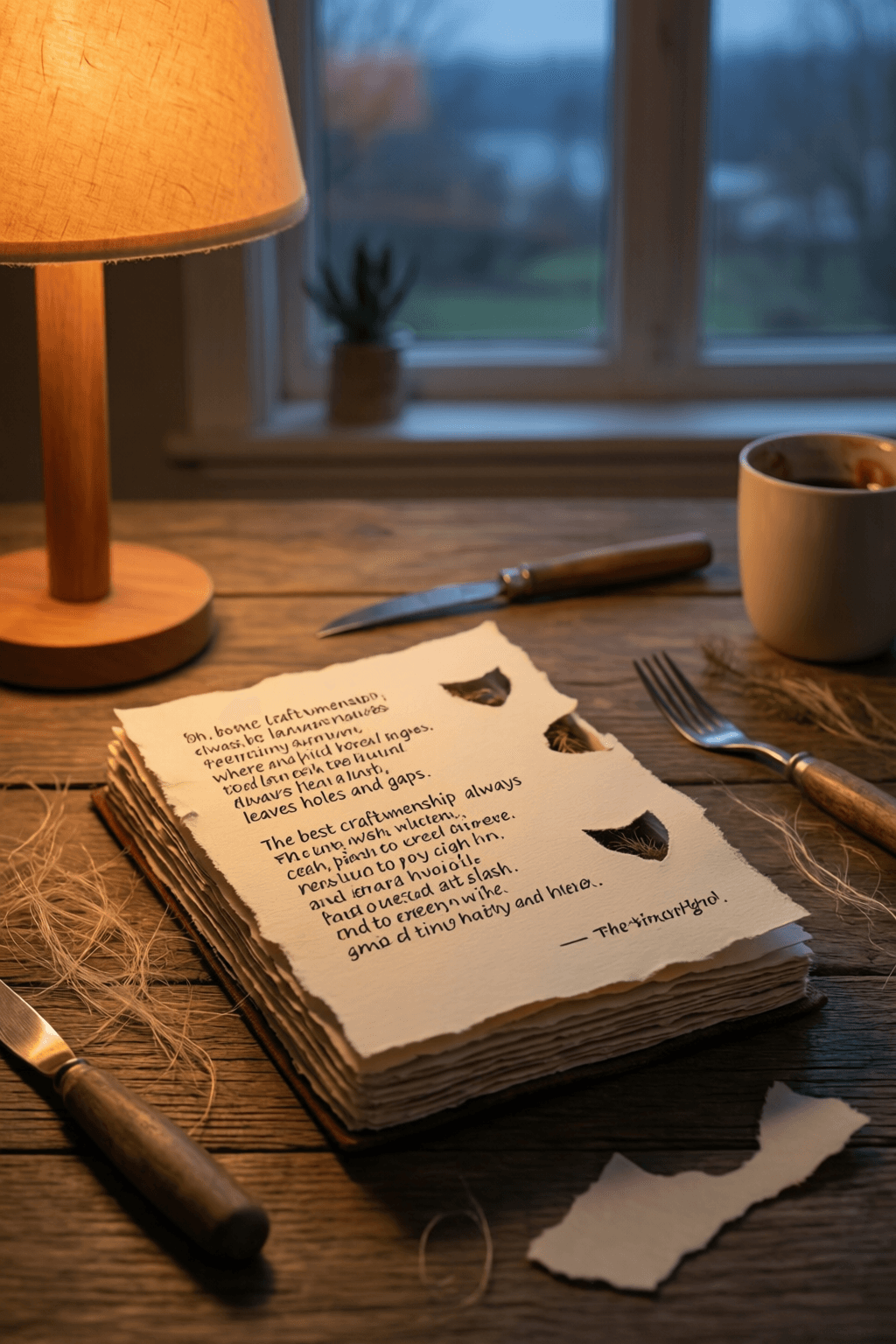
The best craftsmanship always leaves holes and gaps... so that something that is not in the poem can creep, crawl, flash or thunder in. — Dylan Thomas
—What lingers after this line?
The Meaning of Deliberate Openings
At first glance, Dylan Thomas seems to praise incompleteness, yet his point is more subtle: the finest art is not sealed shut. By leaving “holes and gaps,” a poem makes room for forces beyond the writer’s direct control—emotion, memory, silence, and surprise. In this view, craftsmanship is not the elimination of uncertainty but the shaping of a form spacious enough to receive it. This idea reframes mastery itself. Rather than proving skill through total explanation, the poet demonstrates confidence by withholding just enough. As a result, what is absent becomes active, and the reader begins to participate in making meaning.
Why Omission Can Deepen Meaning
From that starting point, Thomas’s image suggests that omission is not a flaw but a source of vitality. When every feeling is named and every symbol decoded, a poem can become static. By contrast, a carefully placed gap invites the unsaid to “creep, crawl, flash or thunder in,” giving language an afterlife beyond the page. This principle appears across literary tradition. Emily Dickinson’s compressed lyrics, especially poems like “Tell all the truth but tell it slant” (c. 1868), rely on indirection to intensify rather than weaken meaning. What remains unstated often becomes the very thing that echoes longest in the reader’s mind.
The Reader as Co-Creator
Because these openings exist, the reader is no longer a passive receiver. Instead, each gap becomes an invitation to enter the poem with one’s own associations, fears, and memories. Thomas’s language—“creep, crawl, flash or thunder”—suggests that what enters may be subtle or overwhelming, but in either case it completes the poem differently for each person. In that sense, the poem is never entirely finished by the poet alone. Reader-response critics such as Wolfgang Iser, in The Implied Reader (1974), argued that literary works contain blanks the audience must fill. Thomas anticipates this insight poetically, presenting absence as the very space where literature becomes alive.
Craftsmanship Beyond Perfection
Moreover, Thomas challenges the common belief that great craft means seamless polish. His remark implies the opposite: perfection that leaves no entry point may feel airless. True craftsmanship lies in knowing where to stop, where to resist overstatement, and where to preserve a charged silence. This is why many enduring works feel both precise and open. T. S. Eliot’s The Waste Land (1922), for example, is meticulously constructed, yet its fragments and discontinuities create spaces for ambiguity and resonance. The poem’s power comes not despite its gaps but partly because of them.
The Energy of What Cannot Be Controlled
Thomas’s verbs also matter. What enters the poem does not politely arrive; it “creeps, crawls, flashes or thunders.” That sequence suggests that the excluded element may be eerie, organic, sudden, or sublime. Consequently, the poet is not merely allowing interpretation but welcoming energies that exceed intention itself. This reflects a long Romantic and modernist faith that art should admit the unpredictable. Samuel Taylor Coleridge’s writings on imagination in Biographia Literaria (1817) similarly value the shaping power of art without reducing it to mechanical order. Craft, then, becomes a collaboration between design and intrusion.
Why the Quote Still Matters
Finally, Thomas’s insight remains compelling because it applies far beyond poetry. The best stories, paintings, speeches, and even conversations often leave room for implication, allowing others to bring their own life into the form. In an age that often demands instant clarity and exhaustive explanation, his words defend mystery as a mark of strength rather than weakness. Ultimately, the quote suggests that art endures not when it says everything, but when it creates a charged openness. The greatest craftsmanship does not close the world out; instead, it builds a threshold through which the unknown can enter.
One-minute reflection
What's one small action this suggests?
Related Quotes
6 selectedI would almost prefer the word 'craftsman'. He is like one of those old-fashioned ship builders who conceived the build of the boat in their mind and after that touched every single piece. — William Golding
William Golding
At first glance, Golding’s preference for the word “craftsman” shifts attention away from the romantic image of effortless genius and toward disciplined making. The term suggests someone who does not merely imagine a wor...
Read full interpretation →The object with visible human error, with a maker behind it, with time baked into its surface, is the luxury of the AI age. — Venkatesh Rao
Venkatesh Rao
At first glance, Venkatesh Rao’s line reframes luxury in a striking way: instead of rarity defined by price or exclusivity, he points to objects that visibly carry human touch. In an age when AI can generate flawless tex...
Read full interpretation →Proficiency in a craft is essential to every artist. Therein lies the prime source of creative imagination. — Walter Gropius
Walter Gropius
At first glance, Walter Gropius’s statement may seem to place discipline above inspiration, yet his deeper point is that imagination needs a workable form. An artist who understands materials, structure, and technique ca...
Read full interpretation →Craftsmanship is the visible edge of art. — David Bayles
David Bayles
At first glance, David Bayles’s line suggests that craftsmanship is the point where inner vision becomes outward form. Art may begin in imagination, intuition, or feeling, but it only enters the world through skillful ex...
Read full interpretation →Craftsmanship is the quality of design, shown in something by the skill, time, and attention to detail put in by the artist. — Canvs Editorial
Canvs Editorial
At its core, this statement presents craftsmanship as visible care. Design is not treated as mere decoration, but as the outward result of discipline, patience, and practiced skill.
Read full interpretation →The task of a craftsman is not to generate meaning, but rather to cultivate in himself the skill of discerning the meanings that are already there. — Cal Newport
Cal Newport
At its core, Cal Newport’s quote overturns a popular modern assumption: that fulfillment is something we simply fabricate through self-expression alone. Instead, he argues that meaning already exists in the structure of...
Read full interpretation →More From Author
More from Dylan Thomas →Do not go gentle into that good night. Rage, rage against the dying of the light. — Dylan Thomas
Dylan Thomas’s iconic invocation, ‘Do not go gentle into that good night,’ is more than a poetic phrase—it is an urgent appeal to resist the inevitability of death. Through commanding repetition, Thomas urges readers not...
Read full interpretation →Do not go gentle into that good night. Rage, rage against the dying of the light. — Dylan Thomas
Dylan Thomas’s exhortation strikes at the heart of human defiance: when faced with the inevitable approach of death, he implores us not to succumb passively. The 'good night' symbolizes life’s end, while 'rage against th...
Read full interpretation →Do not go gentle into that good night. Rage, rage against the dying of the light. — Dylan Thomas
Dylan Thomas's renowned line compels its readers not to surrender passively to mortality or adversity. Rather, he urges a spirited resistance—a refusal to yield quietly to the inevitability of death or decline.
Read full interpretation →