
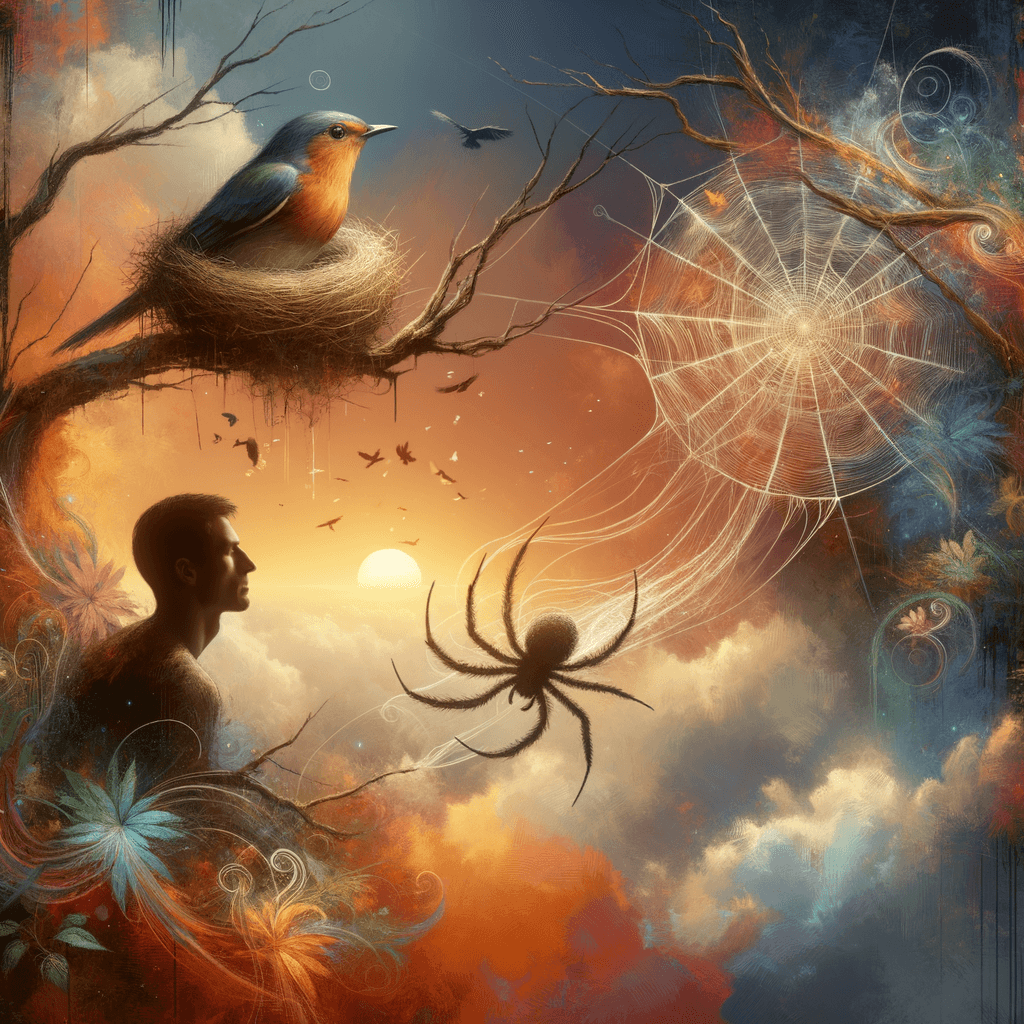
The bird a nest builds, the spider a web, and humans a dream. — Ethiopian Proverb
—What lingers after this line?
The Nature of Creation and Purpose
This proverb highlights the inherent nature of living beings to create something significant in their lives. Just as birds naturally build nests and spiders create webs as part of their survival and purpose, humans are driven to create dreams and aspirations as a central part of their existence.
Innate Instincts and Abilities
It emphasizes the idea that every creature has an intrinsic instinct to produce something meaningful. For humans, this creative instinct manifests in the form of dreams, ambitions, and goals, which are essential for personal fulfillment and purpose.
Symbolism of Nests, Webs, and Dreams
Nests and webs symbolize important structures created for protection, stability, and survival in animals' lives. Similarly, dreams for humans represent something profoundly valuable that provides direction, motivation, and meaning in life.
Human Uniqueness
While other creatures create tangible things for survival, this proverb reflects that humans possess the unique ability to dream and envision the future, which sets them apart and enables progress, creativity, and innovation.
Cultural Wisdom
As an Ethiopian Proverb, this saying encapsulates the deep cultural appreciation for both nature’s wisdom and human potential. It underlines the universal truth that all creatures, including humans, have a fundamental need to create as part of their natural existence.
One-minute reflection
Where does this idea show up in your life right now?
Related Quotes
6 selectedThe moment a man begins to talk about technique, that's proof that he is fresh out of ideas. — Dylan Thomas
Dylan Thomas
Dylan Thomas’s remark begins with a sharp suspicion: when an artist talks too much about technique, the living impulse behind the work may already be gone. Technique, in this sense, becomes a substitute language, a way o...
Read full interpretation →Imperfection inspires invention, imagination, and creativity. — Mary Sharratt
Mary Sharratt
Mary Sharratt’s insight begins with a reversal of ordinary expectations: imperfection is not merely something to fix, but something that awakens possibility. When a plan fails, a surface cracks, or an idea refuses to fit...
Read full interpretation →Don't think. Thinking is the enemy of creativity. It's self-conscious, and anything self-conscious is lousy. — Ray Bradbury
Ray Bradbury
At first glance, Ray Bradbury’s line sounds almost rebellious: “Don’t think. Thinking is the enemy of creativity.” Yet his target is not intelligence itself, but the paralyzing kind of self-awareness that makes an artist...
Read full interpretation →You can be cautious or you can be creative, but there's no such thing as a cautious creative. — George Lois
George Lois
George Lois draws a sharp line between two mindsets: caution protects what already exists, while creativity risks making something new. At first glance, the statement sounds absolute, yet that severity is exactly its poi...
Read full interpretation →Almost always, the creative dedicated minority has made the world better. — Martin Luther King, Jr.
Martin Luther King Jr.
Martin Luther King, Jr. distills a sweeping historical truth into a single sentence: progress is often driven not by the passive majority but by a small, committed group willing to imagine a better order.
Read full interpretation →What keeps life fascinating is the constant creativity of the soul. — Deepak Chopra
Deepak Chopra
At its core, Deepak Chopra’s line suggests that life stays interesting not because the world is fixed and exciting on its own, but because the inner self continually reinterprets it. The phrase “creativity of the soul” p...
Read full interpretation →More From Author
More from Ethiopian Proverb →