
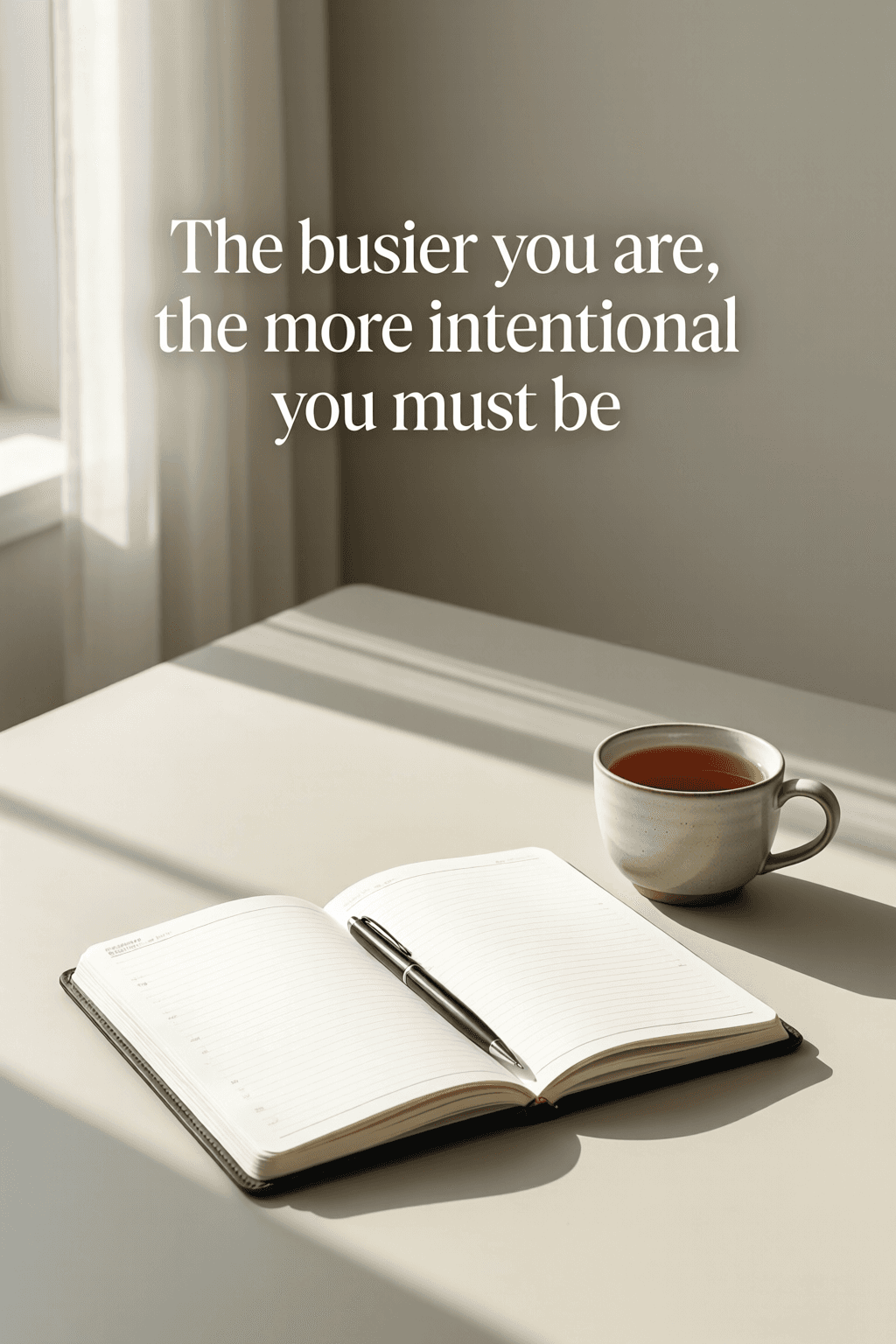
The busier you are, the more intentional you must be. — Michael Hyatt
—What lingers after this line?
The Core Idea Behind the Quote
At its heart, Michael Hyatt’s statement argues that busyness does not excuse drifting through life; rather, it makes purposeful choice even more necessary. When responsibilities multiply, attention becomes fragmented, and without a clear sense of direction, urgent tasks can quietly replace important ones. In that sense, busyness is not merely a scheduling problem but a test of priorities. Seen this way, the quote reframes productivity as an act of conscious alignment. Instead of asking how to do more, it asks how to do what matters most. That shift is crucial, because the fuller a calendar becomes, the easier it is to confuse motion with progress.
Why Activity So Easily Becomes Aimless
Once life accelerates, people often slip into reactive mode, answering emails, attending meetings, and solving immediate problems without stepping back to evaluate whether those actions serve a larger purpose. This is why busyness can feel strangely unproductive: energy is spent, yet meaning and momentum remain unclear. The ancient observation in Seneca’s On the Shortness of Life (c. AD 49) makes a similar point, warning that people are often occupied rather than truly engaged in living. As a result, intentionality becomes a corrective lens. It helps distinguish what is loud from what is valuable, preventing the day from being governed entirely by interruption. In busy seasons especially, that distinction can determine whether a person feels fulfilled or merely exhausted.
Intentionality as a Form of Discipline
From there, the quote suggests that intention is not a vague mindset but a disciplined practice. It may look like deciding in advance when to think deeply, when to rest, and what to decline. Stephen Covey’s The 7 Habits of Highly Effective People (1989) famously emphasized ‘putting first things first,’ and Hyatt’s line follows that same tradition: the more demands compete for your time, the more structure you need to protect what matters. In everyday life, this often appears in small but decisive habits. A manager who blocks uninterrupted planning time, or a parent who safeguards dinner with family despite a packed day, demonstrates that intentional living is built through repeated choices rather than grand declarations.
The Hidden Power of Saying No
Naturally, greater intentionality also requires exclusion. If every request receives an automatic yes, then even worthy commitments can crowd out the most meaningful ones. This is why busy people often need stronger boundaries than others: not because they care less, but because they understand the cost of divided attention. Greg McKeown’s Essentialism (2014) captures this principle by arguing that disciplined pursuit of less can lead to better results. An illustrative example appears in many creative and executive routines: highly productive individuals often decline optional opportunities so they can preserve energy for their central work. In that sense, saying no is not selfishness but stewardship. It protects focus from being consumed by sheer volume.
Choosing Presence Over Constant Rush
Yet intentionality is not only about calendars and efficiency; it is also about presence. The busier a person becomes, the easier it is to be physically somewhere while mentally elsewhere. Hyatt’s quote quietly challenges that habit by implying that crowded lives require deliberate attention not just to tasks, but to moments. Without such care, achievement can grow while awareness shrinks. This is especially visible in ordinary scenes: a rushed conversation with a child, a meal eaten while scanning messages, or a walk taken with the mind still trapped in unfinished work. By contrast, intentional people decide where they will place both time and mind. That choice transforms busyness from a blur into a life that is still recognizably one’s own.
A Practical Philosophy for Modern Life
Ultimately, Hyatt’s quote offers more than advice about time management; it presents a philosophy for surviving modern overload. In a world of constant notifications, open-ended work, and competing expectations, intention becomes the mechanism by which people preserve agency. Rather than letting circumstances dictate every hour, they actively shape days around values, relationships, and long-term aims. Therefore, the quote endures because it speaks to a universal modern tension: the fuller life becomes, the more easily it can lose coherence. Intentionality restores that coherence. It reminds us that a busy life is not automatically a meaningful one, but a deliberate life has a far better chance of becoming both.
Recommended Reading
As an Amazon Associate, we earn from qualifying purchases.
One-minute reflection
Why might this line matter today, not tomorrow?
Related Quotes
6 selectedYou get to decide what you make room for. Start there. — Julia Cameron
Julia Cameron
Julia Cameron’s line begins with a quiet but powerful reminder: our lives are shaped not only by what happens to us, but by what we choose to accommodate. To “make room” for something is to give it time, attention, and v...
Read full interpretation →The goal is not to be perfect, but to be intentional. You are the architect of your own focus. — Brené Brown
Brené Brown
Brené Brown’s quote begins by loosening the grip of perfectionism. Rather than treating flawlessness as the standard, it places greater value on acting with purpose.
Read full interpretation →We don't need to do more; we need to do what matters with deeper presence and less noise. — Oliver Burkeman
Oliver Burkeman
Oliver Burkeman’s line begins by rejecting a familiar modern assumption: that value comes from doing more. Instead, it proposes a quieter and more demanding standard—doing what truly matters.
Read full interpretation →Your life is like a garden. If you're not intentional, your garden will be overrun with weeds and randomness. — Benjamin P. Hardy
Benjamin P. Hardy
At its core, Benjamin P. Hardy’s metaphor turns life into something living, seasonal, and responsive to care.
Read full interpretation →The urge to check your phone shatters uninterrupted time into shards too small to support the presence necessary for an intentional life. — Cal Newport
Cal Newport
At its core, Cal Newport’s line argues that a meaningful life depends on stretches of unbroken attention. The impulse to check a phone may seem trivial, yet each glance slices time into smaller fragments, leaving too lit...
Read full interpretation →It's precisely those who are busiest who most need to give themselves a break. — Pico Iyer
Pico Iyer
Pico Iyer’s remark turns a common assumption upside down: the people who seem least able to pause are often the ones most endangered by never doing so. Busyness can look like competence, ambition, or usefulness, yet it a...
Read full interpretation →More From Author
More from Michael Hyatt →Consistency is the key. Perfection is impossible. — Michael Hyatt
At its heart, Michael Hyatt’s quote sets two ideals against each other: consistency, which is sustainable, and perfection, which is often unattainable. By doing so, it shifts attention from flawless outcomes to steady ef...
Read full interpretation →Limit your regrets and live with purpose. — Michael Hyatt
This quote encourages individuals to make deliberate choices in life, focusing on actions and decisions that align with their values and goals to minimize future regrets.
Read full interpretation →Do not fear failure but fear being in the exact same place next year as you are today. — Michael Hyatt
Michael Hyatt’s quote challenges the commonly held fear of failure by redirecting our apprehension toward stagnation instead. This perspective encourages us to reconsider what truly holds us back from progress.
Read full interpretation →