
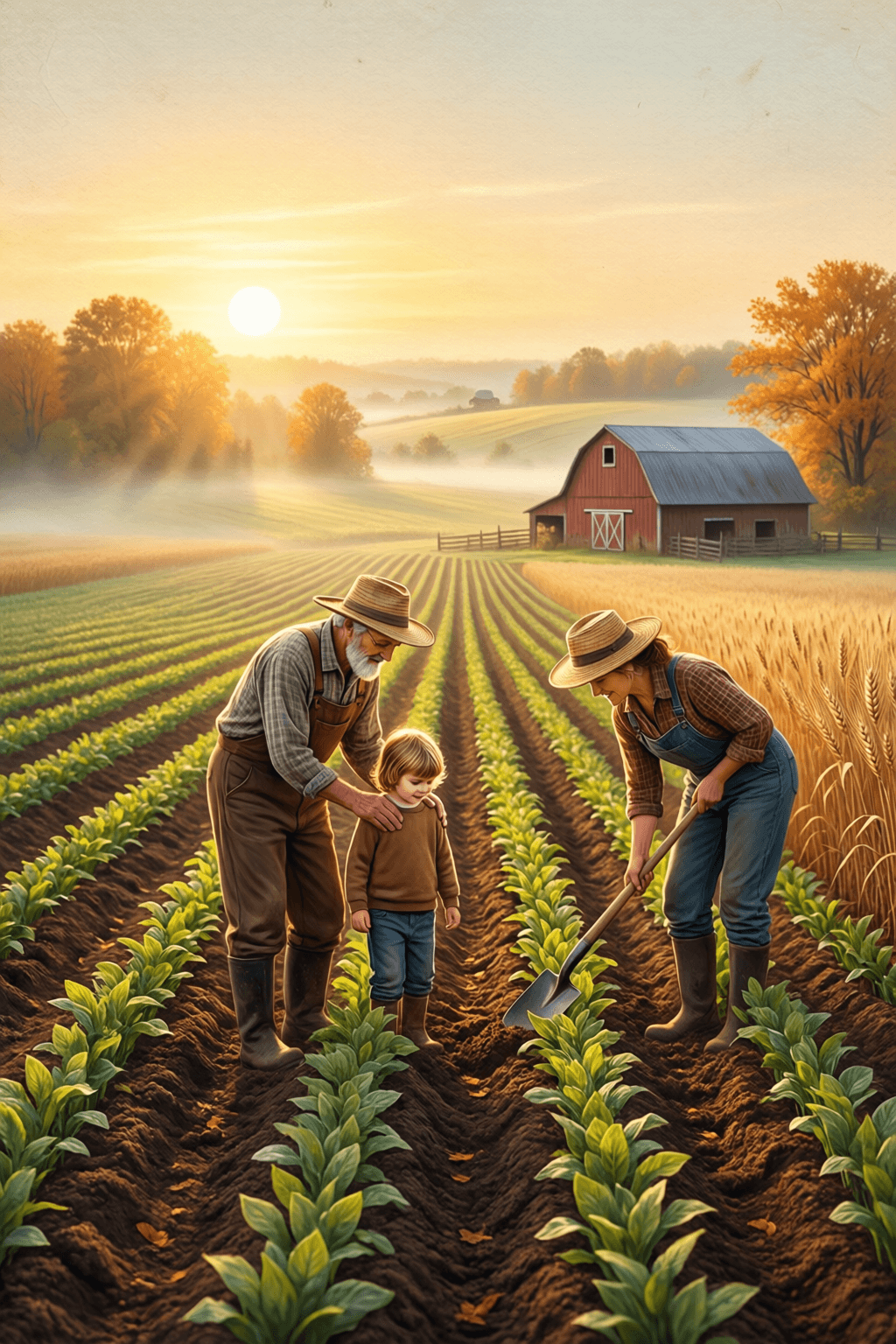
The farmer's work is never done. It's passed on, generation after generation. Let us not forget that the cultivation of the earth is the most important labor of man. — Daniel Webster
—What lingers after this line?
An Unending Human Task
Daniel Webster’s statement begins with a plain truth: farming is never truly finished. Unlike work that ends with a contract or a season, cultivation returns in cycles—plowing, planting, tending, harvesting, and preparing again. In that sense, the farmer’s labor mirrors nature itself, moving continuously rather than concluding once and for all. From this opening idea, Webster enlarges the meaning of farm work beyond mere occupation. He implies that agriculture is a permanent human responsibility, because food, unlike luxury, cannot be postponed. The earth must be cared for repeatedly, and so the farmer becomes the steward of life’s most constant necessity.
The Inheritance of Knowledge
Webster then turns naturally from labor to legacy, noting that this work is “passed on, generation after generation.” Farming is rarely just technical effort; it is also inherited wisdom. Families and communities transmit knowledge about soil, weather, animals, seed, and timing in ways that are often learned by doing rather than by reading alone. This generational chain appears throughout history. Hesiod’s Works and Days (c. 700 BC), for example, offered agricultural guidance as moral instruction as much as practical advice, showing that cultivation has long been tied to tradition. Thus, the farmer does not simply produce crops; he or she receives a trust from the past and hands it forward to the future.
Cultivating Earth as Foundational Labor
From there, Webster makes his boldest claim: that the cultivation of the earth is “the most important labor of man.” His emphasis rests on priority, not prestige. Before cities can expand, schools can teach, or commerce can flourish, someone must produce food. Agriculture sits at the base of civilization, quietly supporting every visible achievement built above it. This idea is echoed in early political thought. Thomas Jefferson, in Notes on the State of Virginia (1785), praised cultivators as essential to national strength, reflecting a broader belief that free societies depend on those who work the land. Webster’s line therefore honors farming not as one profession among many, but as the condition that makes all other professions possible.
A Moral Reminder Against Forgetfulness
Significantly, Webster frames his point as a warning: “Let us not forget.” That phrase suggests a society already drifting toward neglect, benefiting from farmers while overlooking their importance. As economies grow more urban and industrial, the work that sustains daily life can become invisible precisely because it is dependable. Here Webster’s language acts like a civic correction. He urges public memory to catch up with public dependence. Much as Roman writers such as Virgil in the Georgics (29 BC) elevated agricultural labor into poetry, Webster asks his audience to recover respect for those whose effort is humble, repetitive, and indispensable. Remembering the farmer, then, becomes a measure of social gratitude and realism.
The Bond Between Humanity and the Land
Finally, the quotation carries a deeper philosophical force: cultivation is not only economic work but a relationship between human beings and the earth. To farm is to cooperate with seasons, rainfall, fertility, and restraint. The farmer shapes the land, yet is also shaped by it, learning patience, humility, and endurance from forces beyond human control. For that reason, Webster’s remark still resonates in modern debates about sustainability and food security. Wendell Berry’s The Unsettling of America (1977), for instance, argues that good farming reflects an ethical bond with place rather than mere extraction. In this light, Webster’s praise is not nostalgic. It is a reminder that the labor of cultivation remains central because it binds survival, inheritance, and responsibility into one continuous human calling.
One-minute reflection
Where does this idea show up in your life right now?
Related Quotes
2 selectedTo be a successful farmer one must first know the nature of the soil. — Wendell Berry
Wendell Berry
Wendell Berry’s statement begins with a simple but profound truth: successful farming does not start with machinery, markets, or even seeds, but with the soil itself. Before any harvest can be imagined, the farmer must u...
Read full interpretation →The ultimate goal of farming is not the growing of crops, but the cultivation and perfection of human beings. — Masanobu Fukuoka
Masanobu Fukuoka
At first glance, Masanobu Fukuoka’s statement appears to redefine farming in startling terms. Rather than treating agriculture as a purely economic activity focused on output, he frames it as a moral and human practice.
Read full interpretation →More From Author
More from Daniel Webster →