
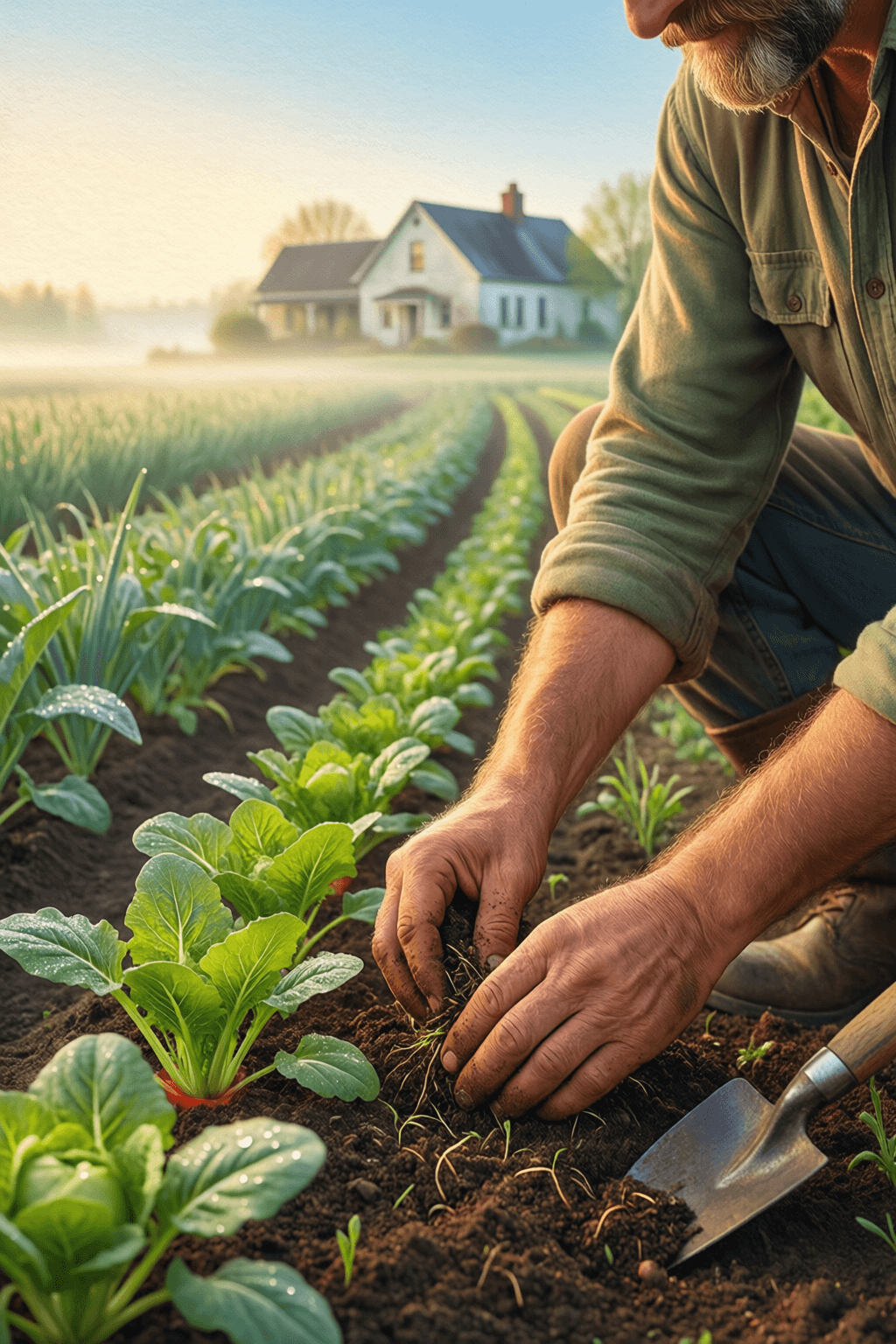
The ultimate goal of farming is not the growing of crops, but the cultivation and perfection of human beings. — Masanobu Fukuoka
—What lingers after this line?
Beyond Harvests and Yields
At first glance, Masanobu Fukuoka’s statement appears to redefine farming in startling terms. Rather than treating agriculture as a purely economic activity focused on output, he frames it as a moral and human practice. In this view, crops are not the final purpose but part of a larger process through which people learn patience, humility, responsibility, and attentiveness to life. This shift in emphasis matters because it challenges modern assumptions about productivity. If the true aim of farming is the cultivation of human beings, then the field becomes more than a workplace: it becomes a school of character. Fukuoka, especially in The One-Straw Revolution (1975), repeatedly argued that how we grow food shapes how we think, live, and relate to the natural world.
Fukuoka’s Natural Farming Philosophy
To understand the quote more deeply, it helps to place it within Fukuoka’s broader philosophy of natural farming. He rejected the idea that human progress always comes from greater control over nature; instead, he believed wisdom often begins with restraint. His methods—minimal tilling, no chemical fertilizers, and respect for natural cycles—were not merely technical choices but expressions of a spiritual and philosophical outlook. From that perspective, farming becomes an exercise in unlearning arrogance. Rather than forcing the land into submission, the farmer observes, cooperates, and adapts. Consequently, the person doing the farming is changed along with the soil. The work cultivates perception and reverence, suggesting that agriculture can refine human consciousness as much as it produces rice, barley, or fruit.
The Field as a Teacher
Seen this way, the farm functions as a place of education. Seasons do not obey human schedules, weather humbles prediction, and growth unfolds at its own pace; therefore, anyone who works closely with the land must confront limits. In that confrontation, people often develop resilience, acceptance, and a clearer sense of interdependence. Many agrarian traditions echo this idea. Roman writers such as Virgil in the Georgics (29 BC) portrayed farming as labor that forms discipline and civic virtue, not simply wealth. Likewise, everyday experience supports Fukuoka’s point: a person who plants, waits, fails, replants, and finally harvests often comes away with more than food. The land teaches steadiness, and that lesson reaches far beyond the boundaries of the field.
A Critique of Industrial Agriculture
From here, Fukuoka’s remark also reads as a quiet critique of industrial agriculture. When farming is reduced to efficiency, mechanization, and maximum yield, the human being at the center of the process can become secondary. The land is treated as a resource, crops as units, and farmers as operators within a production system. What is gained in scale may be lost in meaning. Accordingly, Fukuoka invites us to ask what kind of people such a system produces. If agriculture rewards domination, speed, and extraction, it may also encourage alienation from nature and from one another. His quote resists that logic by insisting that the deepest measure of success is not abundance alone, but whether farming helps create wiser, more balanced, and more fully human lives.
Human Perfection Through Relationship
Importantly, Fukuoka’s use of the word “perfection” does not suggest flawless achievement. Instead, it points toward a process of becoming more whole through right relationship—with soil, food, community, and self. In many philosophical traditions, human flourishing emerges not from conquest but from harmony. Aristotle’s Nicomachean Ethics (4th century BC), for instance, ties human excellence to the repeated practice of virtuous habits, and farming can become one such discipline. Thus, the perfection Fukuoka imagines is organic rather than mechanical. It grows through daily acts of care: sowing attentively, harvesting gratefully, and recognizing dependence on forces larger than oneself. The person shaped by this rhythm may not become “perfect” in a literal sense, yet may become more grounded, ethical, and awake to life.
Why the Quote Still Matters Today
Finally, Fukuoka’s insight feels especially urgent in an age marked by ecological crisis, technological acceleration, and widespread disconnection from food systems. Many people now encounter food only as a packaged commodity, which makes it easy to forget the web of labor, weather, soil, and living systems behind every meal. His quote restores that forgotten connection by reminding us that agriculture influences culture and character alike. As a result, the statement speaks not only to farmers but to anyone concerned with education, sustainability, and the good life. Community gardens, school farms, and regenerative agriculture movements all reflect this broader vision: growing food can also grow responsibility, wonder, and belonging. In the end, Fukuoka suggests that the health of a civilization may be measured by what its farming makes of its people.
One-minute reflection
Why might this line matter today, not tomorrow?
Related Quotes
3 selectedThe farmer's work is never done. It's passed on, generation after generation. Let us not forget that the cultivation of the earth is the most important labor of man. — Daniel Webster
Daniel Webster
Daniel Webster’s statement begins with a plain truth: farming is never truly finished. Unlike work that ends with a contract or a season, cultivation returns in cycles—plowing, planting, tending, harvesting, and preparin...
Read full interpretation →Dreams grow with you. — Masanobu Fukuoka
Masanobu Fukuoka
Masanobu Fukuoka’s phrase, “Dreams grow with you,” poetically likens human ambition to seeds in fertile soil. At the beginning of our lives, aspirations often start as faint wishes or playful fantasies.
Read full interpretation →A farmer is helpless to grow grain; all he can do is provide the right conditions for the growing of grain. — Richard J. Foster
Richard J. Foster
At first glance, Foster’s farming metaphor shifts attention away from control and toward humility. A farmer cannot command a seed to sprout, just as a person cannot force true growth—whether spiritual, personal, or relat...
Read full interpretation →More From Author
More from Masanobu Fukuoka →