
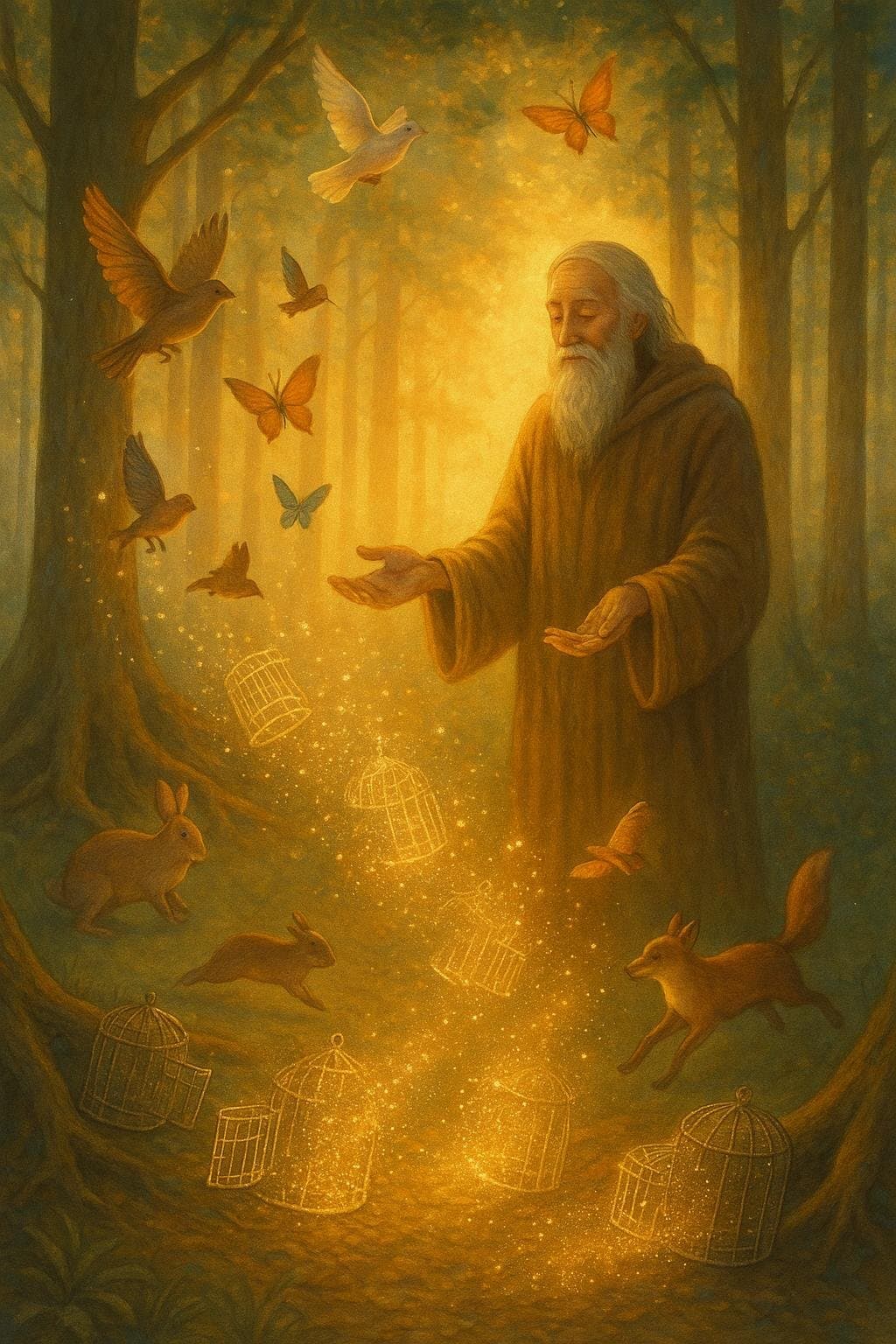
The small man builds cages for everyone he knows; the sage, who is free, sets them all free. — Lin Yutang
—What lingers after this line?
Understanding Cages: Literal and Metaphorical
Lin Yutang's poignant words encapsulate a timeless struggle: the tendency to restrict not only ourselves, but also those around us. The ‘small man’ here doesn't build physical cages, but rather imposes limitations—expectations, prejudices, or judgments—on the lives of others. Such cages are constructed from fear, insecurity, or a desire for control, constricting individual growth and collective harmony.
Contrasting Impulses: The Small Man Versus the Sage
Transitioning from the metaphor of cages, Lin contrasts two archetypes: the ‘small man’ who confines, and the ‘sage’ who liberates. While the former acts from a place of limitation, the sage’s actions are rooted in an expansive sense of freedom. This contrast echoes in Daoist philosophy, where sages are depicted as those who live in harmony with nature and accept the diversity of all beings (see Laozi, *Tao Te Ching*).
Self-Liberation as a Precursor to Liberating Others
Building upon this, the text subtly suggests that only those who are themselves free—like the sage—can truly liberate others. Personal emancipation, whether from ego or societal norms, becomes a necessary step before fostering freedom in the wider community. Buddhism similarly teaches that self-realization enables genuine compassion and guidance (as seen in the life of the Buddha).
Modern Implications: Authority and Empowerment
In contemporary society, the notion of building cages can be witnessed in restrictive workplace cultures or rigid educational systems. Leaders who micromanage often limit their team's potential, whereas visionary mentors—modern sages, in a sense—empower individuals to think independently and act confidently. Such real-world applications highlight the enduring relevance of Lin’s wisdom.
The Call to Emulate the Sage
Ultimately, Lin Yutang’s insight invites self-reflection: do we confine or liberate those we encounter? Emulating the sage involves cultivating understanding, letting go of the need to control, and fostering environments where others can flourish. When we dismantle our own cages, we become catalysts for freedom in the world around us, perpetuating a cycle of liberation rather than limitation.
One-minute reflection
Where does this idea show up in your life right now?
Related Quotes
6 selectedWisdom is knowing when to have rest, when to have activity, and how much of each to have. — Etty Hillesum
Etty Hillesum
Etty Hillesum’s insight begins with a simple but demanding idea: wisdom is not merely knowing what is good, but knowing when it is good. Rest and activity are both necessary, yet either can become harmful when taken at t...
Read full interpretation →Wisdom comes only to the silent mind. — Krishnamurti
Krishnamurti
Krishnamurti’s statement begins with a simple but demanding insight: wisdom is not merely accumulated information, nor is it the reward for constant thinking. Instead, it arises when the mind becomes quiet enough to perc...
Read full interpretation →Never call yourself a philosopher; show it. — Epictetus
Epictetus
Epictetus compresses an entire ethical program into a sharp command: do not claim the title, demonstrate the life. In other words, wisdom is not a badge one pins on oneself but a pattern others can recognize in conduct.
Read full interpretation →You are not starting over. You're starting wiser. — Meredith Eastwood
Meredith Eastwood
At first glance, Meredith Eastwood’s line gently challenges the fear that often accompanies change. To say, “You are not starting over,” is to reject the idea that every setback erases what came before.
Read full interpretation →The wise do things slowly, because they love it. — David Fell
David Fell
At first glance, David Fell’s line seems to praise caution, yet it reaches further than mere hesitation. To do something slowly, in this view, is not to be indecisive but to be fully present.
Read full interpretation →To be old and wise you must first be young and stupid. — Terry Pratchett
Terry Pratchett
At first glance, Terry Pratchett’s line turns wisdom into a joke, yet its humor carries a serious truth: good judgment is rarely innate. Instead, it is usually built from errors, embarrassment, and misread situations tha...
Read full interpretation →More From Author
More from Lin Yutang →If you can spend a perfectly useless afternoon in a perfectly useless manner, you have learned how to live. — Lin Yutang
Lin Yutang’s line quietly overturns the modern habit of equating life with productivity. By praising a “perfectly useless afternoon,” he suggests that living well is not measured only by outputs, achievements, or visible...
Read full interpretation →Besides the noble art of getting things done, there is the noble art of leaving things undone. — Lin Yutang
Lin Yutang’s line begins by honoring productivity—the familiar dignity of finishing what we start—yet it immediately widens the moral frame. By calling both doing and not doing “noble,” he suggests that worth is not meas...
Read full interpretation →The wisdom of life consists in the elimination of non-essentials. — Lin Yutang
Lin Yutang frames wisdom as an act of reduction rather than acquisition: life improves not only by adding skills, possessions, or status, but by removing what dilutes attention and meaning. In this view, clarity comes fr...
Read full interpretation →Hope is like a road in the country; there was never a road, but when many people walk on it, the road comes into existence. — Lin Yutang
This quote suggests that hope is created through collective belief and persistence. Just as a road forms when many people walk the same path, hope strengthens when individuals unite in their vision for a better future.
Read full interpretation →