
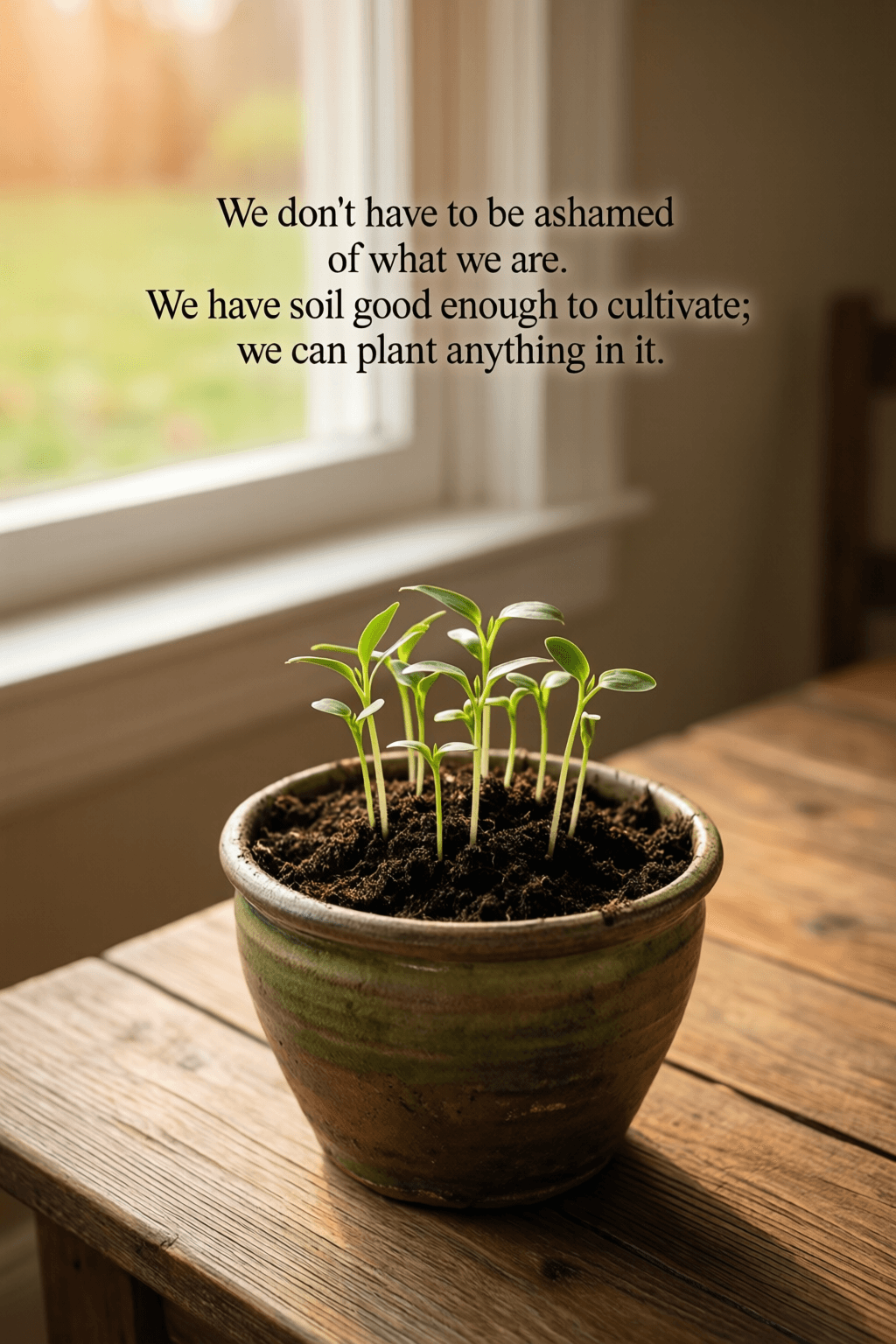
We don't have to be ashamed of what we are. We have soil good enough to cultivate; we can plant anything in it. — Chögyam Trungpa
—What lingers after this line?
Self-Acceptance as the First Gesture
At its heart, Chögyam Trungpa’s line rejects the reflex of shame and replaces it with a more generous view of human nature. To say we need not be ashamed of what we are is not to deny weakness, confusion, or contradiction; rather, it is to insist that these do not cancel our worth. In this way, the quote begins with acceptance, because growth cannot start where the self is treated as irredeemable. From that starting point, Trungpa shifts the metaphor toward possibility. Instead of seeing the self as damaged material, he asks us to imagine it as workable earth. The change is subtle but powerful: soil is not perfect, but it is alive, receptive, and capable of transformation.
The Meaning of Good Soil
The image of “soil good enough to cultivate” is especially striking because it avoids grandiosity. Trungpa does not say the soil is flawless or already flourishing; he says it is good enough. That phrase suggests a humane standard, one that values potential over perfection and effort over self-condemnation. Consequently, the metaphor speaks to anyone who feels unfinished. As in agriculture, growth depends less on ideal conditions than on steady care. Buddhist teaching often returns to this principle: awakening is not imported from elsewhere but uncovered within ordinary mind. Trungpa’s own The Myth of Freedom (1976) frequently emphasizes working with experience as it is, rather than waiting to become someone more acceptable first.
Shame Versus Cultivation
Seen in this light, shame becomes sterile, while cultivation becomes creative. Shame freezes identity into a verdict—telling us that because we have failed, we are failures. By contrast, the farming metaphor implies season, patience, and revision. A neglected field is not a moral disgrace; it is simply a place where care has not yet been applied. This distinction matters because it changes how transformation happens. Rather than attacking the self into improvement, Trungpa points toward tending it. The logic resembles that of many contemplative traditions: clarity emerges not from self-hatred but from attention. In that sense, compassion is not indulgence; it is the condition that makes honest work possible.
Freedom Hidden in Potential
Once the self is understood as fertile ground, the second half of the quote opens outward: “we can plant anything in it.” This does not mean we can instantly become anything we imagine, but it does suggest an inner flexibility deeper than our habits. Character is not a prison; it is a field of tendencies that can be reseeded through practice. Here the quote aligns with psychological ideas about growth and neuroplasticity. Carol Dweck’s Mindset (2006), for example, distinguishes a fixed view of the self from one oriented toward development. Trungpa’s language is more poetic, yet the insight is similar: when people stop identifying with limitation as destiny, they become able to cultivate courage, patience, discipline, or tenderness where none seemed possible before.
A Spiritual but Practical Vision
What makes the statement enduring is that it is both spiritual and concrete. Soil requires labor—digging, watering, weeding, and waiting—and so the quote quietly reminds us that possibility alone is not enough. Acceptance is the beginning, not the finish. Once we stop being ashamed, we become responsible for what we choose to grow. Therefore, the line offers neither easy reassurance nor harsh judgment. It proposes a wiser middle path: honor the ground you are, then work with it. In that balanced vision, dignity comes first, and effort follows naturally. The self is not something to despise or escape, but the very place where transformation can take root.
One-minute reflection
What's one small action this suggests?
Related Quotes
6 selectedWe have the power to craft our growth the way a landscaper crafts a majestic garden. — Chögyam Trungpa
Chögyam Trungpa
Chögyam Trungpa’s image immediately shifts growth from something accidental to something consciously shaped. Rather than imagining personal development as a wild process beyond our control, he suggests that we participat...
Read full interpretation →Quiet confidence is not about being loud; it is about knowing who you are and being comfortable in your own skin. — Julie Andrews
Julie Andrews
Julie Andrews’ observation begins by separating confidence from volume. In a culture that often rewards assertive display, she reminds us that genuine self-assurance does not need constant announcement.
Read full interpretation →Healing may not be so much about getting better, as about letting go of everything that isn't you. — Rachel Naomi Remen
Rachel Naomi Remen
Rachel Naomi Remen’s insight gently shifts healing away from the usual language of repair. Instead of imagining ourselves as broken machines that must be made efficient again, she suggests that healing may involve removi...
Read full interpretation →It's okay to be a little bit of a mess. Even the moon has phases, and it's still the most beautiful thing in the night sky. — Sanober Khan
Sanober Khan
At its heart, Sanober Khan’s line offers relief from the exhausting pressure to appear composed at all times. By saying it is acceptable to be ‘a little bit of a mess,’ the quote reframes disorder not as failure but as p...
Read full interpretation →The art of living is not about being a finished masterpiece; it is about being a work in progress that still knows how to laugh at its own paint spills. — Anne Lamott
Anne Lamott
At its heart, Anne Lamott’s remark reframes life from a quest for perfection into an ongoing act of creation. Instead of imagining ourselves as polished masterpieces, she invites us to see our days as brushstrokes still...
Read full interpretation →You do not need to be a lighthouse for everyone else; sometimes it is enough to just be a boat. — Anne Lamott
Anne Lamott
Anne Lamott’s line gently dismantles the pressure to be endlessly strong, wise, and guiding for others. A lighthouse stands fixed, visible, and responsible for warning everyone around it; by contrast, a boat simply carri...
Read full interpretation →More From Author
More from Chögyam Trungpa →We have the power to craft our growth the way a landscaper crafts a majestic garden. — Chögyam Trungpa
Chögyam Trungpa’s image immediately shifts growth from something accidental to something consciously shaped. Rather than imagining personal development as a wild process beyond our control, he suggests that we participat...
Read full interpretation →When the soul is at peace, the world is at peace. — Chögyam Trungpa
This quote highlights that peace in the world begins with inner peace. When individuals cultivate tranquility in their own soul, they contribute to a more harmonious and peaceful external environment.
Read full interpretation →The more you seek, the more you find, and the more you find, the more you realize you are seeking. — Chogyam Trungpa
Chogyam Trungpa’s words introduce a cyclical relationship between seeking and finding. Unlike a straightforward quest, each discovery doesn’t serve as a conclusion but rather as an invitation to delve deeper.
Read full interpretation →True strength lies in the balance of heart and mind. — Chögyam Trungpa
Chögyam Trungpa’s insight highlights the timeless pursuit of equilibrium within ourselves. By stating that true strength resides in the balance of heart and mind, he suggests that neither emotion nor intellect alone can...
Read full interpretation →