
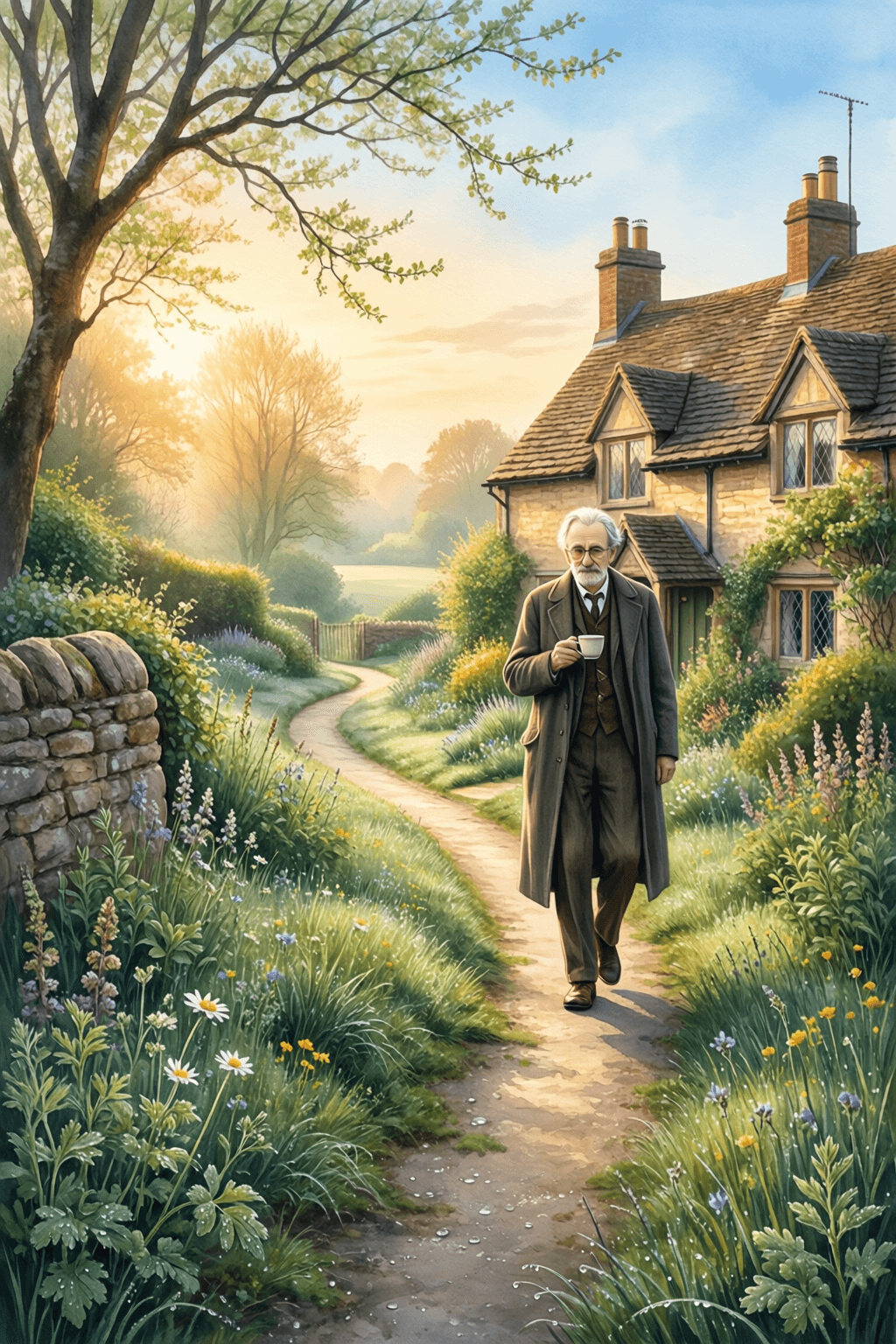
We need, above all things, to slow down and get ourselves to amble through life instead of to rush through it. — Bertrand Russell
—What lingers after this line?
Russell’s Case Against Hurry
At its core, Bertrand Russell’s remark argues that the speed of modern life can become a form of self-impoverishment. To rush through existence is not merely to move quickly; it is to miss texture, reflection, and the quiet satisfactions that make experience meaningful. By urging us to “amble,” Russell presents slowness not as laziness but as a deliberate way of inhabiting the world more fully. In this sense, his advice is both practical and philosophical. Rather than measuring life by how much we can cram into a day, he invites us to ask what kind of attention we are bringing to our days at all. That shift in emphasis opens the door to a broader critique of modern habits.
The Modern Worship of Speed
From there, Russell’s insight feels strikingly contemporary. Industrial culture long celebrated efficiency, punctuality, and output, and those values only intensified in the digital age. Emails, notifications, and packed schedules train people to confuse constant motion with importance, as though a hurried life must be a significant one. Yet this worship of speed often leaves behind a strange emptiness. As Milan Kundera wrote in Slowness (1995), speed can create a kind of forgetting, while slowness allows memory and presence to deepen. Russell’s warning therefore speaks not only to overwork, but to a civilization that risks losing its inner life in the pursuit of acceleration.
Attention as a Form of Living
Once speed is questioned, attention comes into focus. To amble through life means giving the mind time to notice: a conversation’s nuance, a changing season, a passing thought that might otherwise vanish. In this way, slowness becomes the condition for perception itself, because what is hurried is often only half-seen. This idea recalls Henry David Thoreau’s Walden (1854), where deliberate living meant resisting the needless haste of society. Russell similarly suggests that a life well lived depends less on velocity than on awareness. By slowing down, we do not step away from life; rather, we step more deeply into it.
The Emotional Cost of Constant Rush
Moreover, a rushed life often produces more than fatigue; it breeds anxiety, irritability, and a chronic sense of insufficiency. When every task is pursued at speed, even rest begins to feel like failure. People may finish more errands, yet feel less grounded, as if they are always arriving late to their own experience. Modern psychology supports this concern. Research on stress and attentional overload consistently shows that relentless time pressure reduces well-being and weakens emotional regulation. Russell’s advice, then, is not nostalgic sentimentality. It anticipates a truth many now rediscover through burnout: human beings are not designed to thrive in perpetual haste.
Ambling as a Quiet Form of Wisdom
As the quote unfolds in practice, “ambling” suggests an ethic of proportion. It does not mean abandoning responsibility or rejecting ambition altogether. Instead, it means moving with enough spaciousness to preserve judgment, enjoyment, and balance. A walk taken without urgency, a meal eaten without distraction, or an afternoon left unscheduled can become small acts of resistance against needless acceleration. Even ancient philosophy points in this direction. Aristotle’s Ethics emphasizes the mean between extremes, and Russell’s amble fits that tradition well: not idleness, not frenzy, but measured living. What appears modest is actually profound, because it restores choice where compulsion once ruled.
A Fuller Life Through Deliberate Pace
Finally, Russell’s statement leaves us with a simple but demanding lesson: the quality of life depends not only on what we do, but on the pace at which we allow ourselves to do it. To slow down is to reclaim time from mere scheduling and return it to experience, thought, and relationship. For that reason, his advice remains enduringly humane. In a world that praises the rush, ambling becomes a way of protecting wonder, sanity, and depth. By choosing a deliberate pace, we may discover that life was never asking to be conquered quickly, only to be lived attentively.
Recommended Reading
As an Amazon Associate, we earn from qualifying purchases.
One-minute reflection
What's one small action this suggests?
Related Quotes
6 selectedTo have moments of leisure and quiet and rest in your life is the greatest blessing. — Jiddu Krishnamurti
Jiddu Krishnamurti
At first glance, Krishnamurti’s remark shifts attention away from material success and toward a subtler form of abundance. He suggests that the true blessing in life is not endless activity but the presence of unclaimed...
Read full interpretation →When we learn to slow down, the outcomes are better across the board: wiser decisions, less stress, greater resilience, and clarity of purpose. — April Rinne
April Rinne
April Rinne’s observation begins with a simple but powerful reversal of modern habits: faster is not always better. In a culture that rewards urgency, slowing down can seem like hesitation, yet it often creates the menta...
Read full interpretation →Movement does not always mean speed; sometimes, the most courageous step you can take is to slow down and breathe. — Sarah Ban Breathnach
Sarah Ban Breathnach
At first glance, movement is often confused with speed, productivity, or constant visible progress. Sarah Ban Breathnach’s quote gently corrects that assumption by suggesting that motion can also take the form of pause,...
Read full interpretation →He does not seem to me to be a free man who does not sometimes do nothing. — Marcus Tullius Cicero
Marcus Tullius Cicero
At first glance, Cicero’s remark sounds provocative because it praises what many societies treat as waste: doing nothing. Yet his point is not laziness but autonomy.
Read full interpretation →Nature does not hurry, yet everything is accomplished; find your own rhythm, not the rhythm of the screen. — Fritz Schumacher
Fritz Schumacher
At its core, the quotation contrasts two tempos: the unforced pace of nature and the relentless pulse of digital life. Nature does not rush, yet seasons turn, seeds sprout, and rivers carve valleys over time.
Read full interpretation →The slow philosophy is not about doing everything in tortoise mode. It's about doing everything at the right speed. — Carl Honoré
Carl Honoré
Carl Honoré begins by dismantling a common caricature: that “slow” living is merely an aesthetic of delay, a kind of self-imposed sluggishness. By saying it’s not “tortoise mode,” he rejects the idea that slowness is a f...
Read full interpretation →More From Author
More from Bertrand Russell →One must care about a world one will never see. — Bertrand Russell
At its core, Bertrand Russell’s line asks us to stretch our concern beyond immediate experience. To care about a world one will never see is to recognize that moral responsibility does not end with personal benefit or ev...
Read full interpretation →The trouble with always trying to preserve the health of the body is that it's so difficult to do without destroying the health of the mind. — Bertrand Russell
Bertrand Russell’s remark points to a subtle danger in the pursuit of physical well-being: the body can become such an object of vigilance that it crowds out mental freedom. In other words, health ceases to be a foundati...
Read full interpretation →The world is full of magical things patiently waiting for our wits to grow sharper. — Bertrand Russell
This quote suggests that the world is brimming with fascinating and magical elements that are not immediately obvious to us but are waiting to be discovered as our understanding and perception improve.
Read full interpretation →To overcome fear is the beginning of wisdom. — Bertrand Russell
This quote highlights the idea that fear can be a significant barrier to personal growth and understanding. By facing and overcoming fear, individuals can pave the way for deeper insights and wisdom.
Read full interpretation →