
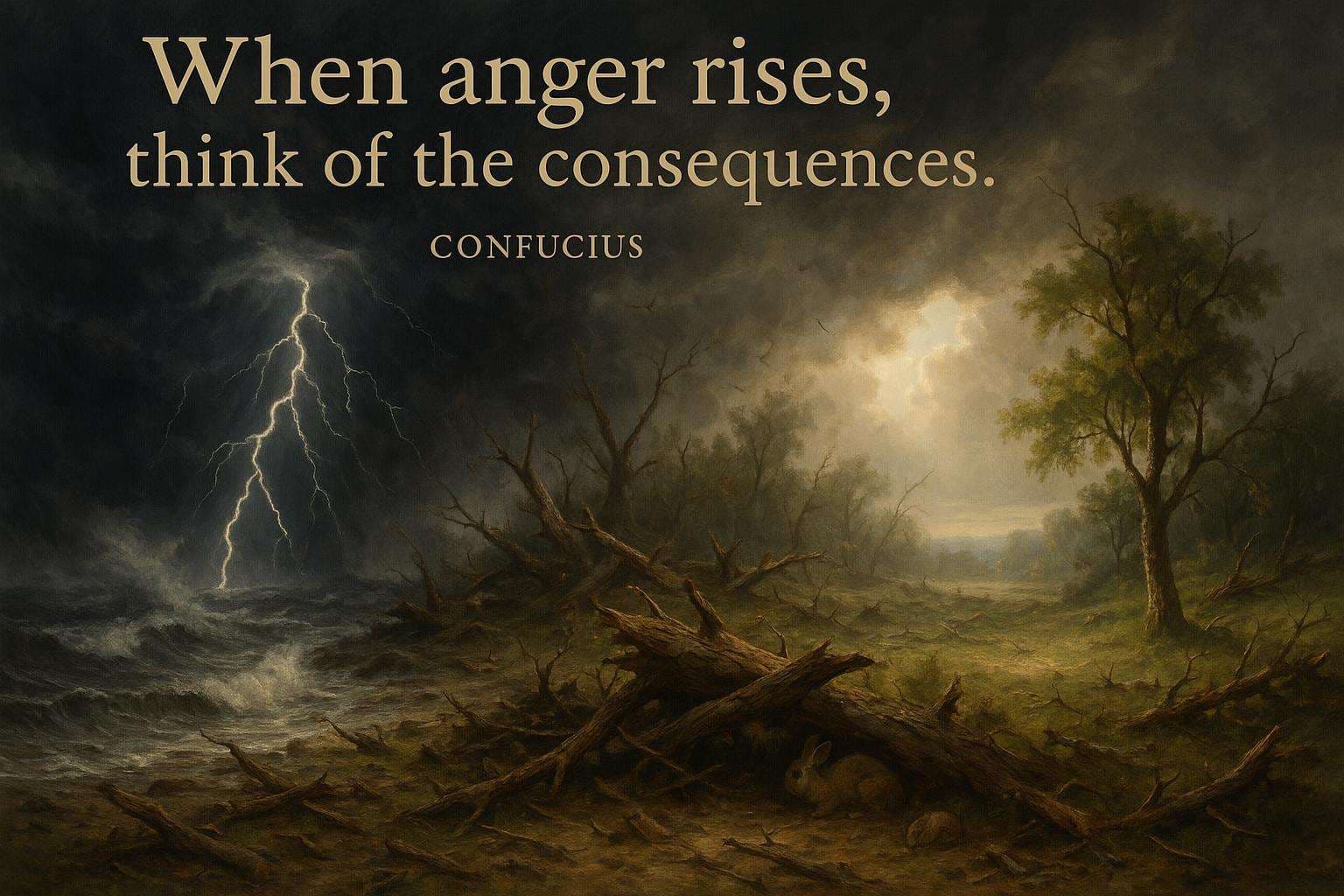
When anger rises, think of the consequences. — Confucius
—What lingers after this line?
The Wisdom of Measured Response
Confucius’s admonition to pause and consider the consequences when anger surfaces is a succinct guide to emotional intelligence. Rather than suppressing emotion, he advocates for temperance—a principle deeply rooted in Confucian philosophy. In both the Analects and classroom traditions, his teachings emphasize self-control as essential to personal development and harmonious relationships.
Cultural Context and Social Harmony
Moving from individual conduct to societal well-being, Confucian thought views unchecked anger as a threat to social order. Ancient China was organized around hierarchical relationships, where losing one’s temper could disrupt familial or civic harmony. The sage’s advice thus serves not only personal tranquility but also larger communal stability, echoing in practices of ritual courtesy and mediation.
Historical Parallels in Other Traditions
Building on this, similar ideas surface across cultures. For example, the Stoic philosopher Seneca, in his essay 'On Anger' (c. 41 AD), warns that rage blinds reason and breeds regret. This cross-cultural consensus underscores a universal insight: anger, when unexamined, often leads to actions we later lament, whereas reflection opens the door to wisdom.
Modern Psychology and Emotional Regulation
Transitioning to the present, contemporary psychology reinforces Confucius’s guidance. Cognitive-behavioral therapy and mindfulness training both teach individuals to pause before reacting, assessing their emotions and likely outcomes. Studies demonstrate that those who reflect during moments of anger experience fewer interpersonal conflicts and greater emotional well-being, validating ancient wisdom with empirical evidence.
Practical Steps for Mindful Anger Management
To bring Confucius’s teaching into daily life, one might employ techniques such as deep breathing, journaling, or a simple mental pause before speaking in anger. By developing the habit of considering consequences—a skill sharpened with practice—we not only avoid immediate regrets but also move closer to the sage’s ideal of virtuous living and enduring respect.
One-minute reflection
Why might this line matter today, not tomorrow?
Related Quotes
6 selectedA thoughtful step taken today saves regrets tomorrow. — Confucius
Confucius
At the outset, the sentiment attributed to Confucius aligns with a core Analects maxim: “If a person lacks long-term concern, he will face near-term worries” (Analects 15.12). Here, prudence is not mere caution; it is pa...
Read full interpretation →One moment of patience may ward off great disaster. One moment of impatience may ruin a whole life. — Chinese Proverb
Chinese Proverb
This proverb highlights how a brief moment of patience can prevent significant negative outcomes. Exercising patience can avert disasters or avoidable troubles.
Read full interpretation →Anybody can become angry—that is easy, but to be angry with the right person and to the right degree and at the right time and for the right purpose, and in the right way—that is not within everybody's power and is not easy. — Aristotle
Aristotle
At first glance, Aristotle’s remark from the Nicomachean Ethics (c. 4th century BC) seems to state the obvious: anger comes easily.
Read full interpretation →One of the best pieces of advice I ever got was from a horse master. He told me to go slow to go fast. — Viggo Mortensen
Viggo Mortensen
At first glance, the advice sounds contradictory: how can going slowly possibly help someone move faster? Yet Viggo Mortensen’s recollection of a horse master’s guidance captures a practical truth learned in disciplines...
Read full interpretation →Turn your anger into disciplined effort; let it be fuel, not a compass. — Alice Walker
Alice Walker
Alice Walker’s line begins from a simple recognition: anger is energy. It speeds the heart, sharpens attention, and demands response.
Read full interpretation →Take calculated risks. That is quite different from being rash. — George S. Patton
George S. Patton
This quote emphasizes the importance of making informed decisions based on careful analysis and consideration. Calculated risks involve weighing potential benefits against possible downsides before taking action.
Read full interpretation →More From Author
More from Confucius →Learning is a lifelong process of unlearning the need for immediate results. Patience is the discipline of trusting the slow, quiet compounding of your efforts. — Confucius
At its core, this saying presents learning not as a race toward instant achievement, but as a gradual reshaping of expectation. The phrase “unlearning the need for immediate results” suggests that education is not only a...
Read full interpretation →Anything worth having is worth waiting for, and everything worth doing is worth doing with patience. — Confucius
At its core, this saying ties value to delay. Confucius suggests that truly meaningful things do not arrive instantly; instead, they ask us to endure uncertainty, effort, and time.
Read full interpretation →A common man marvels at uncommon things. A wise man marvels at the commonplace. — Confucius
Confucius draws a quiet but profound distinction between two kinds of attention. The common man, in this saying, is captivated by what appears exceptional—spectacle, rarity, or public greatness.
Read full interpretation →To learn is to admit you do not know. The moment you stop being a student is the moment your growth ends. — Confucius
Confucius frames learning not as the display of knowledge but as the honest recognition of its limits. In that sense, to learn is to begin with humility: one must first admit, without shame, that there is something missi...
Read full interpretation →