
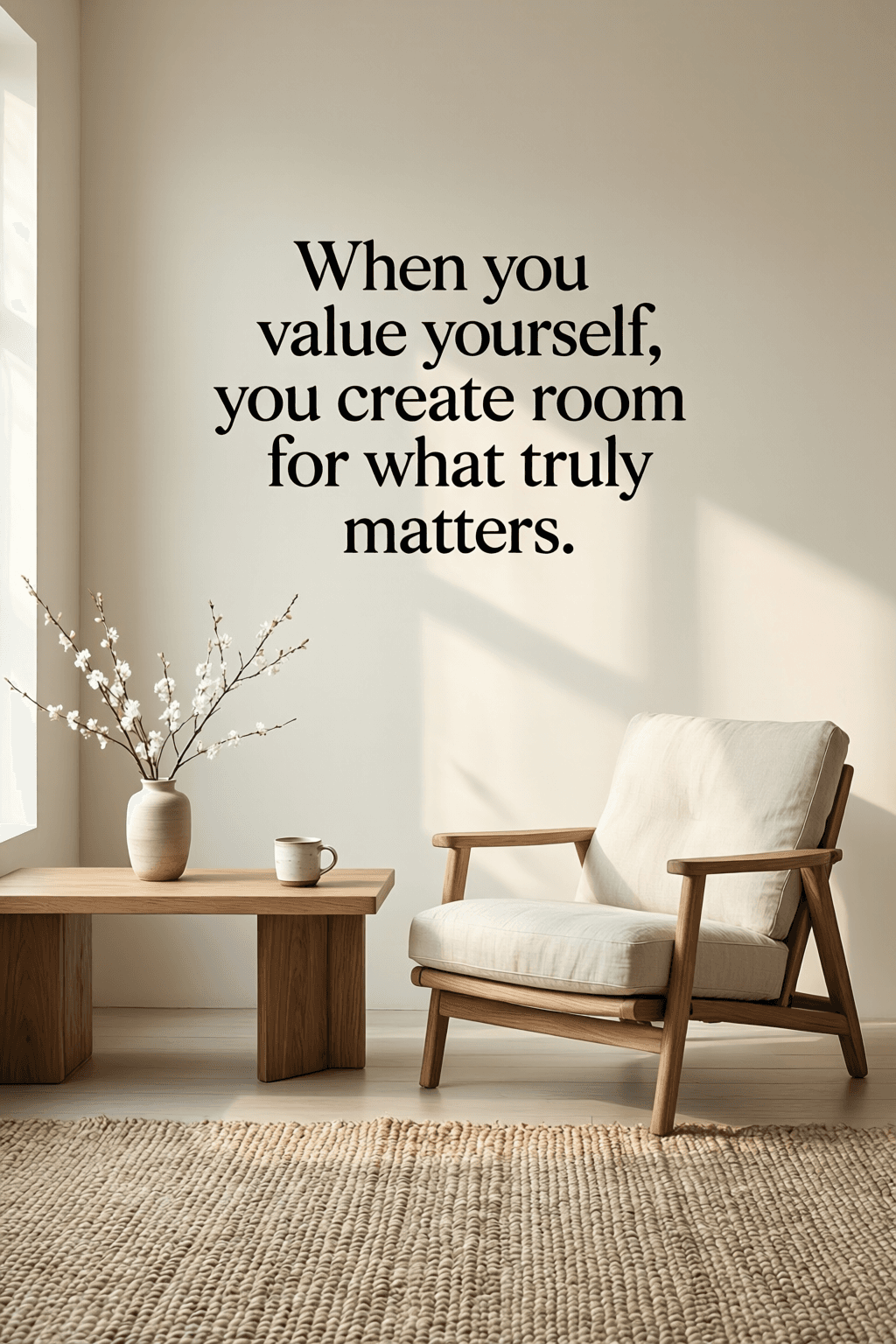
When you value yourself, you create room for what truly matters. — Louise Hay
—What lingers after this line?
The Foundation of Inner Value
Louise Hay’s quote begins with a quiet but powerful premise: valuing yourself is not selfish, but foundational. When a person recognizes their own worth, they stop treating their time, energy, and attention as endlessly available resources. In that shift, life becomes less crowded by obligations rooted in guilt or fear. From this foundation, the phrase “create room” becomes especially meaningful. Self-worth does not merely change how one feels internally; it changes what one permits externally. It opens space for relationships, work, rest, and choices that reflect genuine priorities rather than constant self-neglect.
Letting Go of What Drains You
Once self-value takes root, it naturally exposes what has been taking up too much space. People often fill their lives with approval-seeking, unhealthy relationships, or commitments made only to avoid disappointing others. Hay’s insight suggests that these patterns begin to loosen when self-respect becomes stronger than the need for validation. This idea echoes a broader tradition of personal reflection. In Henry David Thoreau’s *Walden* (1854), the call to simplify life was not merely about owning fewer things, but about clearing away distractions so one could live deliberately. Similarly, valuing oneself helps separate meaningful commitments from emotional clutter.
Boundaries as an Act of Care
As this clearing process continues, boundaries become essential. To value yourself is to understand that saying no can be an expression of wisdom rather than rejection. Boundaries protect the emotional and practical space needed for health, creativity, and authentic connection. In this sense, Hay’s quote reframes self-care as active discernment. A person who values themselves does not necessarily withdraw from others; instead, they engage more honestly. By refusing what diminishes them, they become more available for what nourishes them and for the people they can love without resentment.
Choosing What Truly Matters
The quote then moves toward its central promise: self-worth makes room for what truly matters. That phrase invites each person to define meaning for themselves, whether it is family, purpose, peace, art, service, or spiritual growth. Without self-value, these priorities can be buried beneath urgency and expectation. Viktor Frankl’s *Man’s Search for Meaning* (1946) shows how essential meaning is to human endurance. Though Hay speaks in the language of affirmation and healing, both perspectives converge on the same truth: a life guided by inner value is more capable of identifying and protecting its deepest sources of purpose.
The Emotional Shift from Scarcity to Worth
Moreover, valuing oneself changes the emotional atmosphere of daily life. When people feel unworthy, they often operate from scarcity, accepting less than they need or chasing proof that they matter. But when self-worth strengthens, the frantic need to earn love or significance begins to soften. This shift does not imply perfection or constant confidence. Rather, it means returning again and again to the belief that one’s needs, dreams, and limits deserve respect. Over time, that belief reshapes choices, making life less reactive and more aligned.
A Life Made Spacious by Self-Respect
Ultimately, Hay’s statement is an invitation to build a more spacious life from the inside out. The room she describes is not only physical time on a calendar, but emotional space for clarity, joy, healing, and intention. Self-value becomes the doorway through which what matters can finally enter. In the end, the quote reminds us that life is not enriched by holding everything, pleasing everyone, or enduring every demand. It is enriched by knowing one’s worth well enough to choose carefully. When self-respect leads, what is meaningful no longer has to compete so fiercely for a place in one’s life.
One-minute reflection
Why might this line matter today, not tomorrow?
Related Quotes
6 selectedYou do not have to earn your right to slow down. — Tessa Trelis
Tessa Trelis
Tessa Trelis’s line begins with a quiet but radical correction: rest is not a prize for productivity, nor is slowing down something we must justify with exhaustion. Instead, the quote frames rest as a basic human need, a...
Read full interpretation →You should feel beautiful, and you should feel safe. — Brené Brown
Brené Brown
Brené Brown’s words begin with a quiet insistence: beauty and safety are not luxuries to be earned, but experiences people should be able to inhabit. By pairing the two, she suggests that feeling beautiful is not merely...
Read full interpretation →The real flex is no longer looking busy; it is protecting your energy instead of constantly proving your worth. — Julee Wilson
Julee Wilson
Julee Wilson’s quote reframes what it means to be impressive in a culture that often rewards exhaustion. Rather than treating busyness as proof of ambition, she suggests that real confidence appears when a person no long...
Read full interpretation →Stop abandoning yourself to keep pace with a world that never slows down. — Sophia A. Nelson
Sophia A. Nelson
Sophia A. Nelson’s words begin with a quiet but urgent warning: a world that never slows down will gladly take more from us than we can afford to give.
Read full interpretation →If you don't care to be liked, they can't touch you. True confidence is found when your value is independent of other people's perceptions. — Naval Ravikant
Naval Ravikant
Naval Ravikant’s insight begins with a simple but powerful observation: the desire to be liked can become a point of control. When approval is treated as emotional currency, others can reward, punish, or manipulate us th...
Read full interpretation →Stop shrinking yourself to make others comfortable. Your peace is worth more than their approval. — Nedra Glover Tawwab
Nedra Glover Tawwab
Nedra Glover Tawwab’s words begin with a quiet but powerful warning: when we constantly make ourselves smaller to keep others comfortable, we often pay with our confidence, honesty, and emotional well-being. This kind of...
Read full interpretation →More From Author
More from Louise Hay →You have the power to heal your life, and you need to know that. — Louise Hay
Louise Hay’s sentence functions like a key: it unlocks the door between possibility and practice. You may already possess capacities for change—attention, choice, and care—but without recognizing them, they remain dorman...
Read full interpretation →I don't fix problems. I fix my thinking. Then problems fix themselves. — Louise Hay
At heart, Hay’s line reframes problem-solving as an inside-out process. Instead of attacking the external tangle first, she suggests adjusting the lens through which we view it.
Read full interpretation →