
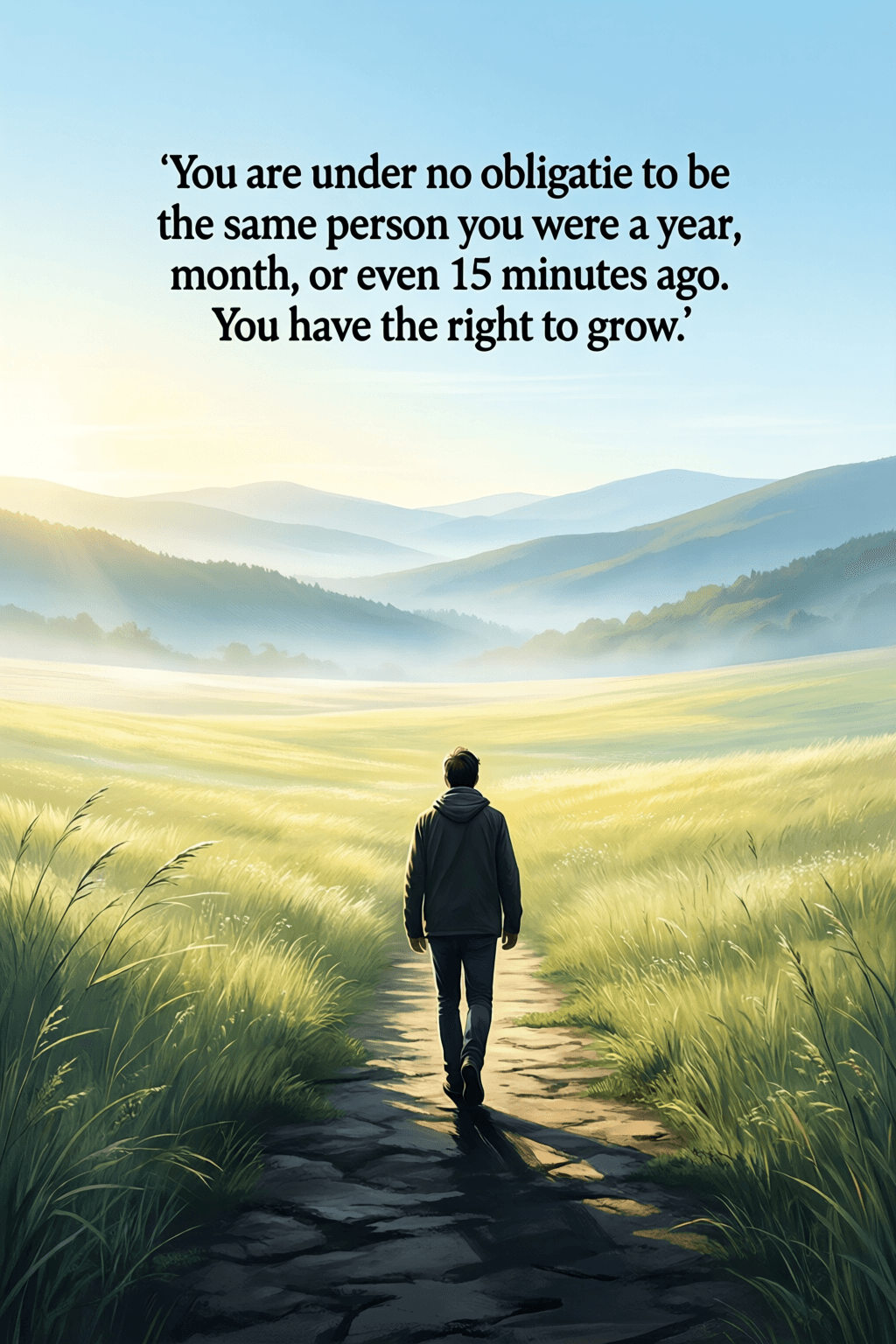
You are under no obligation to be the same person you were a year, month, or even 15 minutes ago. You have the right to grow. — Awilda Rivera
—What lingers after this line?
Releasing the Burden of Consistency
At its core, Awilda Rivera’s quote challenges the common belief that consistency is always a virtue. Many people feel pressured to preserve an older version of themselves simply because others have grown used to it. Rivera disrupts that expectation, reminding us that personal integrity does not require permanent sameness. In that sense, growth can involve contradiction: a person may outgrow opinions, habits, ambitions, or relationships that once seemed essential. Rather than seeing this as instability, the quote reframes change as a sign of self-awareness. What mattered yesterday may no longer fit today, and that shift can be both honest and necessary.
Identity as a Living Process
From there, the quote opens a deeper idea about identity itself: the self is not a finished object but an ongoing process. Philosophers have long explored this fluidity; for instance, Heraclitus famously suggested that no one steps into the same river twice, because both the river and the person are always changing. Rivera’s words bring that ancient insight into everyday emotional life. As a result, identity becomes something we participate in shaping moment by moment. A year can change us dramatically, but so can a conversation, a loss, or a sudden realization. By including even “15 minutes ago,” the quote emphasizes that transformation is not only grand and slow; sometimes it begins in an instant.
Permission to Outgrow Old Selves
Moreover, Rivera’s phrasing is powerful because it speaks in the language of rights: “You have the right to grow.” That wording matters. It suggests that growth is not something for which we must apologize or seek approval. For people who have been confined by family expectations, social roles, or past mistakes, this can feel profoundly liberating. In practice, outgrowing an old self may look quiet rather than dramatic. Someone who once stayed silent may begin setting boundaries; someone defined by caution may finally pursue a long-delayed dream. These shifts often unsettle others at first, yet the discomfort of witnesses does not invalidate the necessity of change.
The Courage to Revise Your Story
Consequently, the quote also speaks to narrative—the stories people tell about who they are. We often cling to these stories because they make life coherent: “I’m the dependable one,” “I’m bad at love,” “I never take risks.” Yet such labels can become cages. Rivera encourages a more courageous approach, one in which the story remains open to revision. Psychologist Dan P. McAdams’s work on narrative identity shows how people build meaning by arranging their lives into stories, but those stories can be rewritten as perspective changes. In that light, growth is not betrayal of the past; it is reinterpretation. We do not erase earlier chapters—we understand them differently and continue writing.
Change as an Act of Self-Respect
Finally, Rivera’s statement suggests that change is not merely possible but deeply respectful of one’s own humanity. To insist on remaining unchanged for the comfort of others can become a subtle form of self-abandonment. By contrast, allowing yourself to evolve honors new knowledge, new wounds, and new strengths as they emerge. Seen this way, growth is less about reinvention for its own sake and more about responsiveness to life. A person who learns, grieves, heals, or awakens cannot help becoming different. Rivera’s quote therefore offers both comfort and challenge: you are not trapped by your former self, and with that freedom comes the responsibility to become more fully who you are now.
Recommended Reading
As an Amazon Associate, we earn from qualifying purchases.
One-minute reflection
Where does this idea show up in your life right now?
Related Quotes
6 selectedYou cannot change what you refuse to confront. Growth begins when you stop hiding from your own truth. — Marc Chernoff
Marc Chernoff
Marc Chernoff’s quote turns growth into an act of courage rather than comfort. At its heart, the message is simple: real change cannot begin while we avoid the facts of our own lives.
Read full interpretation →True cultivation is a slow, private process that eventually blooms into a public strength. — Anne Lamott
Anne Lamott
At first glance, Anne Lamott’s line emphasizes a truth people often resist: meaningful self-development rarely looks dramatic while it is happening. True cultivation unfolds quietly, in habits, reflection, restraint, and...
Read full interpretation →Your potential is not a static state; it is a muscle that strengthens only through the resistance of consistent, daily effort. — Robert Kegan
Robert Kegan
At first glance, Robert Kegan’s statement overturns a comforting myth: potential is not something we simply possess in finished form. Instead, he portrays it as a living capacity, one that changes depending on how we use...
Read full interpretation →You cannot find peace by avoiding life. You must engage with the friction of your own growth. — Henri Nouwen
Henri Nouwen
At first glance, Henri Nouwen’s insight overturns a common fantasy: that peace can be reached by retreating from difficulty, conflict, or responsibility. Instead, he argues that genuine inner calm is not the reward of av...
Read full interpretation →I am learning every day to allow the space between where I am and where I want to be to inspire me and not terrify me. — Tracee Ellis Ross
Tracee Ellis Ross
Tracee Ellis Ross frames personal growth as a lived experience of standing between the present self and the hoped-for future. At first glance, that gap can feel like proof of inadequacy; however, her wording shifts its m...
Read full interpretation →Growth feels scary because comfort feels warm, but you can take one small step. Change doesn't crush you; staying still slowly does. — Justin Welsh
Justin Welsh
At first glance, Justin Welsh captures a tension nearly everyone recognizes: comfort feels safe precisely because it is familiar. Routine wraps itself around us like warmth, making even imperfect situations feel preferab...
Read full interpretation →More From Author
More from Awilda Rivera →