
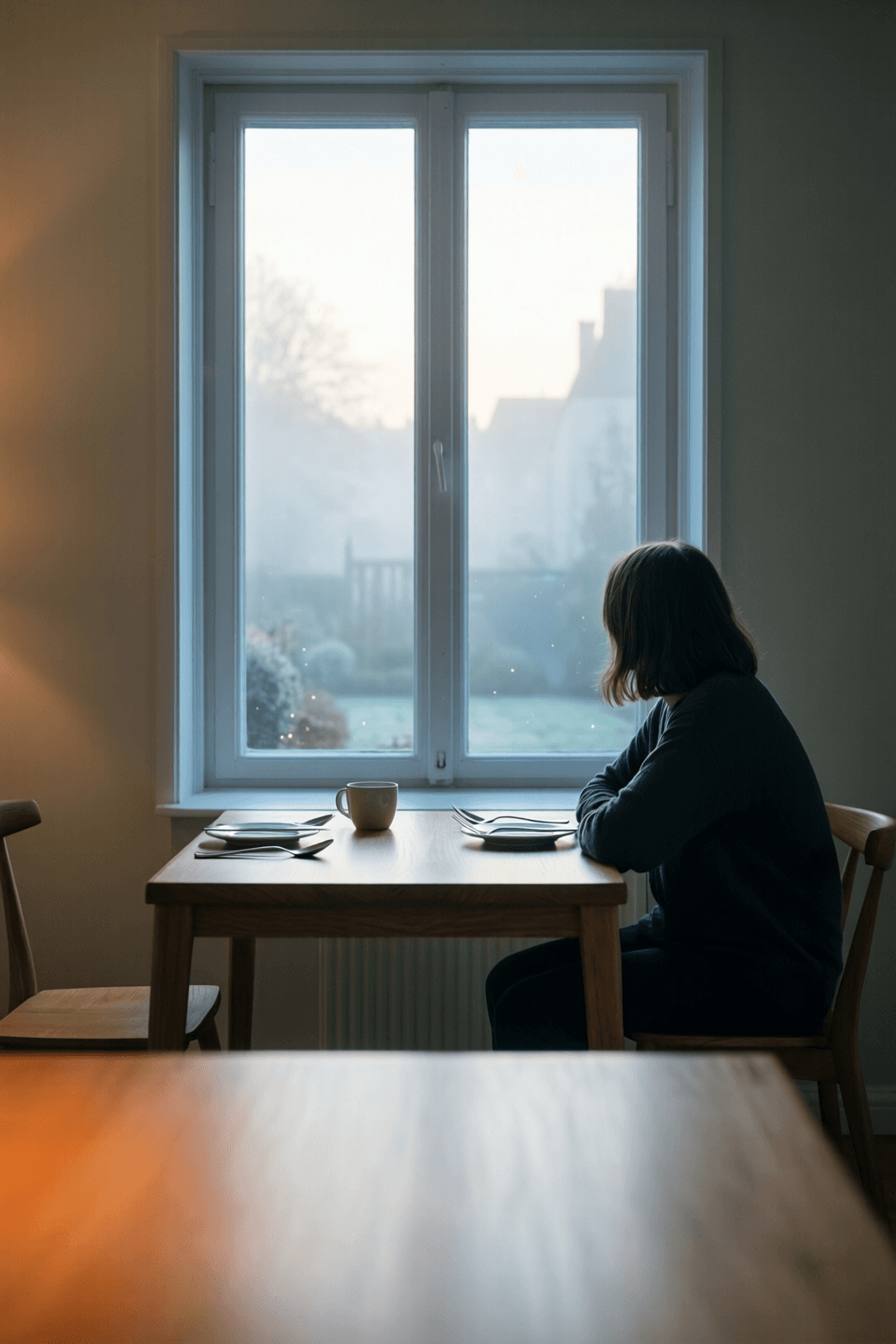
You do not need to leave your room. Remain sitting at your table and listen. Do not even listen, simply wait, be quiet, still and solitary. The world will freely offer itself to you to be unmasked. — Franz Kafka
—What lingers after this line?
The Invitation to Radical Stillness
Kafka begins with a striking command: do not chase the world, but remain in place. At first, this seems to reject ordinary habits of ambition and movement, yet that reversal is precisely his point. By asking us to stay seated, quiet, and solitary, he suggests that insight is not always won through pursuit; sometimes it appears only when striving falls away. In this sense, stillness becomes an active discipline rather than mere passivity. Kafka’s image of the table turns an ordinary room into a site of encounter, implying that revelation can arise within the most modest surroundings. What matters, therefore, is not distance traveled but the quality of attention—or even the relinquishing of forced attention itself.
Beyond Listening Into Waiting
Kafka then deepens the paradox by saying, “Do not even listen, simply wait.” This shift is crucial, because listening still implies effort, selection, and expectation. Waiting, by contrast, is a more surrendered state, one in which the self stops trying to control what may be heard or known. As a result, the quote points toward a form of receptivity that is deeper than observation. It resembles the spiritual patience found in Blaise Pascal’s reflections on solitude in the *Pensées* (1670), where distraction prevents people from encountering truth. Kafka’s waiting asks for a silence so complete that reality can emerge without being shaped too quickly by our preferences.
Solitude as a Condition of Clarity
From there, Kafka’s emphasis on being “quiet, still and solitary” reveals solitude not as deprivation but as clarification. In daily life, noise from society, obligation, and constant reaction can cover over what is already present. Solitude strips away those layers, allowing the hidden structure of things to show itself. This idea echoes Henry David Thoreau’s *Walden* (1854), where retreat from busyness becomes a means of seeing life more honestly. Yet Kafka is even more austere: he does not ask us to build a cabin or seek nature, only to remain with ourselves. Consequently, the inner room becomes a testing ground where distraction fades and truth grows less avoidable.
The World That Unmasks Itself
Perhaps the most startling claim comes at the end: “The world will freely offer itself to you to be unmasked.” Here Kafka reverses the common assumption that truth must be seized. Instead, the world is portrayed as something willing to reveal itself once our restless interference ceases. This image gives the passage a nearly mystical force. Plato’s *Republic* (c. 375 BC) suggests that appearances often conceal deeper reality, but Kafka adds that unveiling does not depend only on intellectual struggle. Rather, when we stop projecting noise onto the world, its disguises loosen on their own. The unmasking, then, is not conquest but disclosure.
A Critique of Modern Restlessness
Read more broadly, the quotation also acts as a quiet rebuke to cultures of constant motion. We are often taught that meaning lies elsewhere—in travel, productivity, novelty, and endless response. Kafka challenges that assumption by implying that our frantic search may itself be what keeps reality hidden. In this way, his words feel especially contemporary. Like the later reflections of Martin Heidegger in *Discourse on Thinking* (1959), which distinguish meditative thinking from calculative busyness, Kafka’s sentence insists that truth cannot always be extracted by force. Sometimes the more we pursue, the less we perceive; therefore, stillness becomes a form of resistance against superficial living.
An Ethics of Presence
Finally, Kafka’s counsel can be read not only as a mystical instruction but as an ethical one. To be present without grasping, to wait without dominating, and to encounter the world without immediately turning it into utility—these are habits of humility. They teach us that reality is not merely raw material for our will. Thus the quote ends in a subtle transformation of the self. The person who sits quietly at the table does not simply learn something new; that person becomes capable of receiving truth differently. What begins as stillness becomes openness, and what begins as solitude becomes a more honest relation to the world.
One-minute reflection
What does this quote ask you to notice today?
Related Quotes
6 selectedIn order to be open to creativity, one must have the capacity for constructive use of solitude. One must overcome the fear of being alone. — Rollo May
Rollo May
Rollo May’s insight begins with a quiet but demanding premise: creativity requires the ability to stand apart from constant noise, approval, and distraction. To be open to new ideas, a person must first become comfortabl...
Read full interpretation →I care for myself. The more solitary, the more friendless, the more unsustained I am, the more I will respect myself. — Charlotte Brontë
Charlotte Brontë
Charlotte Brontë’s words begin as a quiet but forceful act of self-possession. Rather than treating loneliness as proof of failure, the speaker transforms it into evidence of resilience.
Read full interpretation →But many of us seek community solely to escape the fear of being alone. Knowing how to be solitary is central to the art of loving. — bell hooks
bell hooks
Bell hooks begins with a quiet but difficult observation: not every search for community is rooted in love. Sometimes, we reach for others because solitude feels threatening, as though being alone exposes a lack within u...
Read full interpretation →To have passed through life and never experienced solitude is to have never known oneself. — Joseph Krutch
Joseph Krutch
Joseph Krutch’s statement begins with a striking reversal: what many people avoid—solitude—he treats as essential to a meaningful life. In his view, simply moving through the world surrounded by noise, duties, and compan...
Read full interpretation →Don't underestimate the value of Doing Nothing, just going along, listening to all the things you can't hear, and not bothering. — A.A. Milne
A. A. Milne
At first glance, A.A. Milne’s line sounds playful, almost like permission to be lazy.
Read full interpretation →The mind needs solitude in the same way a forest needs quiet after a storm. It is not because nothing is happening; it is because that is when everything begins to grow. — Pico Iyer
Pico Iyer
Pico Iyer compares the mind to a forest recovering after a storm, and the image immediately shifts our understanding of solitude. Rather than treating aloneness as emptiness, he presents it as a necessary period of renew...
Read full interpretation →More From Author
More from Franz Kafka →Forge clarity from doubt; clear vision is the metal that sharpens resolve. — Franz Kafka
The line begins in the smithy: doubt is not waste, but ore. To extract strength from it, we must heat uncertainty with inquiry, hammer it with revision, and quench it in reflection.
Read full interpretation →I had the impression that life is not so bad, but that we are too demanding. - Franz Kafka
Kafka suggests that life itself may not be inherently bad. Rather, our perception influenced by our demands and expectations can make it seem more difficult than it is.
Read full interpretation →Start with what is right rather than what is acceptable. — Franz Kafka
This quote emphasizes the importance of prioritizing what is morally and ethically right over what is socially or superficially acceptable. It encourages making decisions based on principles of right and wrong.
Read full interpretation →The difficult is what takes a little time, the impossible is what takes a little longer. — Franz Kafka
This quote highlights the importance of perseverance. It suggests that even tasks that seem impossible can be accomplished with enough time, effort, and patience.
Read full interpretation →