
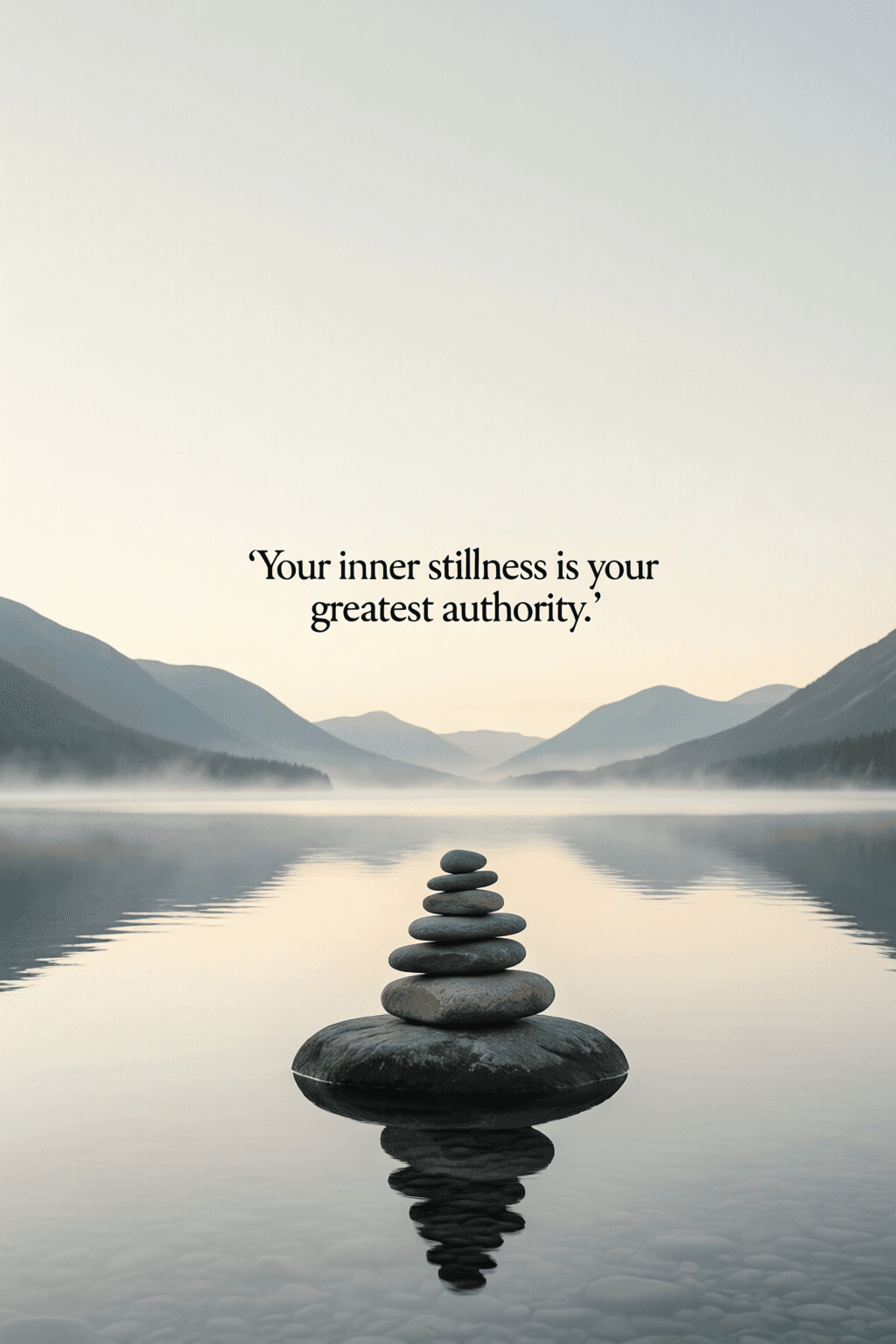
Your inner stillness is your greatest authority. — Epictetus
—What lingers after this line?
The Meaning of Quiet Power
At first glance, Epictetus’s statement shifts authority away from status, applause, or force and places it within the self. As a Stoic philosopher, Epictetus taught in the Discourses (2nd century AD) that freedom begins when a person learns to govern judgment rather than chase control over external events. In that sense, inner stillness is not passivity; it is the disciplined calm that allows a person to respond rather than react. This idea matters because outward authority often depends on unstable things—wealth, reputation, or institutional rank. By contrast, stillness creates a steadier center. From that center, one’s decisions carry weight not because they are loud, but because they are grounded.
Stoic Roots of Self-Mastery
Seen in context, the quote expresses a core Stoic conviction: the mind becomes authoritative when it is no longer enslaved by impulse. Epictetus repeatedly distinguished between what is “up to us” and what is not, a principle laid out plainly in the Enchiridion. Therefore, inner stillness is the condition that lets a person discern that boundary with clarity. Moreover, this is why Stoicism is often misunderstood as emotional suppression when it is really about intelligent regulation. Marcus Aurelius’s Meditations (c. 180 AD) echoes the same spirit, urging the reader to find refuge in the ruling mind. The calm person, in this tradition, does not withdraw from life; rather, they meet life without surrendering their judgment.
Stillness Against the Noise of the World
From there, the quote also reads as a warning about distraction. Modern life rewards immediacy: rapid replies, public performance, and constant opinion. Yet the more noise surrounds a person, the easier it becomes to mistake urgency for truth. Inner stillness interrupts that confusion by creating a pause in which values can be remembered. In practical terms, this means that the strongest voice in one’s life should not be the crowd’s but conscience informed by reflection. Viktor Frankl’s Man’s Search for Meaning (1946) similarly emphasizes the space between stimulus and response. That space, however brief, is where dignity and authorship emerge—an idea that harmonizes closely with Epictetus’s counsel.
Authority Without Domination
Equally important, Epictetus redefines authority itself. In many settings, authority is imagined as the power to command others. However, his quote suggests that the highest authority is self-command. A person who cannot govern anger, fear, or vanity may hold office, yet remain inwardly fragile. By contrast, someone with composure can influence others precisely because they are not ruled by every passing emotion. History offers familiar examples of this quieter form of strength. Mahatma Gandhi’s public discipline, described in accounts of the Indian independence movement, often gave his leadership moral force beyond political rank. In this way, stillness becomes persuasive: it signals integrity, and integrity attracts trust.
A Practice Rather Than a Mood
Finally, inner stillness should not be mistaken for a rare temperament granted to a lucky few. It is better understood as a practice cultivated through repetition—through reflection, restraint, and honest self-examination. Epictetus himself taught students to train their perceptions daily, much as an athlete trains the body. The authority he describes is therefore earned, not inherited. As a result, the quote becomes both comforting and demanding. It comforts because it locates dignity within reach, independent of external chaos. Yet it also demands discipline, since stillness must be protected and renewed. In the end, Epictetus implies that the most reliable guide we possess is not the loudest thought, but the calmest one.
One-minute reflection
Why might this line matter today, not tomorrow?
Related Quotes
6 selectedThe greatest reclamation of power is to stop letting your circumstances dictate your inner stillness. — Epictetus
Epictetus
At its heart, this statement distills a central Stoic lesson: real power begins when we stop treating external events as masters of our inner life. Epictetus, in the Discourses (2nd century AD), repeatedly argued that wh...
Read full interpretation →If you keep looking within, you will find stillness, a tranquillity that you've never experienced before. — Joel Annesley
Joel Annesley
Joel Annesley’s quote begins with a simple but radical suggestion: stop searching outside yourself and look within. In a culture that often equates fulfillment with achievement, stimulation, or approval, this inward turn...
Read full interpretation →He who cannot obey himself will be commanded. That is the nature of living creatures. — Friedrich Nietzsche
Friedrich Nietzsche
Nietzsche’s line presents a stark warning: if a person cannot govern his own impulses, habits, and fears, someone or something else will do the governing for him. In that sense, obedience is never absent; it merely shift...
Read full interpretation →You are the stillness beneath the mental noise. You are the love and joy beneath the pain. — Eckhart Tolle
Eckhart Tolle
Eckhart Tolle’s line points to a radical reframe of identity: you are not the stream of thoughts that narrates your day, and you are not the ache that arises when life hurts. Instead, he suggests there is a deeper “you”...
Read full interpretation →Wisdom is not something we have to strive to acquire. Rather, it arises naturally as we slow down and notice what is already there. — Haemin Sunim
Haemin Sunim
Haemin Sunim’s line quietly overturns a common assumption: that wisdom is a prize earned through relentless effort, accumulation, and self-improvement. Instead, he frames wisdom as something closer to a byproduct of pres...
Read full interpretation →The stillness in stillness is not the real stillness; only when there is stillness in motion does the universal rhythm manifest. — Bruce Lee
Bruce Lee
Bruce Lee’s line challenges the common assumption that stillness is merely the absence of movement. If “stillness in stillness” is not the real stillness, then calm achieved only by freezing the body or withdrawing from...
Read full interpretation →More From Author
More from Epictetus →A ship should not ride on a single anchor, nor life on a single hope. — Epictetus
At first glance, Epictetus turns a practical image into a moral lesson: a ship secured by only one anchor is vulnerable to shifting winds, rough tides, and hidden strain. In the same way, a life fastened to a single hope...
Read full interpretation →Never call yourself a philosopher; show it. — Epictetus
Epictetus compresses an entire ethical program into a sharp command: do not claim the title, demonstrate the life. In other words, wisdom is not a badge one pins on oneself but a pattern others can recognize in conduct.
Read full interpretation →The economy can take your money. A crisis can take your opportunities. But fear can take your judgment—and that is the loss most people never recover from. — Epictetus
At first glance, this saying draws a sharp line between what happens to us and what happens within us. Money can vanish in a recession, and opportunities can disappear when markets collapse, yet Epictetus argues that the...
Read full interpretation →The greatest victory is the battle fought against your own desire to quit when things get quiet. — Epictetus
At first glance, this saying shifts the meaning of victory away from public triumph and toward an inward contest. The hardest battle, it suggests, is not fought in dramatic moments but in silence—when excitement fades, r...
Read full interpretation →