
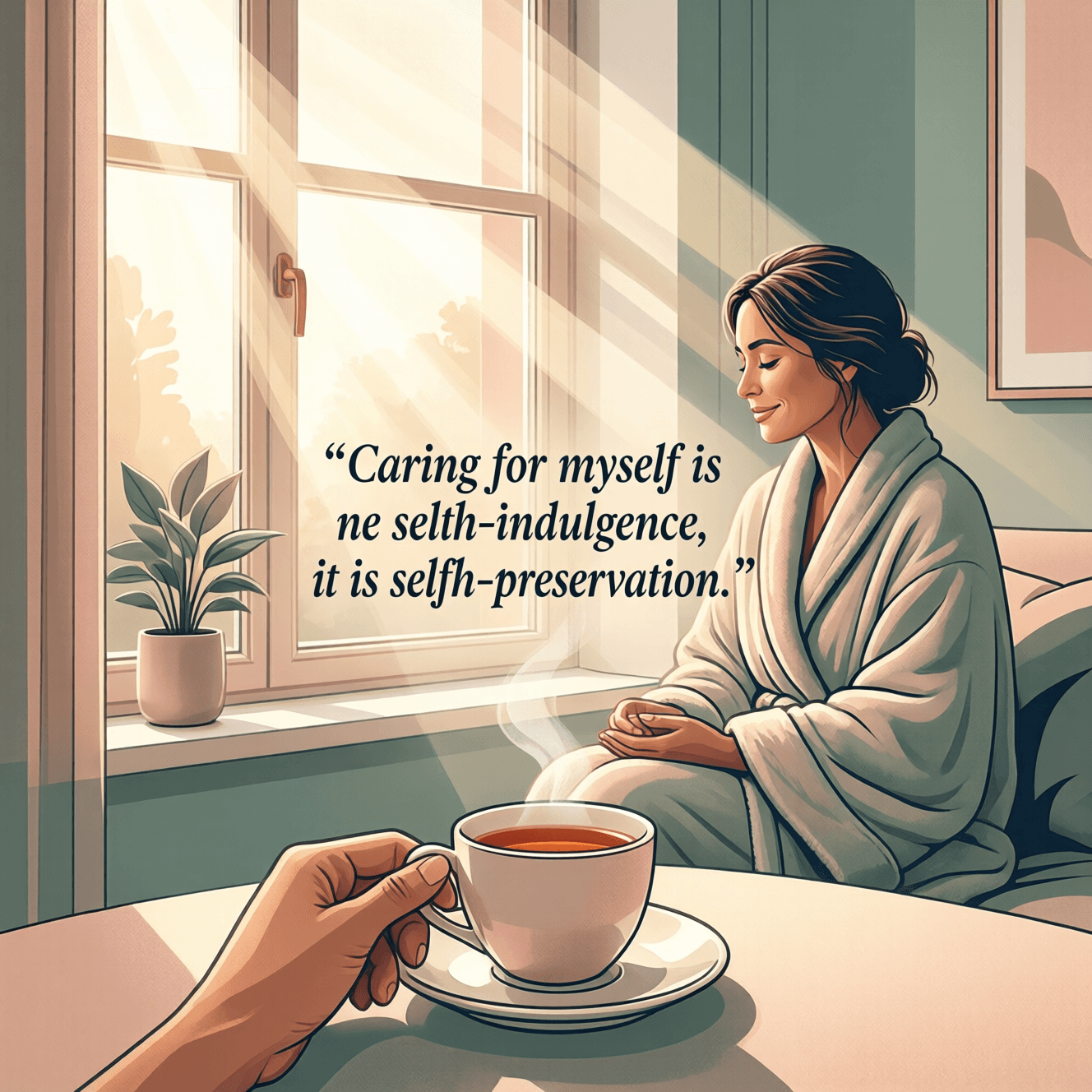
Caring for myself is not self-indulgence, it is self-preservation. — Audre Lorde
—What lingers after this line?
Reframing Self-Care as Necessity
Audre Lorde’s line hinges on a deliberate reversal: what many dismiss as “indulgence” she names “preservation.” In that shift, self-care stops being an optional treat and becomes a practical response to strain, danger, and depletion. Rather than asking whether care is deserved, the quote asks what it costs to go without it. From here, the statement reads less like a personal mantra and more like an argument. If a person’s body, mind, or spirit is worn down by relentless demands, then rest, boundaries, and recuperation are not moral failings—they are the conditions that make continued living and functioning possible.
Indulgence Versus Preservation
To make her point sharp, Lorde distinguishes pleasure from protection. Indulgence implies excess—something unnecessary, perhaps even irresponsible. Preservation, however, implies maintenance: eating enough, sleeping, seeking medical care, stepping away from harm, and refusing to be consumed by obligations that never end. That contrast clarifies why the same act can be judged differently depending on the story attached to it. Taking an evening off might look like laziness to an outsider, yet for someone nearing burnout it functions like first aid. In other words, context turns “treating yourself” into “keeping yourself intact.”
A Political and Ethical Claim
Lorde’s phrasing also suggests that self-care is not only personal but political, a theme she articulated in essays such as “A Burst of Light” (1988), where she writes, “Caring for myself… is an act of political warfare.” The idea is that in systems that profit from exhaustion or silence, a person’s sustained well-being can become a form of resistance. Building on that, self-preservation takes on ethical weight: it protects one’s capacity to think clearly, to refuse mistreatment, and to remain present for communities and causes. Care becomes a way of refusing to be reduced to a resource for others.
The Psychology of Burnout and Recovery
Modern psychology helps explain why Lorde’s distinction matters. The World Health Organization’s ICD-11 describes burnout as stemming from chronic workplace stress not successfully managed, often involving exhaustion and reduced efficacy. When stress becomes chronic, recovery behaviors—rest, support, boundaries—are not luxuries but interventions. Seen through this lens, self-preservation is pragmatic. A person who continually postpones sleep, medical attention, or emotional processing may appear productive for a while, yet the long-term result is often collapse or illness. Lorde’s quote anticipates that reality by treating care as prevention, not reward.
Boundaries as a Form of Care
If self-care is preservation, then boundaries are among its most concrete tools. Saying no, limiting access, and stepping away from exploitative dynamics are not signs of coldness; they are ways of preventing ongoing harm. This is especially true when someone is expected to be endlessly available—at work, in family roles, or in activism. Once boundaries are understood as protective, they become easier to defend internally. The question shifts from “Am I being selfish?” to “What am I protecting?” That transition turns guilt into clarity and helps align choices with long-term health and dignity.
A Sustainable Model of Care
Finally, Lorde’s framing points toward sustainability: care that keeps a person able to continue, not care that merely looks virtuous. Preservation can include simple routines—adequate food, movement, therapy, medication adherence, time alone, or moments of joy—so long as they restore capacity rather than drain it. In practice, this creates a humane cycle. By protecting themselves, people preserve their ability to love, work, create, and contribute without being erased by those demands. Lorde’s sentence, then, is not an excuse for excess; it is a blueprint for endurance.
One-minute reflection
What's one small action this suggests?
Related Quotes
6 selectedCaring for myself is not self-indulgence, it is self-preservation. — Audre Lorde
Audre Lorde
Audre Lorde’s statement turns a common accusation on its head: what some call “self-indulgence” may actually be the basic work of staying whole. By drawing a sharp line between luxury and necessity, she insists that care...
Read full interpretation →Caring for myself is not self-indulgence, it is self-preservation. — Audre Lorde
Audre Lorde
Audre Lorde’s line begins by dismantling a familiar accusation: that tending to oneself is frivolous or vain. By rejecting “self-indulgence,” she separates care from consumption, suggesting that rest, nourishment, and em...
Read full interpretation →Caring for myself is not self-indulgence, it is self-preservation. — Audre Lorde
Audre Lorde
Audre Lorde’s statement pivots on a crucial reframing: what many dismiss as “self-indulgence” can be, in reality, the basic work of staying alive and whole. By pairing “caring for myself” with “self-preservation,” she ch...
Read full interpretation →Caring for myself is not self-indulgence, it is self-preservation. — Audre Lorde
Audre Lorde
Audre Lorde’s line begins by challenging a common moral reflex: the tendency to treat personal care as a luxury or a guilty pleasure. By rejecting “self-indulgence,” she separates self-care from vanity, consumption, or e...
Read full interpretation →Caring for myself is not self-indulgence, it is self-preservation. — Audre Lorde
Audre Lorde
Audre Lorde’s line begins by challenging a common moral reflex: the tendency to label personal care as indulgent. By drawing a firm boundary—“not self-indulgence”—she redirects attention from pleasure or luxury toward so...
Read full interpretation →Caring for myself is not self-indulgence, it is self-preservation. — Audre Lorde
Audre Lorde
Audre Lorde’s line begins by overturning a familiar accusation: that attending to one’s own needs is frivolous or vain. By naming self-care “self-preservation,” she shifts it from the realm of luxury into the realm of ne...
Read full interpretation →More From Author
More from Audre Lorde →We are powerful because we have survived, and that is what it is all about—survival and growth. — Audre Lorde
At its core, Audre Lorde’s statement redefines power not as domination, status, or control, but as the hard-won strength that comes from continuing despite adversity. To survive is already to have resisted erasure, and L...
Read full interpretation →Community does not mean that we all agree on everything. It means that we respect each other enough to stay in the room. — Audre Lorde
At its core, Audre Lorde’s statement challenges the comforting but shallow idea that community is built on sameness. Instead, she argues that real belonging depends on the willingness to remain present with one another e...
Read full interpretation →Caring for myself is not self-indulgence, it is self-preservation. — Audre Lorde
Audre Lorde’s line begins by dismantling a familiar accusation: that tending to oneself is frivolous or vain. By rejecting “self-indulgence,” she separates care from consumption, suggesting that rest, nourishment, and em...
Read full interpretation →Caring for myself is not self-indulgence, it is self-preservation. — Audre Lorde
Audre Lorde’s statement pivots on a crucial reframing: what many dismiss as “self-indulgence” can be, in reality, the basic work of staying alive and whole. By pairing “caring for myself” with “self-preservation,” she ch...
Read full interpretation →